Bid Approval Process for Construction: Steps and Sign-Off
Bid Approval Process for Construction: Steps and Sign-Off ! Construction bid approval title card illustration A construction bid approval process is the internal chain of reviews that turns an estimator's draft into a price your company is willing to be held to.

A construction bid approval process is the internal chain of reviews that turns an estimator’s draft into a price your company is willing to be held to. The strongest version has four parts: a bid/no-bid decision up front, a compliance check against the full bid documents, an independent review of price and risk, and one named person who signs. We built ArosBid around that chain, so approvals, vendor quotes and document compliance sit in one place instead of scattered across inboxes and spreadsheets.
This guide walks through each gate, who owns it, what goes wrong, and how to run it on a real bid calendar.
TL;DR
- Approval is two decisions: whether to bid at all, and whether the final number and terms are safe to submit.
- Split the reviews by discipline: technical, commercial and compliance, each with one named owner and one final approver.
- Hold the internal review well before the deadline, so findings can be fixed rather than just noted.
- Check mandatory conditions (signatures, addenda, bonds, forms) separately from price, because a missed one can disqualify a bid that is otherwise strong.
- Keep a record of every finding and its resolution, so the approval decision can be defended and the debrief is useful.
Table of Contents
- What a bid approval process actually is
- The stages of a bid approval process
- Who signs off and what each person checks
- When to hold the review
- Where approvals break down
- Running the process with ArosBid
- Our perspective
- See the approval workflow in your own bids
- FAQ
- Sources
What a bid approval process actually is
In the UK, this internal step is often called tender adjudication. CCM describes it as a pre-submission review in which senior managers test price, risk, programme and commercial position, then approve, amend or withhold the tender sum. The point is not to redo the estimate. It is to test whether the company can commit to that number on those terms.
In US trade contracting the same thing goes by other names: bid review, final review, go-to-bid meeting. The label matters less than the function. Someone other than the person who built the price decides whether it goes out.
That separation is the core idea. An estimator who built every line carries every assumption in their head, and each of those assumptions is a judgment call. CCM argues the estimator is rarely the best person to test their own price, which is why managers who did not build it, and who will be accountable for delivering the job, take part in the decision.
The stages of a bid approval process
Guides differ on how many stages there are. Some say five, some six or seven. They agree on the order of the work. Here is a version that fits a commercial, institutional or industrial trade bid.

1. Intake and the bid/no-bid decision
Approval begins before any takeoff. When an invitation arrives, someone confirms the basics: owner, project type, location, bid date, bonding and insurance requirements, who else is bidding if you know, and whether your crew capacity matches the schedule.
Then comes the first sign-off: bid or pass. Record the reason either way. A one-line note such as “pass: bid date collides with two active buyouts” is worth far more at the end of the year than a memory. Strategic fit, margin potential, relationship with the general contractor and workload all belong here.
Teams that skip this gate spend estimating hours on jobs they were never going to win or never should have wanted. Our bid management workflow article lays out how that front-end decision fits into a 60 to 90 day cycle.
2. Document control and scope review
Before anyone prices, confirm you have the complete, current set: drawings, specifications, front-end clauses, bid forms and every addendum issued so far. Bid documents contradict themselves. A specification section may require one product while a drawing note calls for another, or a front-end clause may add a requirement that no trade section mentions.
The approver later asks one question about this stage: did we price the controlling version? An addendum log answers it. If an addendum changes quantities, the takeoff is rerun, not patched.
3. Takeoff, quotes and pricing
This is the estimator’s stage, and it is where senior expertise matters most. Quantities are measured, vendor and subcontractor quotes arrive, and the estimator levels them so each quote covers the same scope. Leveling means adjusting or comparing quotes so you are not comparing a price that includes freight and a price that excludes it.
The approval process needs a record from this stage: which quotes were used, what each one excludes, and which scope gaps were carried as allowances or risk. Those exclusions are exactly what a reviewer needs to see.
4. Independent review
The independent review is a reading of the bid by one or two people who priced none of it. imHORA’s tendering guide places it two to three working days before adjudication and has the reviewers test the basis of the estimate, the largest rates against benchmarks, method, preliminaries, quote coverage, the risk register and the commercial terms. It is a judgment review, not a second round of arithmetic.
The same source asks that every finding get a clear response: fixed, priced as risk, qualified in the bid, or accepted by a named approver, with the dollar value at stake. “Noted” is not a response. That rule keeps the review from turning into a list of comments nobody acts on.
5. Compliance check
A bid can be correct on price and still be thrown out. Public procurement rules make this explicit. The World Bank’s sample bidding documents for works describe how the owner first checks that each bid is eligible, properly signed, accompanied by required securities and substantially responsive before any detailed evaluation, and rejects bids that are not.
The ISO 10845-3 standard conditions of tender, written for goods, services and construction works, expect tenderers to check documents on receipt for completeness, sign where required, return every returnable document completed in full and submit a single offer unless the documents say otherwise. Late or non-conforming submissions are treated as non-responsive.
Whatever your owner type, the compliance gate should cover:
- Signatures, notarization and corporate authority on the bid form
- Receipt of every addendum, acknowledged where the form requires it
- Bid security or bond, insurance certificates and validity period
- Mandatory pre-bid meeting attendance or site visit, where required
- Required forms, declarations, alternates and unit prices
- Submission method and proof that it went through
Our pass/fail bid compliance checklist puts these items first, ahead of anything scored, for a simple reason: a mandatory omission ends the conversation.
6. Final approval and submission
The approver signs. According to imHORA, the approval form records the price, the margin build-up, the walk-away price, qualifications, the risk allowance and the confirmed checklist. Many companies also add a rule that approval moves up a level if the expected profit falls below the minimum, so sign-off authority scales with what is at stake.
After approval, someone submits and keeps proof of delivery. Then, win or lose, the team debriefs. That last step feeds the next bid: what the winner priced, where your number sat, and which assumptions held.
Who signs off and what each person checks
Small firms may have two people in the room. Larger ones have a committee. Either way, the roles should be explicit, because “everyone looked at it” means nobody was accountable.
| Role | What they check | What they sign |
|---|---|---|
| Estimator | Quantities, rates, assumptions, scope coverage | That the estimate is complete and consistent |
| Independent checker | Largest rates, exclusions, risk, arithmetic on selected items | That findings are resolved or accepted |
| Compliance reviewer | Mandatory forms, addenda, bonds, insurance, eligibility | That the package is responsive |
| Commercial reviewer | Contract terms, allowances, qualifications, margin | That terms and markup are acceptable |
| Approver (director, owner or VP) | Price, risk, walk-away number, workload | The decision to submit |
CCM’s estimate review checklist uses a similar split: the estimator confirms quantities and rates, a checker independently verifies selected items, a commercial manager approves allowances and qualifications, and the director authorizes submission. It is a UK document, so the titles differ from US usage, but the logic carries over to any trade contractor.
In a ten-person subcontractor, one person may hold two roles. The rule that should not bend is that the person who built the price does not approve it alone, and the person who signs can name the risks they accepted.
When to hold the review
Timing is where most approval processes quietly fail. A review held the night before the deadline cannot change anything. There is no time to send a request for information, get a revised quote or rerun a quantity.
A workable rhythm for a typical bid:
- Decision day: bid or pass, with the reason recorded.
- Several days out: freeze the narrative and scope assumptions, and chase outstanding quotes.
- Two to three days out: independent review and compliance check, with time to fix what they find.
- Day before: final approval meeting, short because the findings are already closed.
- Deadline day: submit early and confirm receipt. Treat the published deadline as the point where bids fail, not the target.
If an addendum lands after the review, the approval does not carry over automatically. Rerun the affected scope, update the log and have the approver re-sign on the changed numbers.
Where approvals break down
Most failures come from the same few places.
The review is informal. Without a defined meeting, checklist and approver, the estimator is the only safeguard. That is a single point of failure on a decision that commits the company’s money.
Findings have no owner. A comment like “check the electrical exclusion” that is assigned to no one and carries no deadline will still be open at submission.
Quotes are not leveled. Three vendor prices that cover different scope make the lowest one look like a bargain when it may be the most expensive once exclusions are priced.
Documents are read in pieces. Estimators price from the sections for their trade. A front-end clause on liquidated damages, a substitution rule or a payment term sits outside those sections and still binds the bid.
Approval lives in email. When the decision is in someone’s inbox, nobody can reconstruct why a bid went out at a given margin. Keeping decisions, versions and the bid email stream organized is a process problem. Our guide on bid email management covers catching invitations and addenda that would otherwise be buried.
If your bids lean on formal tender packages, the quality of the documents you assemble also matters. A guide to tender document preparation covers the building-work side of that package.

Running the process with ArosBid
The steps above work on paper. The trouble is volume: several live bids, dozens of addenda and quotes, and a deadline for each. This is where the tool earns its place, and each step has a specific point of help.
- Intake and bid/no-bid: ArosBid includes bid/no-bid evaluation, so the decision and its reasoning are recorded with the bid instead of in a meeting you cannot recall.
- Scope and compliance review: the platform reads the entire set of bid documents, including front-end clauses, and checks for the missed clauses and conflicting specifications that lead to disqualification. You can see how it works on the AI tender review page.
- Vendor quotes: quote tracking and vendor quote leveling put each quote’s scope side by side, so the reviewer sees exclusions without hunting through attachments.
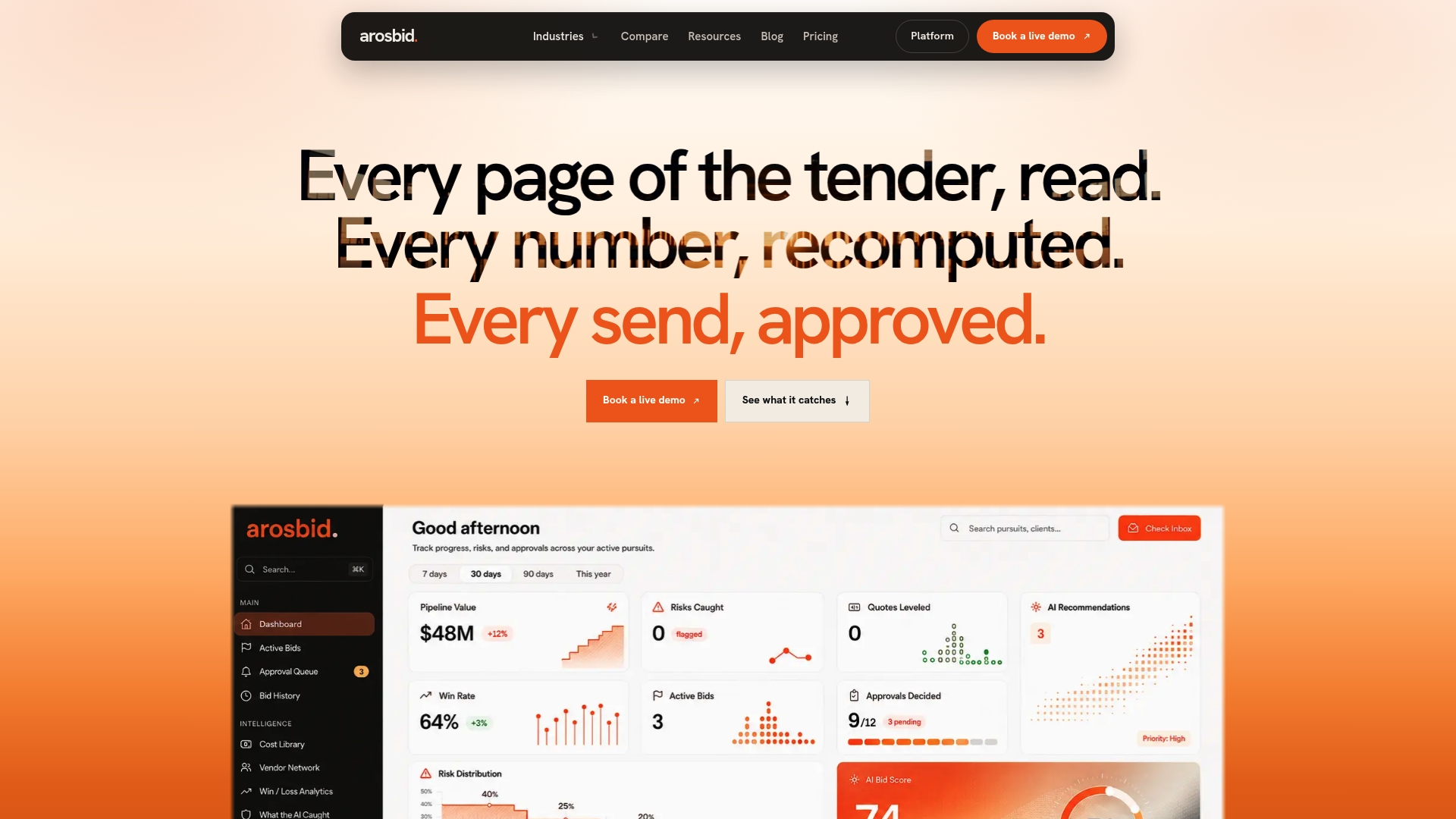
- Approval: a structured command center tracks bid approvals, vendor quotes and document compliance. The automated checks do not replace human authority: people approve and submit.
- After submission: proposal assembly, buyout and debriefing run in the same cycle, and a historical cost library keeps what you learned for the next estimate.
It integrates with Excel and Outlook, so the estimating workbooks and email your team already use stay in place. That matters for adoption: nobody has to abandon their estimating tools to get a controlled approval process.
Our perspective
A bid approval process fails quietly. The number goes out, nothing visibly breaks, and the problem shows up months later as a lost margin or a clause nobody priced. Most teams do not lack skill. They lack a structure that gives the reviewer the right material at the right time.
We think approval works best when the machine does the reading and the people do the deciding. Reading hundreds of pages of drawings, specifications and front-end clauses for contradictions and missed requirements is exactly the work that gets squeezed when three bids are due in the same week. Our approach is to automate that error-checking while leaving the authority to approve and submit with your team.
We also think approval should not be a separate event. Bid/no-bid, document review, vendor quotes, compliance and approval belong in one command center, connected to the Excel and Outlook your estimators already use, so the record of why a bid went out is built as the work happens.
arosbid team
See the approval workflow in your own bids
If your team is running bid approvals through email threads and spreadsheets, ArosBid brings the document review, vendor quote tracking, compliance checks and sign-off into one structured workflow. It is offered as three plans, One Desk, The Department and The Whole Year, which you can compare on the pricing page.
To see it applied to a live bid, you can book a live demo or look at the bid process platform.
FAQ
What is the difference between bid approval and bid/no-bid?
Bid/no-bid is the early decision on whether to pursue an opportunity at all. Bid approval is the later decision on whether the finished price, terms and package are safe to submit. A disciplined process has a recorded sign-off at both points.
Who should approve a construction bid?
The approver should be someone with authority over company risk and margin, such as an owner, director or senior executive, who did not build the estimate. The estimator, an independent checker, and commercial and compliance reviewers each sign their own part first. In a small firm, one person may cover two reviewer roles, but not the estimate and the final approval.
How long before the deadline should the bid review happen?
Hold the independent review and compliance check a few days before the deadline, with the final approval meeting the day before. That leaves time to send requests for information, get revised quotes and rerun quantities if an addendum changes scope. A review in the last hours can only confirm what is already locked in.
What gets a bid disqualified most often?
The common causes are mandatory items rather than price: a missing signature, an unacknowledged addendum, absent bid security, a skipped mandatory pre-bid meeting or a required form left incomplete. Procurement standards such as ISO 10845-3 treat late or non-conforming submissions as non-responsive. A pass/fail compliance check before approval is the direct defense.
Sources
- Tender Adjudication in Construction: A Complete Guide, CCM
- Estimate Review Checklist, CCM
- The Tender Checklist and the Independent Review, imHORA
- Tender Adjudication and Final Approval, imHORA
- Procurement of Works: Sample Bidding Documents, World Bank
- ISO 10845-3:2011 Standard Conditions of Tender