DBE Requirements for Construction Bids: 2026 Guide
DBE Requirements for Construction Bids: 2026 Guide ! Hand-drawn construction bid title card DBE requirements apply to construction bids on projects funded by U.

DBE requirements apply to construction bids on projects funded by U.S. Department of Transportation (DOT) grants, such as highway, transit and airport work. You do not need to be a DBE yourself to bid. As a prime contractor, you must either commit to the contract’s DBE goal with named, confirmed DBE subcontractors, or document that you made good faith efforts to reach it. Since the October 3, 2025 interim final rule, the certification rules and goal counting have changed, so every solicitation’s own language decides what you submit. The safest way to handle that is to treat DBE items as pass/fail requirements and track them from the first read of the documents, which is what we build ArosBid to do.
TL;DR
- DBE rules apply to contracts funded by DOT grants (FHWA, FTA, FAA), not to every public or private job.
- You can bid without DBE certification. Only a firm that performs work as a DBE needs to be certified.
- A compliant bid carries either a DBE commitment with confirmations from each listed firm or a good faith efforts package, in the form and on the deadline the agency sets.
- The October 3, 2025 interim final rule removed race- and sex-based presumptions and suspended goal setting and counting during re-evaluation. Read each solicitation’s addenda, because agencies are handling this differently.
- A missed DBE form is a disqualification risk, so track every DBE requirement as a pass/fail item.
Table of Contents
- What DBE means and which bids it covers
- Do you have to be a DBE to bid?
- Where the rules stand now
- What a compliant DBE bid contains
- Finding DBEs and documenting good faith efforts
- After award: monitoring and replacing a DBE
- What happens if you miss a DBE requirement
- A DBE checklist you can run on every bid
- Perspective
- Keeping DBE requirements under control in your bid process
- FAQ
- Sources
What DBE means and which bids it covers
A Disadvantaged Business Enterprise (DBE) is a for-profit small business owned and controlled by socially and economically disadvantaged individuals. The program is tied to money: it applies to contracts funded by U.S. DOT grants through agencies such as the Federal Highway Administration, the Federal Transit Administration and the Federal Aviation Administration, according to a Congressional Research Service overview. It is separate from general small business goals that agencies set for their own purchasing.
For an estimator, that gives a quick screening question at intake: is any part of this project paid for with DOT financial assistance passed through a state DOT, transit agency, port or airport sponsor? If yes, expect DBE language in the instructions to bidders, the special provisions or a standalone DBE section. If the job is a purely private project or one with no DOT money, the federal DBE program does not govern the bid, although local or state programs may have their own diversity or small business rules. Our public versus private bidding checklist walks through those differences at the screening stage.
Two things trip up teams here:
- DBE language buried in front-end documents. The goal percentage may sit in the bid form, a supplementary condition or an addendum, and the version in the project manual may conflict with the one in the advertisement.
- Assuming a “small business” goal is a DBE goal. The forms, certification and counting rules are different. Read the definition the owner uses.
Do you have to be a DBE to bid?
No. One transit agency states it plainly: you do not have to be certified to bid on its contracts, but you must be certified first if you want to perform work on the contract as a DBE. The same logic holds across DOT-assisted work.
What it means for each role:
- Prime contractor, not a DBE: you bid normally and meet the goal through DBE subcontractors and suppliers, or document your efforts.
- Subcontractor or supplier that is a certified DBE: you can be listed on a prime’s bid and your work counts only if you are certified in the relevant work category when the prime submits.
- Firm that is not certified: you can still quote to primes, but your participation will not count toward a DBE goal.
How certification changed in October 2025
Before October 3, 2025, certification generally required a for-profit small business at least 51% owned and controlled by socially and economically disadvantaged individuals and within Small Business Administration size standards, as laid out in the FHWA handbook. Race- and sex-based presumptions of disadvantage applied to certain groups.
USDOT’s interim final rule of October 3, 2025 removed those presumptions, effective immediately, per a state DOT bulletin. Now every firm must show social and economic disadvantage individually, through a personal narrative and a current personal net worth statement, according to Caltrans’s DBE system page. The business size cap also still matters: average annual gross receipts over the previous three fiscal years must stay under a limit that the CRS reports as $26.29 million, with FAA-assisted work treated differently since the 2018 FAA reauthorization.
For a prime, the practical impact is on the list of firms you can count. A DBE you used successfully last year may be under re-evaluation. Confirm status in the agency’s directory at the time of bid, not from your own historic vendor list.

Where the rules stand now
The interim final rule did more than change who qualifies. It suspended goal setting and the counting of participation toward goals while certifications are re-evaluated nationwide, as that state bulletin explains. Virginia DOT, for example, suspended DBE goals and participation measurement on active federally eligible contracts executed before that date, along with compliance reviews, until its re-evaluation is complete.
A surety and construction industry association summary describes the result as uncertainty for contractors with active contracts and pending procurements. Two points matter most for a bid team:
- Commitments already made still bind you. Primes are still expected to use the DBEs listed in their bids and to monitor performance internally.
- Terminating a listed DBE still needs agency consent. The rule requires prior written consent from the recipient based on good cause, and that requirement continues during the re-evaluation period, per the same VDOT memo.
Because agencies are implementing this differently and guidance keeps moving, do not rely on a template from your last DOT bid. Check each solicitation, its addenda and the agency’s DBE page before you finalize, and ask the agency’s DBE liaison in writing when the documents conflict.
What a compliant DBE bid contains
The exact package depends on the agency, but the pattern is consistent. Bidders typically submit either a DBE commitment or, if they fall short of the goal, a good faith efforts package. A state DOT program plan describes standard forms such as a commitment agreement and verification forms that list the type of work and dollar amount for each participating DBE.
Under the federal rule at 49 CFR 26.53, the information includes:
- the names and addresses of the DBE firms that will participate;
- a description of the work each will perform and the dollar amount;
- written documentation of your commitment to use each DBE;
- written confirmation from each listed DBE that it will participate in the kind and amount of work you stated; and
- if the goal is not met, evidence of good faith efforts, including copies of each DBE and non-DBE quote when a non-DBE was chosen over a DBE.
The agency decides the timing. It can require the information with the bid as a matter of responsiveness, which means a missing form can make the bid non-responsive, or up to 7 days after bid opening as a matter of responsibility. Some agencies use shorter windows, such as 5 days.
For design-build, primes submit an open-ended DBE performance plan with the proposal, describing the work types they will solicit DBEs to perform and the projected timing of subcontracts, as the USDOT final rule summary describes.
A worked example
Suppose a state DOT bridge rehabilitation bid carries a 10% DBE goal on a $12,000,000 bid. That is $1,200,000 of DBE participation to commit. You collect quotes for guardrail, striping and rebar placement. A certified DBE striping subcontractor quotes $260,000 and a DBE rebar placer quotes $540,000. That reaches $800,000, or about 6.7%, short of the goal. You would either find another $400,000 in DBE work, or submit a good faith efforts package showing why you could not. In that package, every quote you received, DBE or not, goes in, along with solicitation records. (The numbers are illustrative and rules on how supply and trucking dollars count vary, so apply your agency’s counting rules.)

Finding DBEs and documenting good faith efforts
When a goal is not fully met, you must show you took all necessary and reasonable steps to get participation, and the agency judges whether that was adequate, per the state DOT plan. Documentation that usually carries weight:
- Solicitations. Dated written invitations to DBEs certified in the relevant work categories, sent early enough for them to price.
- Pre-bid meeting attendance. Attendance at the agency’s pre-bid or outreach meetings.
- Adequate information. Plans, specifications and scope breakdowns sent so the DBE could quote, with follow-up calls.
- Negotiation in good faith. Records of why a DBE’s quote was not used, with competing quotes side by side.
- Certification checks. Screenshots or printouts of directory status on the date you listed each firm.
The weak point on most teams is not effort but records. Calls happen, emails go out and a quote arrives by text, but nothing is in one place when the agency asks. A bid communication log fixes that if everyone uses it, and a method for requirements tracking in bids keeps each DBE item tied to its document and owner. Like-for-like comparison of DBE and non-DBE quotes also matters, because the rule requires you to submit both when you choose a non-DBE; our guide to subcontractor bid leveling covers how to put quotes on the same scope.
After award: monitoring and replacing a DBE
DBE obligations continue once you win. Recipients must monitor DBE work with running tallies that compare payments to listed DBEs against work progress, as 49 CFR 26.37 provides. Plan to keep your own tally, because the agency will compare against it.
If a listed DBE cannot perform, do not substitute quietly. Termination requires the recipient’s prior written consent based on good cause. Document the problem, notify the agency, and start sourcing a replacement DBE right away.
What happens if you miss a DBE requirement
On the bid side, the consequence is simple: if the DBE commitment or good faith efforts documentation is required as a matter of responsiveness and it is missing or incomplete, the bid can be rejected. Our post on bid disqualification causes shows how often missing forms are the reason.
On the contract side, the federal assurance language at 49 CFR 26.13 lists remedies that recipients can build into contracts: withholding monthly progress payments, assessing sanctions, liquidated damages, and disqualifying the contractor from future bidding as non-responsible. The same section says USDOT may refer certain cases for enforcement. False statements on DBE paperwork are a serious matter. If you are unsure whether an arrangement or a document is accurate, talk to your construction attorney before submitting.
A DBE checklist you can run on every bid
Use this at intake, again at the addendum review and again 48 hours before submission. Our bid compliance checklist puts pass/fail items first, and DBE items belong there.
| Check | What to confirm | Where it goes wrong |
|---|---|---|
| Funding | Is DOT money involved? | Missed in a general notice |
| Goal | Percentage, how it is counted, any suspension notice | Conflicting versions across documents and addenda |
| Forms | Which forms are due with the bid and which after | Treating a responsiveness item as post-bid |
| DBE status | Certification valid today, correct work category | Using last year’s vendor list |
| Confirmations | Signed confirmation from each listed firm | Dollar amounts that do not match the quote |
| GFE file | Solicitations, responses, quotes, meeting proof | Records scattered in inboxes and phones |
| Bonding and insurance | Bid bond, if required, alongside the DBE package | Focusing on DBE and missing other pass/fail items; see our bid bond requirements |
Perspective
Most DBE problems we see described in bid disqualifications are not about intent. They are a clause in the front end that contradicts a form, an addendum that changes the goal, or a confirmation that was never collected.
That is why we built ArosBid to read the entire set of bid documents, including the front-end clauses, and to check for conflicting specifications and missed requirements before submission. The platform automates error checking, and your estimators keep authority over what gets submitted.
DBE work also touches the whole bid cycle: intake, vendor quote tracking and leveling, proposal assembly, buyout and debrief. We designed it to run that complete cycle and to work with Excel and Outlook, so your team does not have to replace the tools it already uses.
With the rules in flux, the discipline is the same: every requirement tracked, every quote on file, every addendum read.
arosbid team
Keeping DBE requirements under control in your bid process
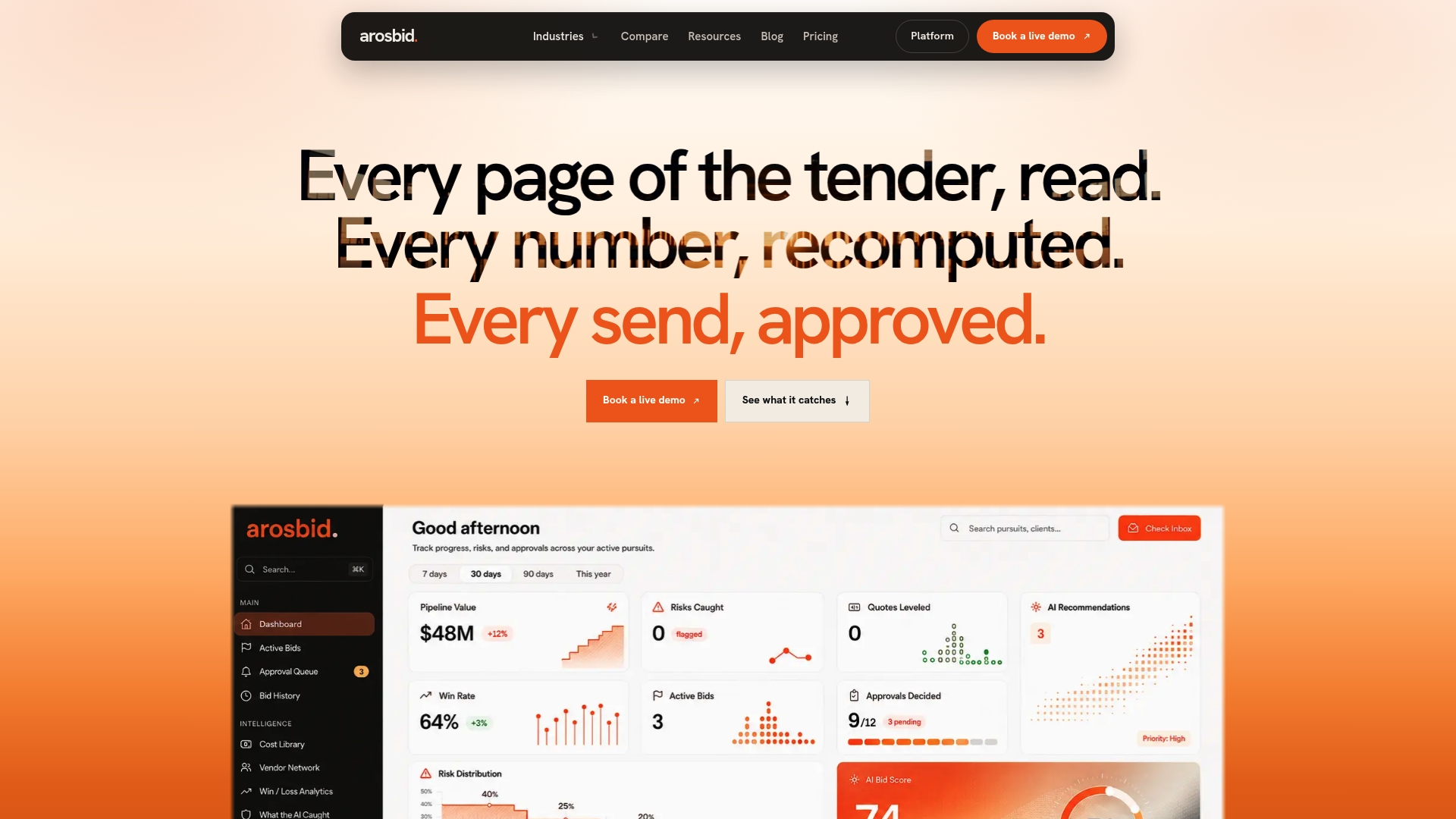
If your team bids DOT-assisted work, the DBE package is one of several pass/fail items competing for the last days before the deadline. ArosBid’s construction bid management software tracks bid approvals, vendor quotes and document compliance in a structured command center, and its vendor quote leveling puts DBE and non-DBE quotes on the same scope. It integrates with Excel and Outlook. You can see the plans on the pricing page or book a live demo.
FAQ
Do I need DBE certification to bid on a DOT-funded construction project?
No. You can bid as a prime without being certified. Certification matters only if you want your work to count as DBE participation, in which case you must be certified before the work is listed.
What are good faith efforts?
They are the documented steps you took to obtain DBE participation when you did not meet the contract goal. They typically include solicitations, pre-bid meeting attendance, sharing adequate project information and negotiating in good faith. The agency evaluates whether they were adequate.
Did the 2025 rule eliminate DBE requirements on bids?
No. It removed race- and sex-based presumptions and suspended goal setting and participation counting during re-evaluation, but commitments already made still apply and agencies are implementing it differently. Read each solicitation and addendum.
When are DBE documents due?
The agency decides. Under the federal rule it can require them with the bid, as a matter of responsiveness, or within 7 days after bid opening. Some agencies set shorter windows, so confirm it in the instructions to bidders.
Sources
- The U.S. DOT Disadvantaged Business Enterprise Program (Congressional Research Service)
- FHWA DBE and Alternative Contracting Methods handbook
- State DOT bulletin on the interim final rule
- Caltrans DBE system page
- VDOT DBE memo, October 2025
- NASBP summary of the DBE interim final rule
- State DOT DBE program plan
- 49 CFR 26.53, good faith efforts procedures
- 49 CFR 26.37, monitoring
- 49 CFR 26.13, assurances
- USDOT DBE final rule summary