Human Review of Construction Bids: A Practical Guide
Human Review of Construction Bids: A Practical Guide ! Illustrated construction bid review title card A human review of a construction bid is a structured check, done by people who know how work gets built, of every document, number and requirement before the bid goes out.

A human review of a construction bid is a structured check, done by people who know how work gets built, of every document, number and requirement before the bid goes out. It works best with named roles, a written log of findings and a final approval from someone with authority to sign. This guide shows how to set that up, what to look for and where software can take the repetitive reading off your team.
TL;DR
- Appoint a review lead and split the work into technical, commercial and compliance checks, with one person who approves the final submission.
- Review every contract document, not just the drawings and specs: addenda, geotechnical, survey, utility and owner-furnished information all count.
- Log each finding against the exact requirement, with evidence, owner, status and disposition, so nothing lives only in someone’s head.
- Use software to read the full document set and flag conflicts, then keep the decision with your people.
- Clean source files give automated checks the best chance to perform, so fix document quality at intake.
Table of Contents
- Why construction bids need expert human review
- What a human review actually covers
- How to organize the review step by step
- What good review discipline looks like in practice
- Documenting findings so they hold up
- Where software fits without replacing your judgment
- Perspective: why we keep people in charge
- Bring review and bid management into one place
- Rules and requirements differ by jurisdiction
- A review timeline you can reuse
- FAQ
- Sources
Why construction bids need expert human review
Most bid problems are not pricing problems. They are reading problems: a clause on page 12 of the front-end documents that changes insurance limits, an addendum that moves the bid date, a spec section that contradicts the drawings. A tired estimator at 11 p.m. on bid night will miss some of these. A second pair of experienced eyes, working from a defined checklist, will catch many of them.
The Construction Management Association of America makes the same point in its constructibility review paper. It says the review should cover all contract-document elements, not only architect-issued drawings. That includes as-builts, geotechnical, environmental, survey, utility and owner-furnished documents. The aim is documents that are coordinated, complete and buildable before anyone signs a contract.
The paper also stresses who should do the reviewing. Reviewers need to think like builders, not only designers. Field-experienced people are better placed to spot buildability gaps, coordination failures and scope ambiguities, the things that later turn into claims and change orders. That is the case for human review in one sentence: judgment about how work really gets done cannot be skipped.
The same logic applies when you are reading someone else’s bid or quote. If you want to see how a reviewer works through competing prices and scope in a single trade, this walkthrough on evaluating roofing contractor bids shows the questions to ask on the owner’s side of the table.
What a human review actually covers
Think of the review as three layers. Each layer has a different question and often a different person.
| Layer | Core question | Typical reviewer |
|---|---|---|
| Technical | Can this be built as drawn and specified, and is our scope complete? | Senior estimator, project manager or field superintendent |
| Commercial | Do the numbers, vendor quotes, allowances and exclusions hold together? | Estimating lead, purchasing |
| Compliance | Does the submission meet every mandatory requirement and form? | Bid coordinator, contracts or legal |
We go deeper on the sequence in our own piece on three stages of human review before final sign-off. The short version: check what disqualifies you first, then check scope and price, then approve.
Start with pass/fail items
Before anyone debates unit costs, confirm the controlling bid version and every addendum. Then separate mandatory requirements, which can get a bid thrown out, from scored criteria, which only affect how you rank. This split is the heart of a bid compliance checklist and it is the step most often skipped when the clock is running.
Typical pass/fail items include:
- Bid bond or security in the right form and amount
- Required licenses, registrations and insurance certificates
- Signed addenda acknowledgments
- Mandatory forms, affidavits and certifications
- Submission format, portal rules and deadline
- Pre-bid meeting attendance, where it is required
Then review scope and constructibility
This is where builder experience pays. The CMAA guidance lists the recurring targets: drawing and specification coordination, missing site conditions, MEP and plenum conflicts, unclear scope boundaries, geotechnical contradictions, subjective notes, inadequate dimensions, miscellaneous power, and unclear owner-furnished versus contractor-installed responsibilities.
A few examples of what that looks like on a real bid:
- The spec calls for a product the drawings never show, or the reverse.
- Ductwork, piping and structure all claim the same space above the ceiling.
- The geotechnical report describes groundwater that the excavation notes ignore.
- Equipment is listed as owner-furnished in one section and contractor-installed in another.
- A note says “as directed by the architect” with no dimension or quantity behind it.
When spec and drawings disagree, you need to know which governs and how you will price it. We cover the contract-side steps in spec versus drawings conflicts, and the fields worth recording for each conflict in five fields every estimator should log.
Finally, review price and vendor quotes
Quotes are where scope gaps hide. Two vendors can be $40,000 apart because one included commissioning and the other did not. Level the quotes against the same scope sheet before you carry any number. Our guide to quote scope gaps explains how to find the holes while you can still ask questions, and how to protect your position before bids lock.
How to organize the review step by step
The team does not need to be large. It needs clear roles and a written record. The approach below follows the model in a 2026 guide to coordinating technical, commercial and compliance reviews.
- Appoint a review lead. One person owns the process, the timeline and the log. This is not necessarily the most senior person, but it must be someone who can chase others.
- Assign roles. Name technical, commercial, compliance and specialist reviewers, plus the person who gives final approval. Specialists might be a fire protection engineer, a structural detailer or a controls contractor.
- Confirm the document baseline. Record the bid version, the addenda received and the date and time you stopped accepting changes.
- Review in parallel. Each reviewer works from the same document set and writes findings into one shared log.
- Record every finding properly. Tie it to the exact requirement and document location, then add the evidence, impact, owner, status and proposed disposition.
- Reconcile across disciplines. A technical fix often changes the price, and a price decision may change a compliance answer. Resolve these together.
- Document the approval. The person authorized to commit the company signs off, and the record shows what they saw.
The underlying idea is that compliance is evidence, not impression. “I think we covered that” is not a finding. “Section 00 21 13, paragraph 4.2 requires a 5% bid bond, confirmed in the attached bond form, owner: contracts” is.
A simple log layout
| Field | Example entry |
|---|---|
| Requirement reference | Spec 09 51 00, 2.3.A |
| Document location | Division 09 spec, p. 14; sheet A-501 |
| Finding | Ceiling tile type differs between spec and finish schedule |
| Evidence | Marked-up PDF, RFI draft |
| Impact | Price difference on 12,000 sq ft |
| Owner | Estimator on interiors |
| Status | Open, RFI sent |
| Disposition | Price base spec, qualify alternate |
If you also keep a record of questions and answers with the owner and vendors, our note on running a bid communication log shows what to capture so the log and the communication record agree.
What good review discipline looks like in practice
Public owners give a useful picture of how seriously this is taken. The Texas DOT San Antonio District has a standard operating procedure for construction cost estimates that requires at least three different people to develop, review and approve each estimate. The 2025 version also calls for quantity calculations, unit-price assumptions, explanations for prices outside average low-bid ranges, standardized file naming, milestone PDFs, retained review checklists, redlines and proof of approval.
You do not need a state agency’s paperwork to borrow the principles:
- Separation of duties. The person who built the estimate should not be the only person who checks it.
- Explain outliers. If a unit price sits far from your historical range, write down why.
- Keep the trail. Checklists, redlines and approvals should be retrievable months later, when a dispute or a debrief needs them.
The payoff for reviewing early can be large. CMAA’s account of a Los Angeles Unified School District program describes multidisciplinary, construction-experienced reviewers using checklists, audits, site visits and back-checks. It reports thousands of errors, omissions, conflicts and ambiguities found, and estimates at least a 10-to-1 payback from catching issues before contracting. That program is an owner-side review, but the lesson carries to the contractor side: an hour spent before submission is cheaper than a change-order fight after award.
Documenting findings so they hold up
A review that lives in email threads is hard to defend and impossible to learn from. Keep one log per bid, store it with the bid file, and carry the open items into your clarifications and qualifications. For a sense of how a due diligence checklist turns scattered checks into a defensible record, this contractor due diligence checklist shows the habit in a different trade and country.
Three habits make the log useful:
- Write findings as facts. State what the document says, not what you assume it means.
- Close every item. Each finding ends as resolved, priced, clarified by RFI, qualified in the proposal or accepted as a risk, with a name next to the decision.
- Review the log at debrief. Win or lose, patterns appear: the same vendor omits the same scope, the same owner writes the same ambiguous clause.
If your scope review reaches the contract stage, our 16-point scope of work review gives project managers a checklist to use before signing.
Where software fits without replacing your judgment
The hard part of human review is volume. A bid package may run to thousands of pages across front-end documents, specifications, drawings and addenda. People are good at judgment and poor at reading every line at 2 a.m. Software is the reverse, which is why the two pair well.
We built AI tender review to read the whole document set, including the front-end clauses that are easy to skim, and to flag missed clauses and conflicting specifications for a person to assess. It surfaces; your team decides. Nothing is submitted without human authority.
Two practical points on getting good results from any automated review:
- Feed it clean files. A 2025 master’s thesis from the Polytechnic University of Catalonia tested automated compliance checking on public transportation bid packages. It reported F1 scores of at least 0.97 on two clean MassDOT packages, while a package with corrupted text scored 0.46 overall. Document quality matters, so ask for native PDFs where you can and flag scans early.
- Keep your tools. Review works best when it lives where your team already works. ArosBid integrates with Excel and Outlook, so estimators keep their spreadsheets and inboxes rather than rebuilding their process around a new system.
Perspective: why we keep people in charge
We build bid software, and we still say the same thing to every estimating team: the person who signs the bid owns the bid. Technology should make that person better informed, not make the decision for them.
What we see across bids is that disqualifications and costly misses rarely come from an estimator who lacked skill. They come from a clause nobody had time to read, a spec section that quietly contradicted a drawing, or a vendor quote that left out a piece of scope. Those are reading and coordination failures, and they are exactly where a machine reading every page, paired with an experienced reviewer deciding what matters, beats either one alone.
That is why ArosBid reads the entire document set, including front-end clauses, and automates error-checking while leaving authority over submissions with your team. It also runs the full cycle, from intake through vendor quote tracking and leveling, bid/no-bid evaluation, proposal assembly, buyout and debrief, so the findings from review feed the next bid instead of disappearing.
The best review is one your team will actually do on a Thursday night with a deadline at noon Friday. Build it so that it is fast, written down and owned by someone.
arosbid team
Bring review and bid management into one place
If your reviews currently run across spreadsheets, shared drives and inbox threads, ArosBid gives you a structured command center for tracking bid approvals, vendor quotes and document compliance. You can see the plan options on the pricing page, explore how we handle construction bid management, or see vendor quote leveling for trade RFQs.
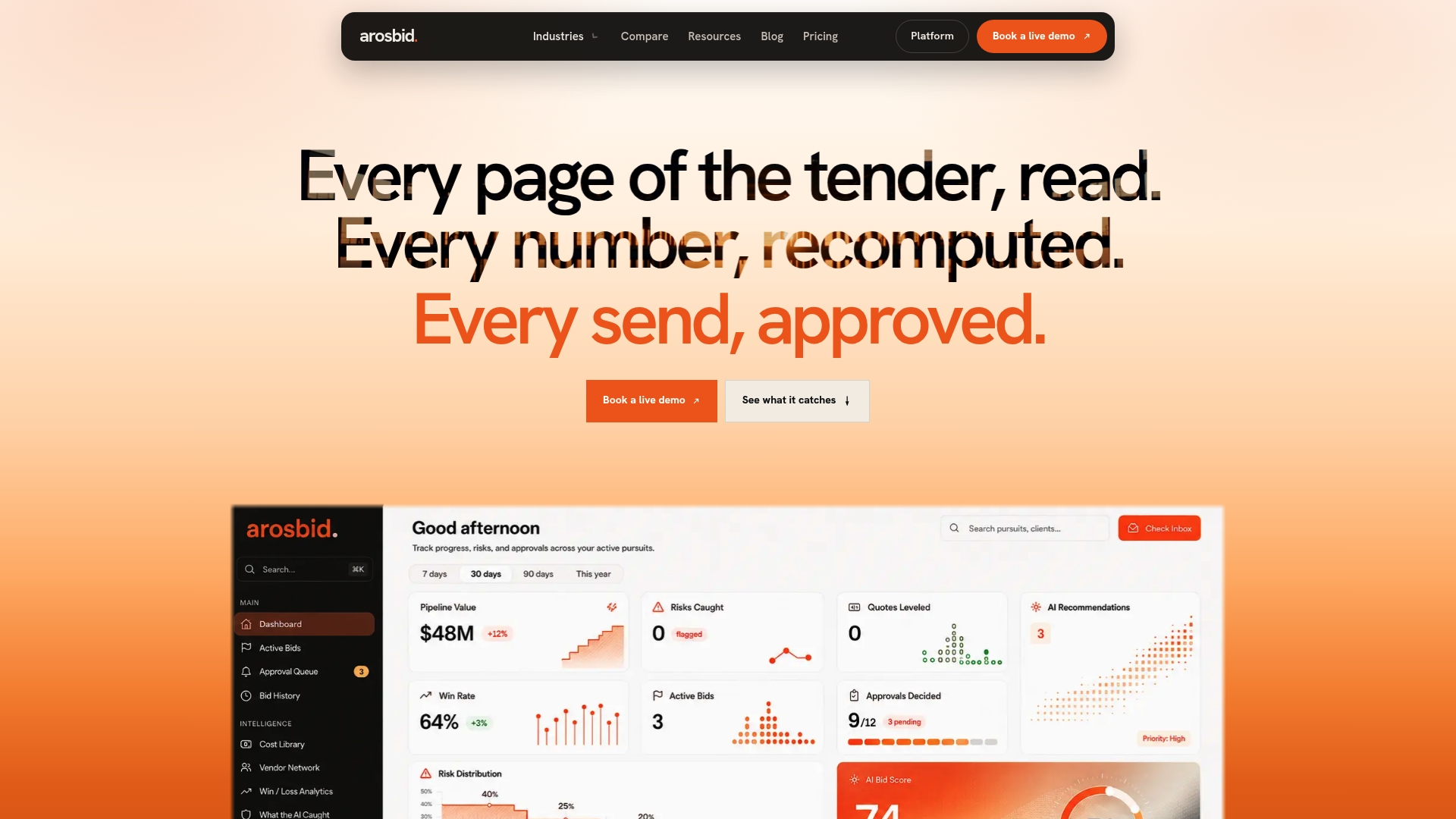
When you want to see it on your own kind of package, book a live demo and we will walk through a review from intake to sign-off.
Rules and requirements differ by jurisdiction
The review structure above holds anywhere, but the requirements you check against do not. Procurement rules, forms and evaluation methods vary by country and by owner.
Two examples show how much. South Sudan’s 2024 trial-edition works bidding document is adapted to its 2018 Act and 2024 Regulations. Its Instructions to Bidders and General Conditions must not be modified, and procurement-specific details sit in the Bid Data Sheet, Special Conditions and Works Requirements. The Dominican Republic’s procurement manual describes mandatory stages from planning through payment, and says evaluators must apply the credentials and technical-evaluation methodology stated in the solicitation.
The practical lesson: always find out which sections the owner fixes and which they let bidders qualify, and which methodology will score you. Then build those into your pass/fail list for that bid, not your last one. For US work, check the specific owner’s instructions to bidders and any state or agency rules that apply.

A review timeline you can reuse
A review needs time built into the bid schedule, not squeezed in at the end. A workable rhythm for a typical package looks like this:
- Day one of bid period: Confirm the document baseline, assign roles and run the pass/fail pass so disqualifying items surface early.
- Middle of bid period: Technical and scope review while quotes arrive. Send RFIs early, because answers take time and owners often stop accepting questions well before the bid date.
- Two days before submission: Level vendor quotes, reconcile findings across disciplines and make bid/no-bid or markup decisions.
- Final day: Check addenda one more time, confirm forms, bonds and portal requirements, and get the documented approval.
Shift the schedule to fit your project size. What matters is that the compliance pass comes first and the approval comes last, with the log connecting them.
FAQ
Who should review a construction bid before it is submitted?
At minimum, someone other than the person who built the estimate. Ideally you cover technical, commercial and compliance angles, with a field-experienced person looking at buildability and one authorized person approving. Small teams can combine roles, but the author should not be the only checker.
How long does a proper bid review take?
It depends on package size and complexity, so build it into the bid schedule rather than hoping for time at the end. Starting the pass/fail check on day one and running scope review while quotes come in keeps the final review short. Rushed reviews are where missed clauses and conflicts get through.
Can software do the review for us?
Software can read the full document set quickly and flag missed clauses, conflicting specifications and gaps for your team to assess. The decision to submit, qualify or walk away stays with your people. We design ArosBid on that principle, with human authority over every submission.
What should we log during a bid review?
For each finding, record the requirement reference, document location, evidence, impact, owner, status and disposition. Add the final approval with name and date. This gives you a defensible record and useful material for the post-bid debrief.
Sources
- CMAA, Constructibility Reviews
- ONES, How to Coordinate Technical, Commercial, and Compliance Reviews of Construction Bids
- TxDOT San Antonio District, Standard Operating Procedure for Reviewing and Documenting Construction Estimates (May 2025)
- UPC master’s thesis, Master in Risk Analysis of Civil Infrastructure (July 2025)
- South Sudan, Procurement of Medium and Large Works bidding document (2024)
- Dominican Republic DGCP, Manual General de Procedimientos Ordinarios de Contratación