Project Bid Timeline: How to Plan Every Stage
Project Bid Timeline: How to Plan Every Stage ! Illustrated construction bid timeline title card A project bid timeline is a schedule that starts at the bid due date and works backward: invitation review, bid/no-bid, subcontractor quote requests, estimate build, review, approval and submission, each with an owner and an internal deadline.

A project bid timeline is a schedule that starts at the bid due date and works backward: invitation review, bid/no-bid, subcontractor quote requests, estimate build, review, approval and submission, each with an owner and an internal deadline. The owner’s due date is fixed. Everything before it is yours to design, and most disqualifications and missed bids come from that internal part being left vague.
This guide covers the stages every bid passes through, how long each internal step usually needs, how to set milestones, and how to keep a bid calendar current when addenda change the dates.
TL;DR
- Work backward from the due date and set internal deadlines for quote requests, estimate lock, review and approval, not just for submission.
- Procurement follows the same arc everywhere: notice, bid period, questions and addenda, opening, evaluation, award, contract. Your internal plan has to fit inside the owner’s version of it.
- No universal duration exists. Use your own history, then adjust for scope, number of subs and how complete the documents are.
- Treat every addendum as a calendar event: log it, check the dates it moves, and re-read the clauses it touches.
- One shared bid calendar, linked to the tools your team already uses, beats a spreadsheet only one person updates.
Table of Contents
- The stages of a project bid timeline
- How long should each step take?
- Build the timeline backward from the due date
- Pre-bid milestones that are easy to miss
- Handling addenda and schedule changes
- Compliance checkpoints inside the timeline
- Running a bid calendar for several bids at once
- Perspective
- Where software helps with the timeline
- After submission: award, buyout and debrief
- FAQ
- Sources
The stages of a project bid timeline
The owner’s side of the timeline is the part you do not control, but you need to know it, because your internal plan hangs from it. Sources describe it with slightly different groupings, and the differences are useful.
The Royal Architectural Institute of Canada describes tendering as notifying prospective bidders, issuing tender documents, holding a bidders’ conference, answering inquiries, receiving and evaluating proposals, negotiating outstanding contract terms and awarding. A public-sector training document on tendering groups it more coarsely into prequalification or shortlisting, the bid period, evaluation and award, and contract signature.
For US public work, Hawaii’s state procurement office gives a granular example. Its construction guidance splits competitive sealed bidding into preparation before advertising, the bid period, public notice, addenda and deadline administration, pre-bid meetings, bid opening, evaluation and award, any protest period, and contract execution. Rules differ by state and agency, so treat it as one model, not the law everywhere.
From the bidder’s chair, that becomes eight working stages:
- Opportunity found. The invitation or notice arrives.
- Bid/no-bid. You decide whether the job fits your trade, capacity and risk.
- Document review. You read the full set, including front-end clauses and specifications.
- Pre-bid meeting and questions. You walk the site, ask questions and read the answers.
- Takeoff, quotes and estimate. You quantify scope and collect vendor and subcontractor pricing.
- Review and approval. A second person checks compliance and numbers, and management signs off.
- Submission and opening. You deliver in the required form before the deadline.
- Award, buyout and debrief. You learn the result, buy out the work if you won, and record what you learned if you did not.
Notice that stages 1 to 4 consume calendar time without producing a single number. That is where timelines are quietly lost.
How long should each step take?
There is no standard duration, and anyone who gives you one is guessing about your project. What exists are reference points and a method.
Reference points. Federal rules give a floor for the owner’s bid period. For federal sealed bidding, the Federal Acquisition Regulation says a bidding time of at least 30 calendar days applies when a synopsis is required, and it lists complexity, anticipated subcontracting and geographic distribution of bidders among the factors for setting a reasonable period. Construction has its own provisions, and private owners set whatever they like, so read the invitation, not the rule of thumb.
Inside the bid period, one 2026 example from a building-controls contractor in the UK reports 10 to 15 working days of internal effort for a competent firm, stretching to 4 to 6 weeks for complex projects, with supplier waiting time around 6 to 10 working days. That is one trade in one market, so use it as a sanity check on proportions rather than a benchmark: most of the elapsed time is waiting on other people.
The method. Pull your last ten bids. For each, note the invitation date, due date, the day the last sub quote arrived, the day the estimate was locked and the day it was submitted. The pattern tells you your real durations: how late quotes actually arrive, how long review actually takes. That history is worth more than any published figure.

Build the timeline backward from the due date
Fix the due date and time first, including the time zone and the delivery method. Then subtract.
Here is an illustrative schedule for a bid with 21 calendar days between invitation and due date. The numbers are an example of the method, not a standard.
| Milestone | Days before due date | What must be true |
|---|---|---|
| Bid/no-bid decision | 19 | Documents skimmed, fit and risk assessed, owner named |
| Quote requests out to vendors and subs | 17 | Scope packages defined, due date for quotes stated |
| Pre-bid meeting and site walk | Set by owner | Attendee assigned, questions list ready |
| Question cutoff for the owner | Set by owner | All open questions submitted before the cutoff |
| Quotes due from vendors and subs | 6 | Follow-ups made at day 10 and day 8 |
| Estimate locked (no more changes) | 3 | Quotes leveled, scope gaps closed |
| Independent compliance review | 2 | Reviewer who did not build the estimate |
| Management approval | 1 | Final number, markups and alternates decided |
| Submission | Same day, with buffer | Uploaded or delivered well ahead of the cutoff |
Three habits make this table work.
Set the quote deadline well before your own. The gap between when subs are due and when you lock is where late quotes, scope gaps and bad leveling get absorbed. Asking vendors to respond a week ahead of the due date, rather than the day before, is common practice because their pricing has to be leveled and compared before you can use it. Our guide to bid tabulation for estimators shows how to cut that comparison work down.

Protect one day for review. Treat approval and compliance review as scheduled work, not leftover time. Good practice is for the compliance reviewer to check legal entities, bonds, licenses and required signatures, and where possible to be someone who did not prepare the whole estimate, since the person who built it tends to read what they meant, not what is on the page.
Submit early. Portals fail, couriers slip and files exceed upload limits. A bid that is technically complete at 2:01 p.m. against a 2:00 p.m. deadline is a disqualified bid. Plan to submit with a real buffer.
Pre-bid milestones that are easy to miss
The early part of the timeline is mostly questions and clarifications, and it has hard cutoffs.
The pre-bid meeting. Some are mandatory, and missing one can bar you from bidding. Put the date in the calendar the day the invitation arrives, assign an attendee and prepare questions in advance. Our pre-bid meeting and job walk checklist lays out a nine-step agenda.
The question cutoff. Owners typically stop answering questions some days before the due date. A conflict between two specification sections found the night before the due date cannot be resolved by asking. Reading the entire document set in the first days, not the last, is what makes the cutoff usable. Automated review can speed that up; see how AI tender review reads front-end clauses and flags conflicts for a human to decide.
Bonds and insurance. Bid bond requirements, surety letters and certificates take outside parties days to produce. Start them at the bid/no-bid stage, not at submission. Typical bond percentages and traps are covered in our piece on bid bond requirements.
Public versus private differences. Public work usually brings fixed opening times, mandatory forms and protest windows. Private work may allow negotiation and late changes. Check which world you are in with the public vs private bidding checklist.
Handling addenda and schedule changes
Addenda are the main reason a clean timeline falls apart. They change scope, specifications and sometimes the due date itself. Under federal sealed bidding, the contracting officer must issue changes to quantity, specifications, delivery schedules or opening dates by formal amendment sent to everyone who received the invitation, before the time for bid opening, and must consider whether the bid period needs extending. Other owners follow similar practice, but the rules are theirs.
What that means for your calendar:
- Log every addendum the day it arrives, with its number, date and what it changes.
- Check whether any date moved. If the due date or question cutoff shifted, update every internal milestone, and tell your subs and vendors their dates changed too.
- Re-read the clauses it touches. Addenda often modify one paragraph that conflicts with another section the addendum did not mention.
- Acknowledge it if required. Many solicitations require the bid form to list received addenda. Missing one is a classic compliance failure.
- Forward scope changes to vendors. A quote based on the original drawings may no longer match.
A last-day addendum is the stress test of your plan. If your review day is protected and your estimate lock was three days out, you have room to absorb it. If not, you are guessing.
Compliance checkpoints inside the timeline
Timing and compliance are the same problem. Most disqualifications are not pricing errors; they are missing forms, unsigned pages, wrong entity names, absent bond documents or an unacknowledged addendum. Put a pass/fail check at two points: early, when you read the invitation for mandatory requirements, and late, against the final package. Our six-phase bid compliance checklist puts pass/fail items first, ahead of pricing.
It also helps to borrow the discipline of other fields that run on strict readiness checks. A homeowner-facing renovation firm, for instance, publishes a list of what to prepare before quoting, and the principle carries over to commercial bids: gather scope information, access details and approvals before pricing, not during.
Also verify jurisdiction-specific rules. Holidays, weekends and working-day counts differ by country. One tendering guide for Saudi Arabia, for example, notes that the weekend is Friday and Saturday and public holidays often fall inside tender periods, so it counts working days rather than calendar days. In the US, the equivalent checks are state holidays, local office closures and the time zone of the owner.
Running a bid calendar for several bids at once
One bid is a checklist. Five bids in the same week is a scheduling problem. A bid calendar should show, at a glance:
- Every due date and time, with time zone and delivery method
- Mandatory meetings, question cutoffs and bond deadlines
- The estimator, reviewer and approver on each bid
- Status of vendor and sub quotes, by scope package
- Open addenda and who is acting on them
Two rules keep it honest. First, there is one calendar, not one per estimator. Second, dates come from the documents and addenda, not from memory. If the calendar and the invitation disagree, the invitation wins and the calendar gets corrected.
Need a longer view? Our 60 to 90 day bid management workflow shows how to stage work across a pipeline, so that the week several bids converge is not a surprise.
Connect it to the tools you already use
Most estimating teams live in Excel and Outlook. A calendar that requires everyone to move to a new system gets abandoned in the first busy week. Practical options:
- Put due dates and milestones into shared Outlook calendar entries, with reminders for quote follow-ups.
- Keep a tracking sheet in Excel with one row per bid and one per scope package, owned by one person.
- Send vendor requests from email and track responses in the same place as the milestone dates.
The weakness of all three is that they do not talk to each other. That is the gap a platform fills, as long as it fits around your existing tools rather than replacing them.
Perspective
We built ArosBid around a simple observation: bids rarely fail on the day they are submitted. They fail weeks earlier, when a clause is skimmed instead of read, a spec conflict goes unnoticed, or a quote request goes out a day too late to be leveled properly.
That is why we treat the timeline as part of the bid, not as a wrapper around it. Our platform reads the entire set of bid documents, including front-end clauses, and flags the issues that cause disqualification, so your team spends its early days deciding instead of searching. It automates the error checking and leaves authority over the submission with your people, where it belongs.
We also think teams should not have to abandon their tools to get this. ArosBid works with Excel and Outlook, and it runs the cycle from intake through buyout and debrief, so the calendar, the vendor quotes, the compliance checks and the lessons from the last loss all sit in one structured command center.
arosbid team
Where software helps with the timeline
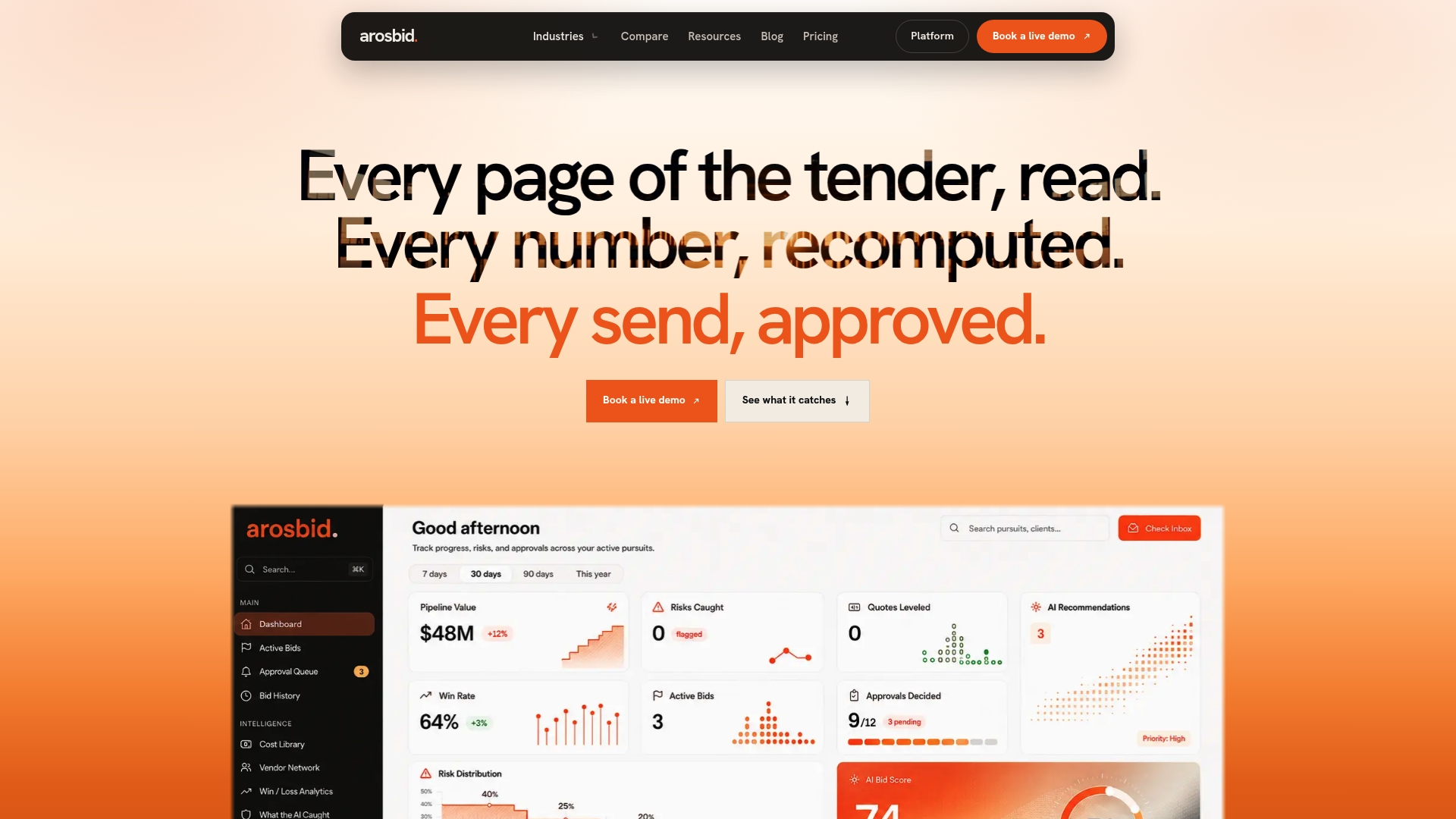
When the bid calendar, document review and quote tracking live in separate places, the timeline is only as reliable as the person updating it. ArosBid is built for construction trade teams who want to run the complete bid cycle, from bid/no-bid through proposal assembly, buyout and debrief, without replacing their estimating or document tools. It tracks vendor quotes and leveling, checks documents for compliance, and keeps approvals visible to the whole team.
If you want to see how it would handle your current bid load, start with the Bid Process Platform, or compare plans on the pricing page.
For teams focused on pricing work, the construction estimating and bidding software page covers takeoff, estimating and vendor quote leveling in more depth.
After submission: award, buyout and debrief
The timeline does not end at submission. Owner evaluation, any protest period and contract execution follow, and the dates are the owner’s. Block time for three things:
- Clarification requests. Evaluators may ask questions or request a bid correction. Keep the estimator reachable.
- Buyout. If you win, subcontract and purchase orders need to go out against the quotes you carried. Quote validity periods matter here, so record how long each quote is good for.
- Debrief. Win or lose, record the result, the competing range if known, and what slowed you down. That record is what makes the next timeline accurate.
FAQ
How far in advance should I start a bid?
Start the day the invitation arrives. Reading the documents and deciding bid or no-bid in the first few days leaves time to ask questions before the cutoff and to request vendor quotes early. Your own past bids are the best guide to how much total time a given size and type of job really needs.
What does bid opening date mean?
It is the date and time when the owner stops accepting bids and begins opening them, which on public work is often done publicly. Your submission must be in before that moment. If an addendum moves it, the new date governs, so update your calendar immediately.
How long should I give subcontractors to send quotes?
Give them enough time to price properly, then build in a buffer before your own estimate lock. A practitioner discussion among estimators often cites about two weeks for hard-bid pricing, but the right figure depends on the due date and the scope. Always state the quote due date in the request and follow up before it passes.
What is the difference between a bid timeline and a bid calendar?
A bid timeline is the schedule for one bid, from invitation to award. A bid calendar combines the timelines of all your active bids so you can see conflicts in workload, shared deadlines and who is stretched too thin.
Sources
- Chapter 6.5, RAIC Canadian Handbook of Practice
- Tendering and Awarding the Contract, PPP Certification
- Construction Procurement, Hawaii State Procurement Office
- FAR 14.202-1 Bidding time
- FAR 14.208 Amendment of invitation for bids
- The BMS Tender Process: A Step-by-Step Timeline
- How to Manage a Construction Bid from Invitation to Award
- Planning the Tender: Team, Programme and Enquiries
- Small home repairs checklist: what to prepare before quoting
- r/estimators community