Construction Cost Control: A Practical Guide for Bid Teams
Construction Cost Control: A Practical Guide for Bid Teams ! Sketches frame a construction cost control title Construction cost control is the routine of setting a budget from a reliable estimate, then tracking committed and actual costs against it until closeout.
Construction cost control is the routine of setting a budget from a reliable estimate, then tracking committed and actual costs against it until closeout. Most of it is won or lost before award: an estimate built on a missed clause or a conflicting specification becomes a budget that cannot be met. That is why we treat bid review and cost control as one workflow, and why the sections below start at the bid and follow the money through buyout, change orders and debrief.
TL;DR
- Cost control compares actual and forecast costs against an agreed budget, and its budget is only as good as the estimate behind it.
- Track committed costs (subcontracts, purchase orders, approved change orders) as well as invoices, or overruns show up too late.
- Written approval before extra work, a clear change-order procedure and job cost accounts that match your estimate do most of the protecting.
- Catch conflicting specifications, missed clauses and addenda before submission, because pricing errors are cost overruns that haven’t happened yet.
- Feed final-cost variances back into the next estimate so each bid is better than the last.
Table of Contents
- What construction cost control actually covers
- Start in the bid: an estimate you can manage to
- Catch conflicts before you submit
- From bid to budget: job cost accounts
- Track committed cost, not just invoices
- Change orders: where profit leaks
- Where cost control usually breaks
- Software that fits the workflow you already have
- Close the loop after the job
- See it on your own bids
- FAQ
- Sources
What construction cost control actually covers
The Association for Project Management describes cost control as managing and monitoring expenses so a project stays within budget. Cost planning comes first: estimate the cost, agree a budget, then manage actual and forecast costs against it. Done well, it limits spend where possible, reveals overspending early and gives you real cost data for the next job.
A Purdue University study of construction cost control describes it as a cycle. The estimate prepared in preconstruction becomes the yardstick for actual cost performance. During construction you compare actual costs with that estimate to find hot spots. After construction, final-cost variances flow back into future estimates and into better field procedures.
One point from Carnegie Mellon’s construction management text is worth keeping in front of the whole team. Control, in its words, is mainly about spotting deviations from the plan, not finding savings. Major savings are available in planning and design. Changes made during construction tend to delay work and push costs up. So the strongest cost control happens upstream, in the estimate and bid review.
Start in the bid: an estimate you can manage to
The Purdue study explains that a bid compiles costs by resource and cost classification: direct project costs, indirect costs (general conditions), home office overhead and profit. It also notes that a primary attribute of an accurate estimate is the amount of detail in the takeoff, up to a point of diminishing returns where more detail no longer justifies the effort.
The Construction Industry Institute adds that better scope definition yields better estimate accuracy. Its guide also says no estimate should be released without internal review, and that a support document should record assumptions, inclusions and exclusions. Those inclusions and exclusions matter later. When a change order dispute arrives, the written basis of your price is your evidence.
The NCHRP 8-49 guide, written for highway work but useful for any estimator, recommends setting a baseline estimate and managing to it, documenting the basis and assumptions, identifying risks early to size contingencies and reviewing for accuracy and full scope coverage. Reliability, as the Government of Alberta puts it, depends on the level of detail and specifications available, the techniques used and the experience of the estimator.
What an estimate review should verify
PwC’s audit guidance on estimating and bidding is a good model of what independent review looks like. It recommends checking estimates against specifications, plans and drawings, verifying clerical accuracy, and comparing:
- material quantities to the customer’s specifications
- material costs to vendor price lists and subcontractor bids
- labor rates to union contracts
- equipment costs to supplier rental rates
It also recommends precluding undocumented management-level adjustments. A number that moved late with no note is the one nobody can defend at the debrief. If you want a structured version of this review, our 3 stage estimate review checklist and pre-bid QA/QC process lay out the checks in order.
Catch conflicts before you submit
The cheapest overrun to prevent is the one you price in by mistake. Addenda are a common source: an Oregon DOT internal audit found addenda were issued for 66% of projects let between January 2019 and June 2020, and 49 of them each changed specifications, bid schedules and plans. If your pricing is not reconciled to the final addendum, your budget is wrong on day one.
A University of Reading study of two UK contractors found the same pattern from the bidder’s side: tender queries and amendments kept arriving, many with significant changes that were hard to price in the time available. The authors link poor tender documents to inaccurate estimates, claims and disputes.
The Los Angeles Bureau of Engineering lists the most common construction-phase causes of over-budget projects as poor design, unclear specifications and weak control over owner-initiated changes. Two of the three are visible in the bid documents if someone reads all of them.
A bid review routine that works
- Read the whole set, front end first. Instructions to bidders, general and supplementary conditions, and Division 01 often carry the clauses that move cost: liquidated damages, allowances, bonding, schedule constraints.
- Cross-check specifications against drawings and each other. Conflicts between sections, or between a spec and a detail, are where scope gaps hide.
- Log every finding with its cost, schedule or cash-flow effect and a single action: clarify, qualify, price or accept. Convert percentages into dollars and periods into dates so the decision-maker can rank the risk.
- Ask the question while you still can. Ask whenever the answer materially changes price or risk, because an unasked query is hard to rely on later.
- Reconcile every addendum against your takeoff, vendor quotes and bid form before the final check.
- Run the final checklist twice: once a day or two before submission for scope and pricing, and once immediately before for forms, signatures, addenda and the deadline.
This is the step where our platform is built to help. ArosBid reads the entire set of bid documents, including front-end clauses, and automates error-checking for missed clauses and conflicting specifications, while the estimator keeps authority over what gets submitted. Our post on 10 bid checks that reduce estimating errors covers the manual version of the same routine.
From bid to budget: job cost accounts
Once you win, the estimate has to turn into a budget. Carnegie Mellon’s text explains that the detailed estimate is converted into a project budget whose job cost accounts are the basic unit of cost control. If you retain quantity and labor-input data, you can tell whether an overrun came from unit prices, labor productivity or material consumption, instead of just seeing a bigger total.
That only works if your estimate cost codes and your accounting cost codes line up. When they don’t, someone reconciles by hand every month and the variance report arrives late. Our 10 step cost code setup for PMs walks through aligning them, and our guide to labor cost estimating shows how hours and burden should be built so they can be tracked later.
Buyout is the first real test. Subcontractor and supplier quotes need to be compared on the same scope, with inclusions, exclusions and alternates lined up, before a commitment is made. Vendor quote leveling in ArosBid tracks and levels quotes for trade RFQs, so the number you commit to matches the scope you priced.
Track committed cost, not just invoices
Actual cost, the invoices, payroll and paid expenses, always lags the field. Committed cost is what you have already agreed to spend: executed subcontracts, issued purchase orders and approved change orders not yet invoiced. A project that looks fine on actual cost can already be over on commitments. Track both together, and update commitments the moment a change is approved.
The Los Angeles Bureau of Engineering’s manual lists what construction cost control includes: constructability review, a cash-flow plan, variance monitoring, forecasting potential change orders, recording authorized changes in the cost baseline and preventing unauthorized ones. It must be integrated with scope, schedule and quality control, since a schedule slip is usually a cost event too.
Philip Moncrief of Long International lists the project manager’s execution-phase duties: a control plan that warns of trends early, an approved cost code structure, exception reporting, cash-flow forecasts, risk analysis to size contingency, controlled use of contingency and monthly financial reports to owner and management.
Change orders: where profit leaks
Moncrief draws useful distinctions. A deviation is any change from plan. A trend is a deviation with cost, schedule or quality implications. A scope change alters the contractual scope. A change order is a trend or scope change that changes the contractual basis and is normally signed by both parties. On lump-sum projects, he notes, trends that never become change orders add to the contractor’s cost and reduce profit.
An Eastern Pennsylvania contractor association makes the practical point: weak change-order processes are a leading cause of lost profitability on interiors and tenant-improvement work, and it recommends written approval before extra scope is performed, with training for foremen and PMs. Undocumented extra work silently erodes margin.
A workable change-order routine:
- Log every pending change request the day it appears, with a rough cost and schedule effect.
- Separate approved from unapproved changes in the forecast.
- Do not start extra work without written approval.
- Update commitments and the budget as soon as a change is approved.
- Raise disputes early. The Los Angeles manual treats timely dispute resolution and change-order negotiation as cost-control tools in their own right.
Where cost control usually breaks
| Problem | What it looks like | Where to fix it |
|---|---|---|
| Unclear specifications | Scope gaps and conflicting requirements surface during construction | Document review and bidder queries before submission |
| Late cost visibility | Accounting lags the field, so overruns appear after the fact | Track commitments alongside actuals |
| Disconnected systems | Estimating, PM and accounting data reconciled by hand | Align cost codes and connect the tools you already use |
| Spreadsheet risk | Version control problems, formula errors, inconsistent updates | Locked review steps and one shared source of truth |
| Uncontrolled changes | Extra work without written approval | Standard change-order procedure |
| Missed hidden costs | Permits, inspections, license and jurisdictional fees left out | Estimate review against a standard checklist |
The hidden-cost and single-source-of-truth points echo Smartsheet’s overrun analysis, which also lists poor estimates, design errors, scope creep and external pressure such as inflation and labor shortages among the causes.
Software that fits the workflow you already have
Most estimating teams already live in Excel and Outlook. Cost control software earns its place when it connects to those tools instead of asking the team to start over. ArosBid integrates with Excel, Outlook and major takeoff, cost and project management tools, so documents, quotes and estimates stay in the places your team already works. It covers the bid cycle end to end: automated document review and compliance checks, takeoff, estimate, vendor quote tracking and leveling, bid/no-bid evaluation, proposal assembly, buyout and debriefing, with a historical cost library behind it. You can see how the pieces fit on the bid process platform page.
Close the loop after the job
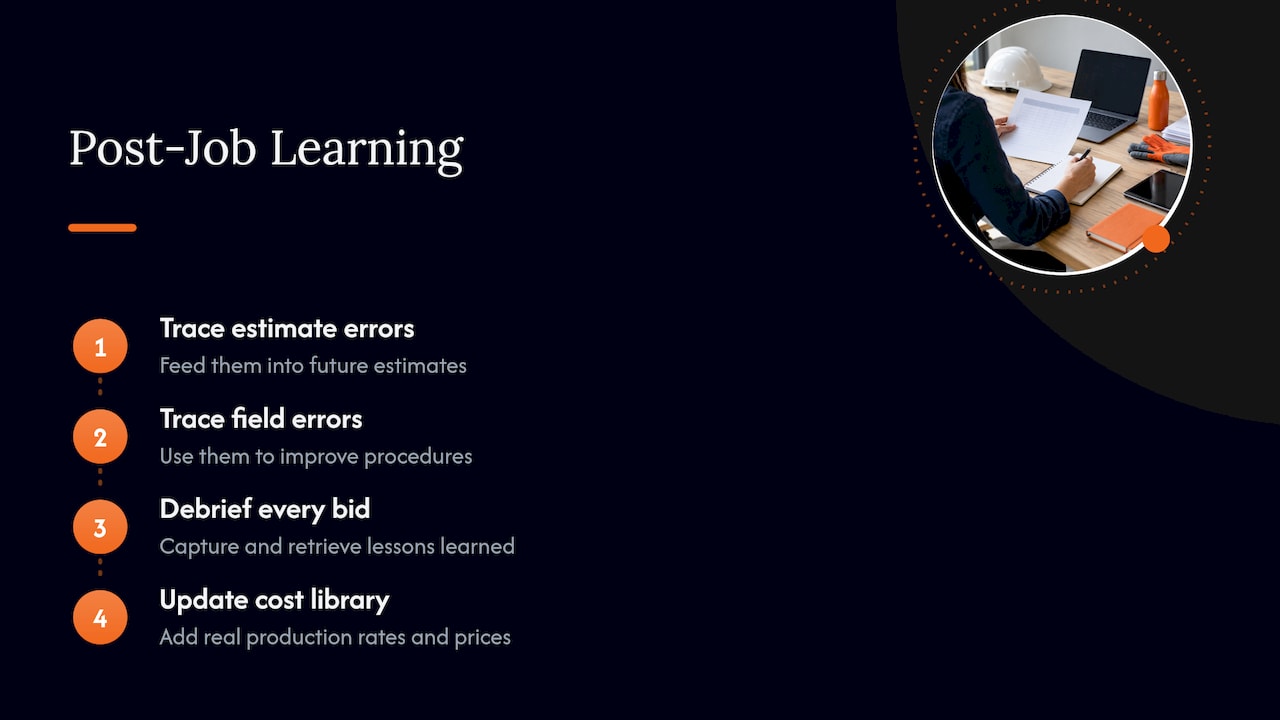
The Purdue cycle ends with analysis of final-cost variances: variances caused by inaccurate estimates go into future estimates, and variances caused by field execution drive better procedures. The Construction Industry Institute makes the same point from the estimating side: lessons learned must be captured and retrieved so estimating standards actually change.
In practice, that means a short debrief on every bid, won or lost, and a cost library that is updated with real production rates and prices. Our posts on lessons learned from construction bids and building a historical cost library cover how to do it without rebuilding your tools. For owners and facility teams who carry the cost story past handover, the same discipline applies to upkeep, for example by tracking stoppage costs with plant records.
What we think
Cost control gets treated as something that starts after award. We see it the other way around. A budget is a promise made by the estimate, and the estimate is only as good as the documents that were read and the conflicts that were caught before the bid went out.
That is why we built ArosBid to read the entire set of bid documents, front-end clauses included, and to check for missed clauses and conflicting specifications. It automates the error-checking, and it leaves the estimator in charge of what gets submitted. People keep authority; the software does the tedious cross-reading.
The second belief is that one cycle beats scattered tools. When intake, takeoff, estimate, vendor quotes, buyout and debrief sit in one structured command center, the cost data from the last job is there for the next bid. And because the platform works with Excel, Outlook and the takeoff, cost and project management tools teams already use, nobody has to overhaul their systems to get there.
arosbid team
See it on your own bids
If your overruns trace back to what was missed or mismatched at bid time, the fix belongs in your bid workflow. ArosBid is subscription software for construction companies and subcontractors, with document review, compliance checks, takeoff, estimating, quote leveling, bid/no-bid evaluation, buyout and debriefing in one place.
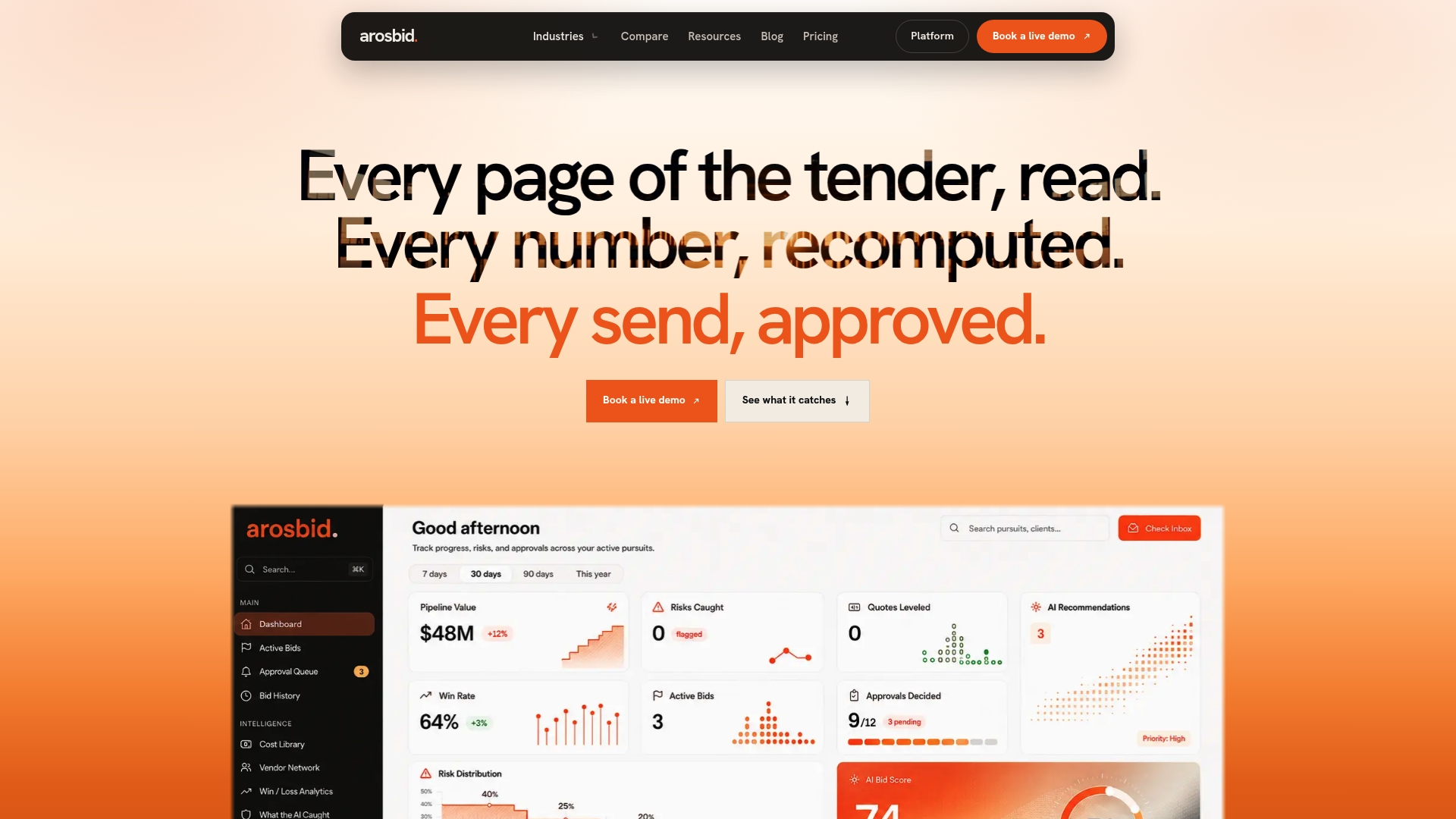
Read how it works on the construction estimating and bidding software page, or compare the One Desk, The Department and The Whole Year plans on the pricing page.
FAQ
What is the difference between cost control and cost management?
Cost management is the broader discipline: estimating, budgeting, forecasting and reporting. Cost control is the part that compares actual and forecast costs with the budget and acts on variances. In practice the two share the same data, so a clean estimate and consistent cost codes serve both.
How often should we review project costs?
Moncrief’s execution-phase duties include monthly financial reports to owner and management, with exception reporting and early trending in between. Many teams review committed and actual costs together at that monthly cadence, and flag any trend with cost implications as soon as it is logged.
Why track committed costs as well as actual costs?
Invoices arrive after the work and often after the decision. Committed costs, such as signed subcontracts, issued purchase orders and approved change orders, show what you have already agreed to spend, so you see an overrun while you can still act on it.
How does bid review affect cost control?
A missed clause, a conflict between spec and drawing or an unreconciled addendum puts an error into the estimate, and the estimate becomes the budget. Reviewing the full document set before submission, and logging each finding with its cost effect, removes problems before they turn into change-order disputes.
Sources
- What is project cost planning and control? (APM)
- Construction Project Cost Control (Purdue University)
- Project Management for Construction: Cost Control, Monitoring, and Accounting (Carnegie Mellon University)
- Improving Early Estimates Best Practices Guide (Construction Industry Institute)
- Procedures for Estimation and Management for Highway Projects (NCHRP 8-49)
- Classes of Construction Cost Estimates (Government of Alberta)
- Estimating and Bidding (PwC Viewpoint)
- Management Letter 21-03, Addenda Process (Oregon DOT)
- Quality of tender documents: case studies from the UK (University of Reading)
- Control and Variance Analysis (Los Angeles Bureau of Engineering)
- Purpose and Principles (Los Angeles Bureau of Engineering)
- Project Management Cost Control in Construction (Long International)
- How Eastern Pennsylvania Contractors Can Strengthen Their Bid Review (ABC Eastern Pennsylvania)
- Construction Cost Overruns: How to Avoid Going Over Budget (Smartsheet)