Equipment Cost Estimating: Rates, Formulas and Bid Checks
Equipment Cost Estimating: Rates, Formulas and Bid Checks ! Equipment estimating title card with hand-drawn machinery Equipment cost in a construction bid is an hourly rate built from ownership cost, operating cost and mobilization, multiplied by the hours the machine really works.

Equipment cost in a construction bid is an hourly rate built from ownership cost, operating cost and mobilization, multiplied by the hours the machine really works. Most equipment errors come from one of three places: a cost left out, an hour count that assumes the machine never sits idle, or a quote that was never checked against the bid documents. This guide gives you the formulas, a worked example, the rules of thumb and the bid checks that keep an equipment line defensible.
It is written for estimators and project managers who price equipment inside a trade bid and want a number they can explain to a reviewer. Because equipment lines sit beside labor, vendor quotes and clauses buried in the front end of the spec, we also show where the line breaks in a real bid workflow.
TL;DR
- An equipment rate has two parts: ownership (depreciation, interest, insurance, taxes) and operating (fuel, lubricants, repairs, tires). Operator wages, mobilization and contingency are priced separately.
- Utilization drives the rate. In the worked example below, dropping from 1,000 to 600 hours a year lifts the interest, insurance and tax cost per hour from $13.80 to $23.00.
- Rent versus buy comes down to a break-even: annual fixed ownership cost divided by the hourly rental rate minus your owned operating cost.
- The 0.6 rule scales a known equipment price to a different capacity, but it only gives an early, rough number.
- Write down the basis of estimate and level every equipment quote against the bid documents before you submit.
Table of Contents
- What an equipment estimate has to include
- Calculating an hourly rate for owned equipment
- Estimating the hours before you price them
- Rent, lease or buy
- The 0.6 rule: a first-pass number, not a bid number
- Document the basis and check the quote
- Where equipment pricing meets the rest of the bid
- Bring equipment lines into one bid workflow
- FAQ
- Sources
What an equipment estimate has to include
The Idaho Transportation Department’s estimating guide splits equipment cost into bare equipment cost (no operator, no fuel), ownership cost (depreciation, indirect costs and major repairs) and operating cost (fuel, lubricants, tires, field repairs and maintenance, and operator expense). That is the backbone. A complete bid line adds the pieces that fall outside an hourly rate.
Ownership costs are what you pay whether the machine works or sits in the yard. Beyond the purchase price, Construction Business Owner lists sales taxes, delivery fees, financing costs, attachments, insurance, annual property taxes and extended warranty, and recommends allowing for inflation in labor, fuel and parts over the machine’s useful life.
Operating costs accrue only when the machine runs: fuel, lubricants, filters, tires, repairs and maintenance.
Items that usually sit outside the hourly rate. The US Army Corps of Engineers’ equipment ownership and operating expense schedule excludes operating labor, mobilization and demobilization, field office and home office overhead, contingency, profit and escalation from its total hourly rates. It treats license fees, property taxes, storage and insurance as indirect costs carried in overhead.
The ASPE estimating guide makes the same cut for a practical reason: operators are priced separately as labor at loaded rates, because the same operator may run several machines and wages are set by collective agreements or prevailing wage rules. It also suggests covering mobilization in general conditions instead of the hourly rate. If you are pricing the operator line, our guide to labor cost estimating, hours and burden covers it.
| Cost element | Where it goes in the bid | Typical trap |
|---|---|---|
| Depreciation, interest, insurance, taxes | Ownership rate per hour | Rate built on 100% utilization |
| Fuel, lubricants, repairs, tires | Operating rate per hour | Best-case fuel burn |
| Operator | Labor, loaded rate | Double counted inside the machine rate |
| Delivery, pickup, permits | Mobilization (general conditions) | Trip in priced, trip home forgotten |
| Unforeseen cost, price change, extra time on site | Contingency | Left at zero |
Calculating an hourly rate for owned equipment
The lesson on equipment pricing from HSM University uses a backhoe-loader to show the arithmetic. Depreciation is the purchase price minus salvage, divided by useful life in hours. Interest, insurance and taxes are a percentage of average investment divided by annual hours. Fuel, lubricants, repairs and tires come from stated hourly bases.
A worked example
The inputs: a $185,000 machine, $45,000 salvage after 10,000 hours, interest, insurance and taxes at 12% of average investment per year, 1,000 hours of work per year, diesel burn of 2.6 gallons an hour at $4.00 a gallon, repairs at 60% of depreciation, lubricants at 15% of fuel, and tires at $1.50 an hour.
| Line | Per hour |
|---|---|
| Depreciation | $14.00 |
| Interest, insurance, taxes | $13.80 |
| Ownership | $27.80 |
| Fuel | $10.40 |
| Repairs | $8.40 |
| Lubricants | $1.56 |
| Tires | $1.50 |
| Operating | $21.86 |
| Total before operator | $49.66 |
The lesson reaches the same $49.66 an hour total. Treat the percentages as teaching inputs: replace them with your own fuel logs, repair history and insurance quotes.
Why utilization moves the number
An estimated rate is an estimated cost divided by an estimated utilization, so Mike Vorster notes in Construction Equipment that a utilization error hurts the rate as much as a cost error. In the example above, if the backhoe works 600 hours a year instead of 1,000, the interest, insurance and tax cost climbs from $13.80 to $23.00 an hour, according to the same HSM lesson. Fixed ownership dollars are known. Hours are the risk.
ASPE gives the plain version: a rate based on 100% annual utilization when the company historically averages 75% will never recover its ownership costs. Track actual hours worked and adjust rates as needed.
Estimating the hours before you price them
A rate is only half of the line. The other half is hours, and the Idaho DOT guide describes the sequence: set the desired production (cubic yards per hour, for example), choose equipment with capability comfortably above that level, estimate probable production, divide the quantity of work by probable production to get equipment hours, and apply the rate. Round up to the next half or whole day.

The Pennsylvania Turnpike Commission’s cost estimating manual lists what shapes production: the schedule, the controlling piece of equipment, available space, equipment size and mobility, weather, haul distance and restrictions, and mobilization. It adds that rural projects can carry higher transportation, support, wage and per diem costs, while urban jobs face confined work areas, traffic, limited hours and night work that slow production.
Quotor’s equipment costing guide adds a point that is easy to miss: price the period the machine genuinely needs to be committed, not the overall project duration. Compare off-hiring between uses against continuous hire, including remobilization and minimum-hire periods.
Adjusting for site conditions
Site conditions change both hours and cost. Access, haul distance, weather windows and working hours each shift production, and a contingency line should carry what you cannot yet price. Any budget walkthrough that builds up access, site constraints and a contingency allowance line by line, such as this rear extension cost breakdown, shows the same habit: name each condition, then put a number on it.
For equipment, the USACE Volume 6 schedule classes operating conditions as average, difficult or severe, and the difficult rate is the arithmetic mean of the average and severe rates. Even if you do not use the government schedule, the idea carries over: set a condition class on purpose, not by feel.
Rent, lease or buy
Rental rates are quoted by the day, week or month. HSM University says the weekly rate is typically about three to four times the daily rate and the monthly rate about three times the weekly rate. Rental generally covers ownership and major repairs, while the renter pays fuel, daily maintenance, damage beyond normal wear, delivery and pickup, and often a damage waiver or proof of insurance.
ASPE offers a shortcut: three days equal one week and three weeks equal one month. For hourly rates, divide a monthly rate by 176, a weekly rate by 40 and a day rate by 8. The Idaho guide uses the same 176 hours a month, after applying regional factors.
The break-even formula
HSM’s rent-or-own test is: annual fixed ownership cost divided by (rental rate per hour minus owned operating cost per hour). The result is the number of hours a year at which owning starts to win.
Run it on the backhoe example. Say annual fixed ownership is the $27.80 an hour ownership rate times 1,000 hours, or $27,800, and owned operating cost is $21.86 an hour. If a comparable rental is $60 an hour with the renter covering fuel, the owned-operating comparison needs to match what the rental covers, so line up like with like before you divide. If you compare a rate that includes repairs with one that excludes them, the answer is wrong before you start.
Two cautions from the research. Craig Gramlich points out that rental rates are time-based and charged whether or not the machine works, while internal ownership rates are often usage-based and charged only when it works. And a finance payment should not be mixed with the full purchase price in one ownership calculation; Equipment Link’s buy-or-rent guide suggests using down payment and scheduled payments for cash flow, handling interest separately, and leaving tax and depreciation treatment to your accountant. It also recommends converting every option to a common period and pricing downtime exposure such as idle labor and replacement rentals.

The 0.6 rule: a first-pass number, not a bid number
The 0.6 rule, also called the six-tenths rule, scales the known cost of an equipment item to a different capacity. The formula is new cost = known cost × (new capacity ÷ known capacity) raised to an exponent, and the exponent is about 0.6 when you do not know a better one. According to these lecture notes on capital cost estimation, the exponent for most process equipment ranges between 0.4 and 0.8, and doubling capacity raises cost by roughly 50 to 60%, not 100%.
An example: a unit with a capacity of 100 costs $80,000. For a capacity of 200, the ratio is 2, and 2 raised to the 0.6 power is about 1.52. The estimate is roughly $121,000.
The limits matter as much as the formula:
- The exponent differs by equipment type. A review of cost engineering techniques describes it as often close to 0.6, not fixed at it.
- The same review ranks a current vendor quote as the best basis for a purchase cost, with data from similar equipment you bought before as the next best. The rule fills the gap before quotes arrive.
- Old prices must be brought forward with a cost index, since the scaled number only adjusts for size, not for time.
Use it for budgets and bid/no-bid screening. Replace it with a quote before the number goes into a price you are held to.
Document the basis and check the quote
An equipment line that nobody can explain next year is a liability. The National Park Service’s estimating handbook requires a Basis of Estimate Statement that describes scope, names cost-data sources, documents assumptions, explains mark-up and identifies major changes from earlier submittals. It calls this one of the most important elements of a well-documented estimate, because reviewers and future users, especially after staff turnover, can see why the numbers are what they are.
The Idaho guide lists assumptions worth writing down: site conditions, phasing, mobilization, specialty equipment, known difficult conditions such as long hauls or remote locations, construction windows, duration, work days and shifts, anticipated productivity and contract packaging.
Oversights that survive review
A finance firm’s guide to costing equipment into a quote lists the repeat offenders:
- Treating the monthly repayment as the total cost.
- Using best-case fuel or production figures instead of operating records.
- Forgetting a repair buffer on used equipment.
- Pricing the trip in but not the trip home.
- Assuming every available hour is billable, when weather, site access, waiting on other trades and gaps between jobs create standby time.
Turn that list into a pre-submission check. Before the number is final, confirm that each equipment quote states what it includes (operator, fuel, delivery, pickup, damage waiver), that the minimum hire period matches your schedule, and that the spec does not impose conditions that change the machine you priced: a crane capacity, an emissions requirement, a noise limit or a working-hours restriction in a front-end clause.
Where equipment pricing meets the rest of the bid
Equipment lines fail in the gaps between documents. A rental quote arrives in Outlook, the hours live in an Excel sheet, and the restriction that changes the machine sits on page 40 of Division 01. Our estimating errors checklist and bid accuracy checks cover the routine that closes those gaps, and a historical cost library keeps your own rates and actual hours where the next estimate can use them. If you want to build rates from your own history instead of catalog data, see parametric estimating in six steps.
What we think at ArosBid
Equipment cost is rarely lost in the math. It is lost in the handoffs: a quote that excludes delivery, a clause that restricts working hours, an assumption that lived in one estimator’s head. That is why we built ArosBid to read the entire set of bid documents, including the front-end clauses, and to automate error-checking while leaving authority over the submission with your people.
The platform runs the bid cycle from intake through buyout and debrief, and it works with the tools you already use, including Excel and Outlook, so you do not replace your estimating or document tools to get there. Vendor quote tracking and leveling put the quotes for a trade side by side, and the historical cost library holds the rates and actuals you will want at the next bid.
Our view: the estimator’s judgment on utilization, production and site conditions is the valuable part. Software should clear the clerical and compliance load around it so that judgment is applied to every line, on every bid.
arosbid team
Bring equipment lines into one bid workflow
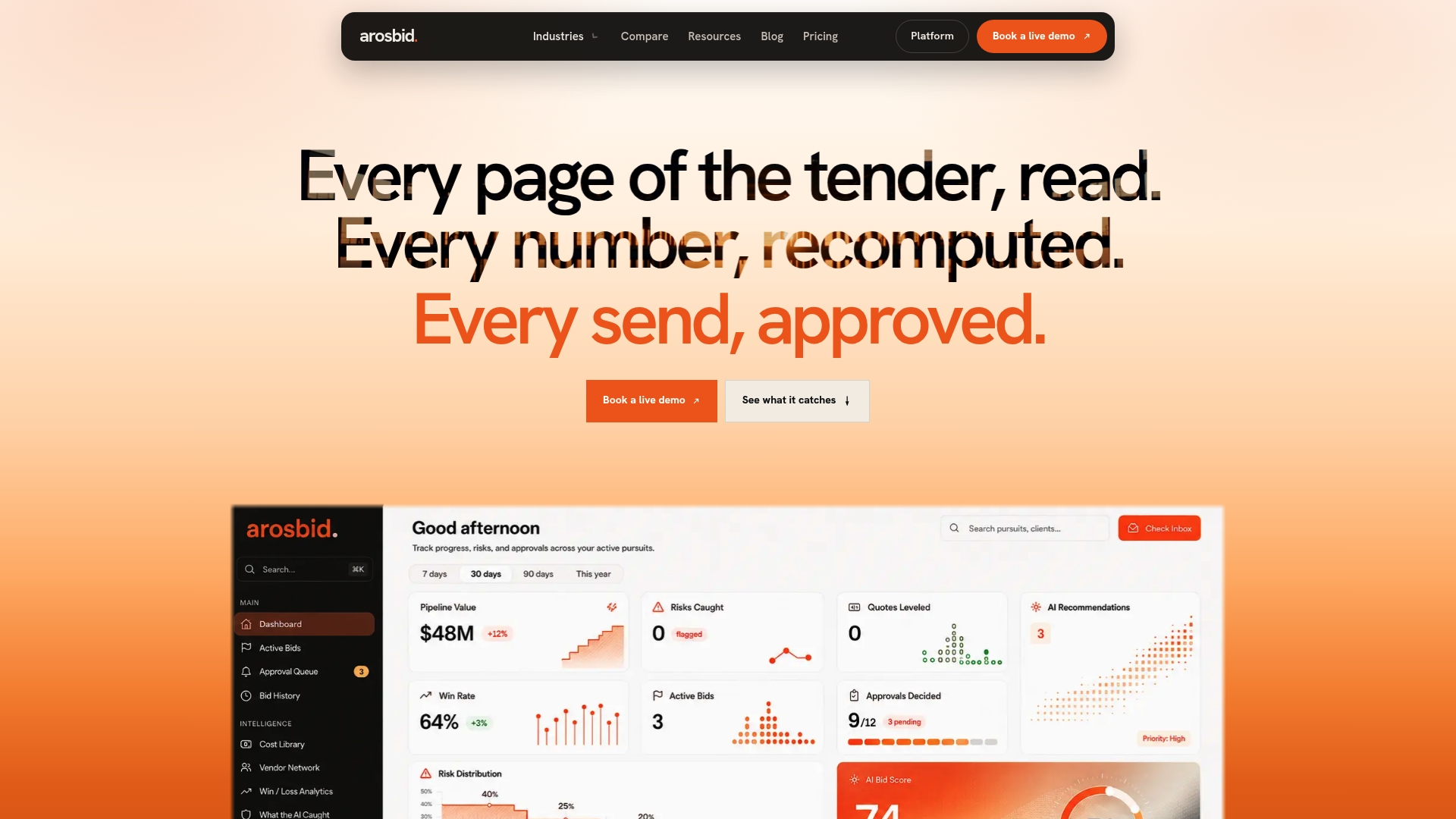
If equipment pricing, vendor quotes and spec review currently live in separate files and inboxes, ArosBid’s construction estimating and bidding software handles takeoff, estimate, vendor quote leveling, compliance checks and proposal assembly in one place, with integrations for Excel, Outlook and major takeoff, cost and project management tools. Plans are listed on the pricing page, and you can book a live demo to see it on your own trade.
Mechanical and electrical teams that price rented lifts, cranes and tools inside trade bids can start from our mechanical estimating and bid software or the electrical estimating page.
FAQ
How do you calculate the cost of a machine per hour?
Add the ownership rate and the operating rate. Ownership is depreciation (purchase price minus salvage, divided by useful hours) plus interest, insurance and taxes spread over annual hours. Operating is fuel, lubricants, repairs and tires. The operator is priced separately as labor.
What is the 0.6 rule for cost estimating?
It scales a known equipment cost to a new capacity: multiply the known cost by the capacity ratio raised to about 0.6. Doubling capacity raises cost by roughly half. It suits early budgets, and a vendor quote should replace it before the final bid.
Should operator cost be included in the equipment rate?
The ASPE guide recommends keeping it out and pricing operators as labor at loaded rates, since one operator may run several machines and wages are set by agreements or prevailing wage rules. This also avoids counting the same person twice.
Where does mobilization go?
ASPE suggests covering mobilization in general conditions instead of the hourly rate. Whichever place you choose, price both the trip in and the trip home, and note the choice in your basis of estimate.
Sources
- Idaho Transportation Department, Construction Cost Estimating Guide
- US Army Corps of Engineers, EP 1110-1-8 Vol. 12
- US Army Corps of Engineers, EP 1110-1-8 Vol. 6
- Construction Business Owner, What Is Your Equipment’s True Cost?
- HSM University, Equipment pricing: owning, operating and rental costs
- ASPE, The Essentials of Successful Estimating
- Construction Equipment, Calibrating Equipment Rates
- Construction Equipment, Rent or Buy Depends on Utilization
- Pennsylvania Turnpike Commission, Cost Estimating Manual
- Quotor, How to Estimate Equipment Cost in Construction
- Equipment Link, Industrial Equipment Cost Guide: Buy or Rent
- Lecture notes on capital cost estimation
- Cost Engineering Techniques and Their Applicability
- National Park Service, Cost Estimating Requirements Handbook
- TMF, How to Cost Equipment Into a Quote