Stop Bad Bids Fast: 6 Go No Go Criteria and Templates for Construction
Stop Bad Bids Fast: 6 Go No Go Criteria and Templates for Construction ! Decorative construction bid decision title card A defensible go/no-go decision rests on six categories: financial, strategic, technical, market, risk, and readiness.

A defensible go/no-go decision rests on six categories: financial, strategic, technical, market, risk, and readiness. Score each one against a pre-agreed weighted checklist before the meeting starts, set your pass thresholds in advance, and write the outcome down. Skip that prep work and every gate review turns into a debate about feelings instead of evidence.
TL;DR:
- Building a pre-weighted, thresholds-based decision matrix before review prevents debates based on feelings and ensures evidence-driven gate reviews.
- Financial assessments should include worst-case scenarios, and a project that fails at a low-probability threshold should be conditionally approved pending de-risking.
- Must-have criteria, such as permits or rollback plans, should be disqualifiers that can immediately veto a go decision.
- Consistent documentation of scores, rationale, and conditional conditions are essential to maintain integrity and avoid goalpost shifts.
- Automated evidence collection platforms like ArosBid help streamline the process, ensuring review scores reflect actual project readiness without scattered manual checks.
Table of Contents
- What Are the Core Go/No-Go Criteria for a Project?
- How Do You Build a Weighted Go/No-Go Decision Matrix?
- What Goes in a Go/No-Go Meeting Checklist and Decision Record?
- What Do Real Go/No-Go Scoring Examples Look Like?
- What Mistakes Undermine a Go/No-Go Decision?
- How Does ArosBid Apply Go/No-Go Criteria to Construction Bids?
- When Should You Actually Say No-Go?
- Run Your Next Gate Review Without the Guesswork
- Sources
What Are the Core Go/No-Go Criteria for a Project?
Every credible gating model traces back to five or six recurring dimensions. Research on 77 highly innovative product launches found that go/no-go criteria consistently cluster into strategic fit, technical feasibility, customer acceptance, market opportunity, and financial performance, and that the weight given to each one shifts as a project moves through development gates. Early on, strategic fit and technical feasibility dominate. By the later gates, financial performance and market validation carry more weight because you finally have real numbers instead of projections.
Here’s what to actually check under each category.
- Financial. Look at net present value (NPV), internal rate of return (IRR), and simple payback period. Don’t just model the expected case (P50); model a downside scenario (P10) and ask whether the project still survives a bad quarter.
- Strategic. Does the project reinforce a market position you’re already trying to build, or does it just look busy? Weigh opportunity cost: what else could this budget and team fund instead?
- Technical. Working prototypes, user acceptance testing (UAT) pass rates, open defect counts by severity, and a written rollback plan. If nobody can describe how to undo the change safely, the project isn’t ready for a gate review at all.
- Market. Signed letters of intent, pre-orders, or a documented set of customer interviews carry far more weight than a market-size slide deck. Validated demand beats projected demand every time.
- Risk. Regulatory exposure, vendor lock-in, and single-customer revenue dependency top the list. Each identified risk needs a named mitigation, not just an acknowledgment that it exists.
- Capability and readiness. Staffing levels, completed training, approved standard operating procedures (SOPs), and confirmed support coverage for launch day.
Pro Tip: Score financial viability with a probability range instead of one number. A project that clears NPV at P50 but collapses at P10 isn’t a clean go. It’s a conditional go pending a de-risking step.
Decision-support literature backs a two-track approach here: use exploratory tools like impact analysis and force-field analysis to surface what you don’t know yet, then switch to decision tools like cost-benefit analysis and decision trees to actually make the call. MindTools’ guidance on go/no-go decisions is explicit that sunk costs should never enter that second-stage calculation. Money already spent tells you nothing about whether the remaining spend is worth it.
How Do You Build a Weighted Go/No-Go Decision Matrix?
A go/no-go matrix works only if it’s built before anyone looks at the evidence. Build it backwards, not forwards.
- Separate disqualifiers from trade-offs. Some criteria are must-haves: fail one, and no score elsewhere saves the project. A permitting requirement you can’t meet is a disqualifier, not a deduction. Decision-framework guidance from Incertive recommends locking this must-have list before scoring begins, precisely so nobody can quietly downgrade a dealbreaker into a “minor concern” mid-meeting.
- Assign weights to the should-haves. A paired comparison, where you judge each criterion against every other one and tally the wins, works better than guessing percentages out of thin air. It forces you to actually decide whether technical feasibility matters more than market validation for this specific project, rather than defaulting to an even split.
- Set your pass threshold before you see the scores. One widely used model scores each criterion from 1 to 5 and requires critical criteria to hit at least 4 to pass, per the scoring approach in Gonogo. Whatever numbers you pick, write them down and date them.
- Run a sensitivity check. Nudge your weights by 10% in each direction and see if the recommendation flips. If a small weighting change changes the verdict, you don’t have a decision. You have a coin flip dressed up in a spreadsheet.
Document the rationale for every weight, not just the final score.
Pro Tip: If your gate review keeps producing split votes, the problem usually isn’t the project. It’s that your weights were never agreed on before the meeting, so everyone is silently applying their own.
What Goes in a Go/No-Go Meeting Checklist and Decision Record?
The meeting itself should be short if the homework got done. A production-readiness checklist built around yes/no questions with adjustable weights, similar to the Projectmanagement, gives reviewers a structure they can move through in under an hour instead of re-litigating scope from scratch.
Group your checks into three buckets:
- Technical: UAT approval rate, count of open critical defects, completed security scan, and a confirmed rollback plan.
- Operational: training completion rate, support team readiness, and signed-off SOPs.
- Financial: spend-to-date versus budget, remaining contingency reserve, and schedule variance.
Any single failed item in a showstopper category should force a No-Go or Conditional Go outright, regardless of how well everything else scored.
| Check Category | Example Item | Pass Signal |
|---|---|---|
| Technical | UAT pass rate | most test cases signed off |
| Technical | Rollback plan | Documented and tested |
| Operational | Staff training | all frontline team certified |
| Financial | Contingency remaining | At least 10% of budget untouched |
Close every gate with a written decision record, not a verbal agreement. A go/no-go decision record template should capture the choice (Go, Conditional Go, or No-Go), the specific conditions attached, a named owner for each condition, and a recheck date. The same guidance is blunt about one non-negotiable: never enter a go/no-go meeting without a verified rollback plan already in hand.
What Do Real Go/No-Go Scoring Examples Look Like?
Numbers make this concrete faster than any explanation.
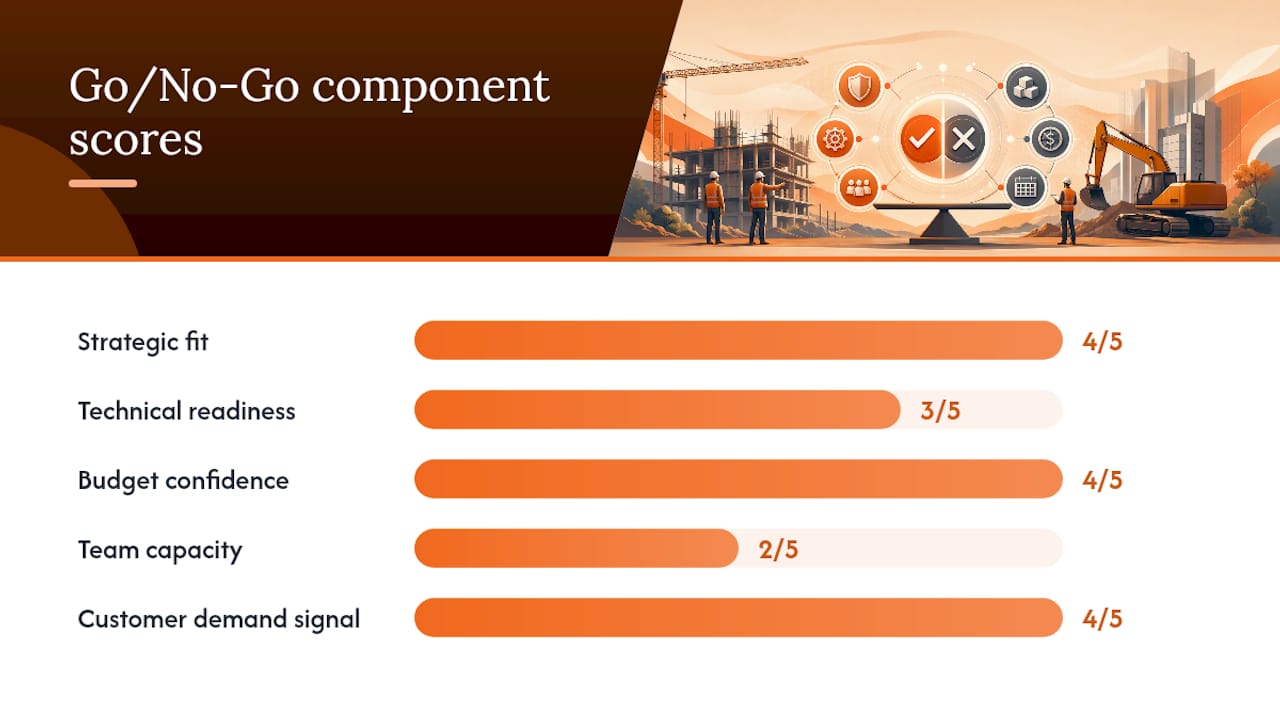
- Strategic fit: 4/5
- Technical readiness: 3/5
- Budget confidence: 4/5
- Team capacity: 2/5
- Customer demand signal: 4/5
Weighted total: 3.4 out of 5, against a pass threshold of 3.5. That’s a No-Go, or more precisely a “fix team capacity first” No-Go. One weak input dragged an otherwise strong project below the line, which is exactly what the threshold is supposed to catch.
Larger construction bid, probabilistic financial threshold: Here you’re not scoring a single financial number. You’re scoring a range. If projected margin at P50 clears your target but margin at P10 (the pessimistic case) turns negative, that’s a Conditional Go pending a value-engineering pass on materials cost, not a clean approval.
When a score lands right on the line, don’t force a verdict either way. Scope a timeboxed “WAIT” experiment instead, a two to four week test with one specific hypothesis and a measurement plan, following the approach Gonogo for borderline outcomes. File your scoring templates and decision records in one shared location so the next gate review starts from a known format instead of a blank page.
What Mistakes Undermine a Go/No-Go Decision?
Sunk-cost bias is the most common failure mode in gate reviews, and it’s rarely disguised as sunk-cost bias. It shows up as “we’ve already invested six months, let’s just push through.” The fix isn’t a lecture on rationality. It’s a rule: money and time already spent don’t enter the scoring model at all.
A close second is shifting the goalposts mid-review, quietly lowering a threshold once the evidence comes in weak. That’s why weights and pass thresholds get locked before anyone opens the evidence.
- Bring in at least one reviewer with no stake in the project’s success to challenge optimistic assumptions.
- Keep an audit trail of who scored what and why, especially for major capital gates.
- Document every conditional approval with a specific verification step and a deadline, not a vague “revisit later.”
Pro Tip: If a project has failed a gate twice already, the third review should require a new reviewer. Teams that have said Go before tend to keep finding reasons to say it again.
How Does ArosBid Apply Go/No-Go Criteria to Construction Bids?
Bid/no-bid decisions in construction carry the same six-category logic, just compressed into a tighter timeline and higher stakes per bid. ArosBid’s bid/no-bid workflow automates the checks that most often get skipped under deadline pressure: missed addenda, conflicting specifications, and clause-level compliance gaps that trigger disqualification after submission.
The platform’s command center feeds gate evidence directly into the review instead of forcing an estimator to hunt for it:
- Tracked approvals show exactly where a bid stands in the sign-off chain.
- Vendor quote leveling surfaces pricing gaps between subcontractor quotes before they become a margin surprise.
- Document compliance checks flag missing addenda before the bid ever reaches a reviewer’s desk.
A typical conditional-go pattern is this: documentation checks clear, but vendor quotes still need leveling before the number is trustworthy. That becomes a named action, assigned to an estimator, with a recheck date, exactly the discipline a formal decision record demands.
When Should You Actually Say No-Go?
Say No-Go when a must-have criterion fails outright, not when the overall score just feels low. A single missing permit or an unverified rollback plan should end the conversation regardless of how good the financial case looks. Say Go only when every must-have clears and the weighted score beats your pre-agreed threshold with room to spare, not by a hair.
Scope a Wait experiment tightly: one hypothesis, one measurement, one deadline. “We’ll get three more customer interviews by Friday and re-score” works. “Let’s keep an eye on it” does not. Vague follow-ups are how No-Go decisions quietly become Go decisions with no new evidence at all.
— Rohan
Run Your Next Gate Review Without the Guesswork
Everything in a solid go/no-go matrix depends on having real evidence at the table, and that’s where most construction teams lose time: chasing down addenda, comparing subcontractor quotes line by line, and confirming compliance manually before a bid deadline. Arosbid builds that evidence trail automatically. Document compliance checks, vendor quote leveling, and tracked approvals all live in one command center, so your readiness and risk scores at gate time reflect what’s actually true, not what someone remembers from a phone call last week.
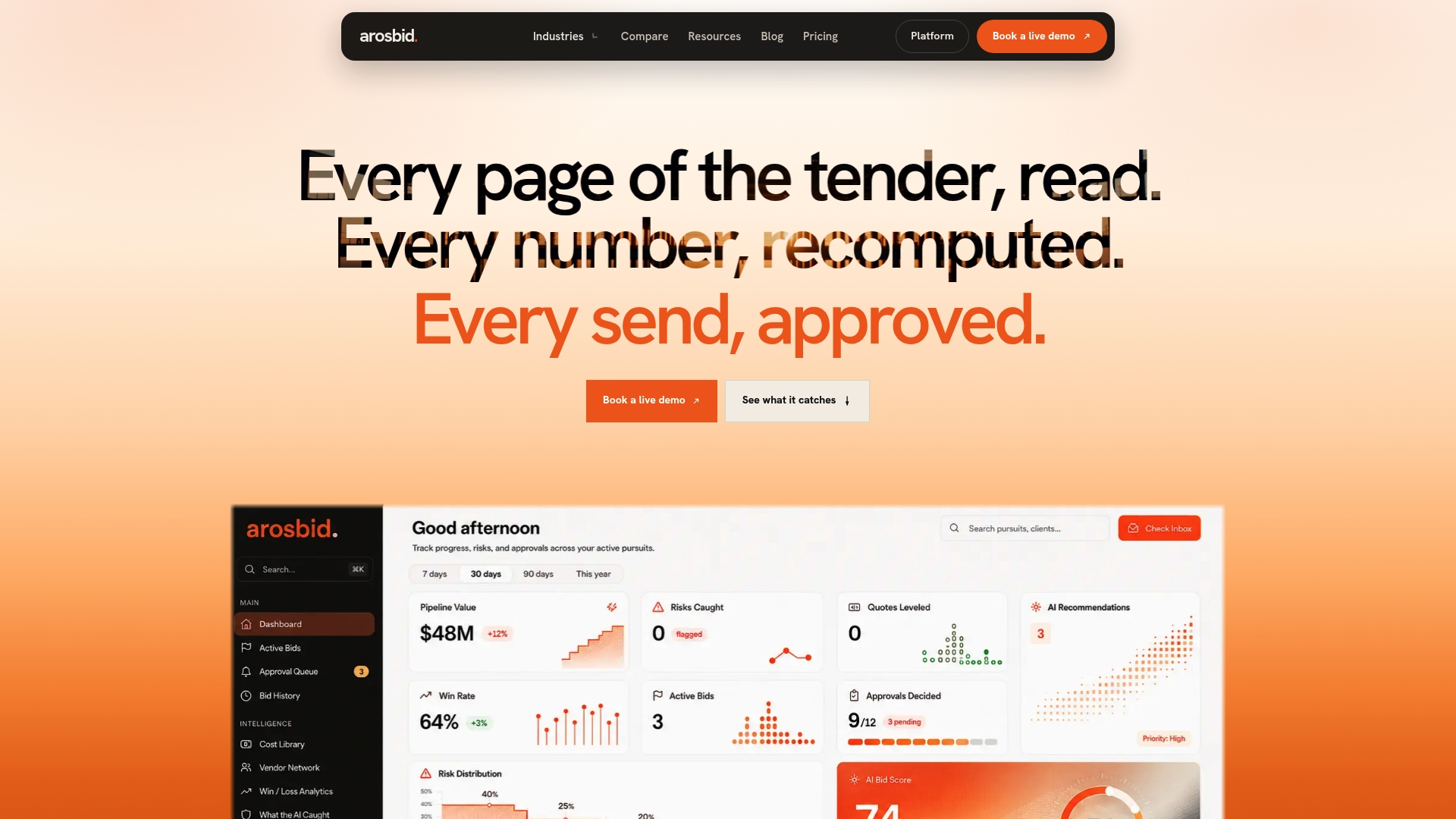
If your team is still assembling gate evidence from scattered spreadsheets and email threads, see how ArosBid’s construction bid management software centralizes that work, or book a live demo to walk through a bid/no-bid decision on one of your own upcoming projects.
Sources
For deeper reading beyond this guide, the original study on go/no-go criteria across 77 innovative products remains the clearest academic breakdown of how criteria weighting shifts by gate. The production-readiness checklist from ProjectManagement.com offers a ready-to-adapt template, and the decision record template from PM Resource Hub covers the documentation side in full.
- Criteria employed for go/no-go decisions when developing successful highly innovative products
- Go/No-Go Decision Framework for Business Leaders | Incertive
- Go/No-Go Decisions — MindTools
- Projectmanagement
- Gonogo