Improve Bid Accuracy Without Cutting Margin: 8 Checks for Estimators
Improve Bid Accuracy Without Cutting Margin: 8 Checks for Estimators ! Bid accuracy title card illustration The fastest way to improve bid accuracy is to combine a defensible basis of estimate, digital takeoff with saved assemblies, routine estimate-versus-actual tracking, and a mandatory pre-submission contract review.

The fastest way to improve bid accuracy is to combine a defensible basis of estimate, digital takeoff with saved assemblies, routine estimate-versus-actual tracking, and a mandatory pre-submission contract review. Support those four with standardized templates, written vendor quotes, and a peer check on high-dollar items. Purpose-built estimating workflows consistently outperform consumer chatbots when the goal is bid-ready numbers, not quick drafts.
TL;DR:
- Combining a clear basis of estimate, digital takeoff, and routine tracking reduces bid errors caused by missed scope items or unpriced allowances.
- Using purpose-built estimation tools with OCR, spec tracking, and source-linked citations improves accuracy over general chatbots, which often miscount or omit details.
- Regular post-job variance analysis by trade helps identify biases and calibrate unit rates, leading to ongoing estimate improvement within ±3% to 5% target ranges.
- Implementing a disciplined pre-bid scope check and a final “submit only when” list catches last-minute mistakes and fatigue-related errors before submission.
- Establishing a fixed minimum margin and updating contingency based on market signals prevents profitability erosion during volatile conditions.
Table of Contents
- 8 practical tactics to catch missed scope and tighten your bids
- Tools and workflows: purpose-built platforms versus general AI
- How to measure and report estimate accuracy
- Write a defensible basis of estimate that reduces surprises
- Takeoff and data hygiene: common errors and how to prevent them
- Closeout, post-job review, and data calibration
- Managing market volatility and contingency without breaking your floor
- Where the ArosBid team lands on all of this
- See the ArosBid workflow on your next bid
- FAQ
- Sources
8 practical tactics to catch missed scope and tighten your bids
Most bid losses trace back to a handful of repeatable gaps: missed addenda, unpriced allowances, or a scope item nobody owned. A short, disciplined checklist closes most of them before submission.
- Run a pre-bid scope check covering addenda, bonds, allowances, and owner-furnished items.
- Require a peer check on any pay item above your firm’s dollar threshold.
- Build every estimate from standardized templates and a curated unit-rate library.
- Collect written, itemized quotes from major subs instead of verbal numbers.
- Price long-lead items and site-condition risk explicitly, with conservative allowances where data is thin.
- Set a minimum margin floor and a clear rule for when you can tighten it, never a blanket percentage cut.
- Cross-check the final estimate against the contract’s actual submission requirements.
- Run a short “submit only when” list the night before: signatures, addenda acknowledged, quotes attached, math checked.
That last step catches more last-minute errors than people expect, mostly because fatigue sets in right when precision matters most.
Pro Tip: Assign one person to own the “submit only when” checklist on every bid, even a small one, so it never becomes an afterthought under deadline pressure.
Tools and workflows: purpose-built platforms versus general AI
General-purpose chatbots answer quick questions well, but they were not built to process a full bid package. Purpose-built tools provide full-set extraction, spec diff tracking, and clickable citations that a consumer chatbot cannot reliably produce, which matters because a chatbot can skim scanned pages, miscount door schedules, or generate unlinked prose that looks confident but has no source behind it.

One experiment found a very wide spread between four AI models asked to estimate the same apartment renovation bid set, including consistent door-count errors across models. That gap is the verification problem in one number: without a traceable link back to the source document, you cannot tell which number to trust.
Tools worth requiring on any estimate above a minor dollar threshold:
- OCR that reads scanned plan sets, not just digital PDFs.
- Spec-diff and addenda tracking that flags what changed between revisions.
- A persistent risk register and submittal log tied to the project file.
- Vendor quote leveling that normalizes units and scope across bids.
- Native Excel and Outlook integration so the workflow fits existing habits.
A safe sequence: run digital takeoff, auto-populate saved assemblies, collect vendor quotes, level them, run the contract checklist, then route for peer review. Use AI to draft language and flag anomalies, never to finalize a takeoff count without a human checking the source page.
How to measure and report estimate accuracy
You cannot improve what you do not measure, and most firms never close the loop on actual accuracy. The standard formula is straightforward: Accuracy % = (1 − |Estimated Cost − Actual Cost| / Actual Cost) × 100. A Denver estimate of $4.8 million that closed at $5.0 million worked out to 96% accuracy under that formula.
High-performing firms generally target total project variance within a defined band, with tighter tolerance on well-defined work and wider tolerance on complex or early-stage scopes.
| Variance band | What it signals |
|---|---|
| ±3% to 5% | Typical target for a well-documented, repeatable bid |
| — | Acceptable range for complex or less-defined projects |
| — | Signals a systemic estimating failure, not a one-off miss |
Track variance by CSI division or trade, not just at the job level, because that is how you separate a consistent bias (always underpricing drywall) from random error. Computing standard deviation across completed jobs alongside the mean variance shows whether your estimates are both accurate and consistent.
- Measure accuracy at job closeout, every time, not just on large projects.
- Roll up results quarterly by trade and by estimator.
- Trigger a formal review when any division’s variance exceeds your internal limit.
Write a defensible basis of estimate that reduces surprises
AACE recommends a basis of estimate as a required deliverable that documents scope, assumptions, methodology, and supporting data, making the estimate auditable long after the bid is submitted.
A minimum BOE should include:
- The scope and purpose of the estimate, stated plainly.
- Assumptions made where documents were silent or ambiguous.
- Explicit exclusions, so nobody assumes something was included.
- Pricing basis: quotes, historical data, or published unit costs.
- Allowances and their logic, not just a dollar figure.
- Referenced documents and the estimator’s role on the team.
A BOE pays off twice: it supports change-order negotiation when scope shifts, and it gives you a clean reference for post-job calibration. AACE treats estimates as probabilistic ranges rather than single-point numbers, and documenting that range up front reduces disputes later. Prepare the BOE alongside the estimate, not after, and keep the supporting files.
Takeoff and data hygiene: common errors and how to prevent them
Takeoff mistakes cluster around the same items project after project: door and hardware counts, fixture schedules, and waste factors on panelized or linear materials. A quick door-count cross-check against the schedule, and a row-by-row review on your two or three highest-dollar trades, catches most of these before they reach the bid.
Saved assemblies help, but only when paired with a verification gate on anything above your dollar threshold. A standing-seam roofing takeoff workflow that documents cut lists and waste factors by panel up front shows how a saved assembly prevents the same waste-factor mistake from recurring on every job.
- Run a door and fixture count check against the schedule on every bid.
- Lock saved assemblies for major trades and require sign-off to edit them.
- Update unit-rate libraries automatically as closed jobs feed back in.
Pro Tip: Calibrate your unit-rate library every quarter, not once a year, so pricing drift gets caught while it is still small.
Closeout, post-job review, and data calibration
The feedback loop is where most firms leave accuracy gains on the table. A short, repeatable closeout process turns every finished job into better pricing on the next one.
- Build a post-job variance worksheet comparing estimated to actual cost by trade, normalizing for any approved scope changes.
- Feed the results back into your unit-rate library, productivity factors, and contingency guidance.
- Schedule the first review 30 to 60 days after substantial completion, then run a quarterly aggregate analysis across all closed jobs to catch estimator-specific bias.
That quarterly rollup is also where you decide whether a variance is a one-time surprise or a pattern worth fixing in the library.
Managing market volatility and contingency without breaking your floor
Define your floor before the market pressures you into guessing: cost to build, plus a risk allowance, plus your minimum acceptable margin. Owner guidance on contingency planning maps uncertainty to recommended allowance levels by project phase, which is a useful reference point when sizing your own.
- Tighten pricing only where you have a specific market signal, such as a current itemized quote for the material or trade, never across the board.
- Size contingency by project class: less-defined scopes carry a wider allowance than a repeat job with a known unit-rate history.
- Update prices before award if lead times or quotes shift materially after submission, rather than absorbing the gap silently.
Where the ArosBid team lands on all of this
We built our platform around the same discipline this guide describes: automated checks for missed clauses and conflicting specs, paired with human review before anything gets submitted. If you want to see the workflow applied to a real bid set, we are glad to walk through it with you directly.
— arosbid team
See the ArosBid workflow on your next bid
We built ArosBid around the exact gaps this guide addresses: missed addenda, unleveled vendor quotes, and estimates nobody can trace back to a source document. Our platform reads the full bid set including front-end clauses, flags conflicts before submission, and keeps a complete audit trail without asking your team to abandon Excel or Outlook.
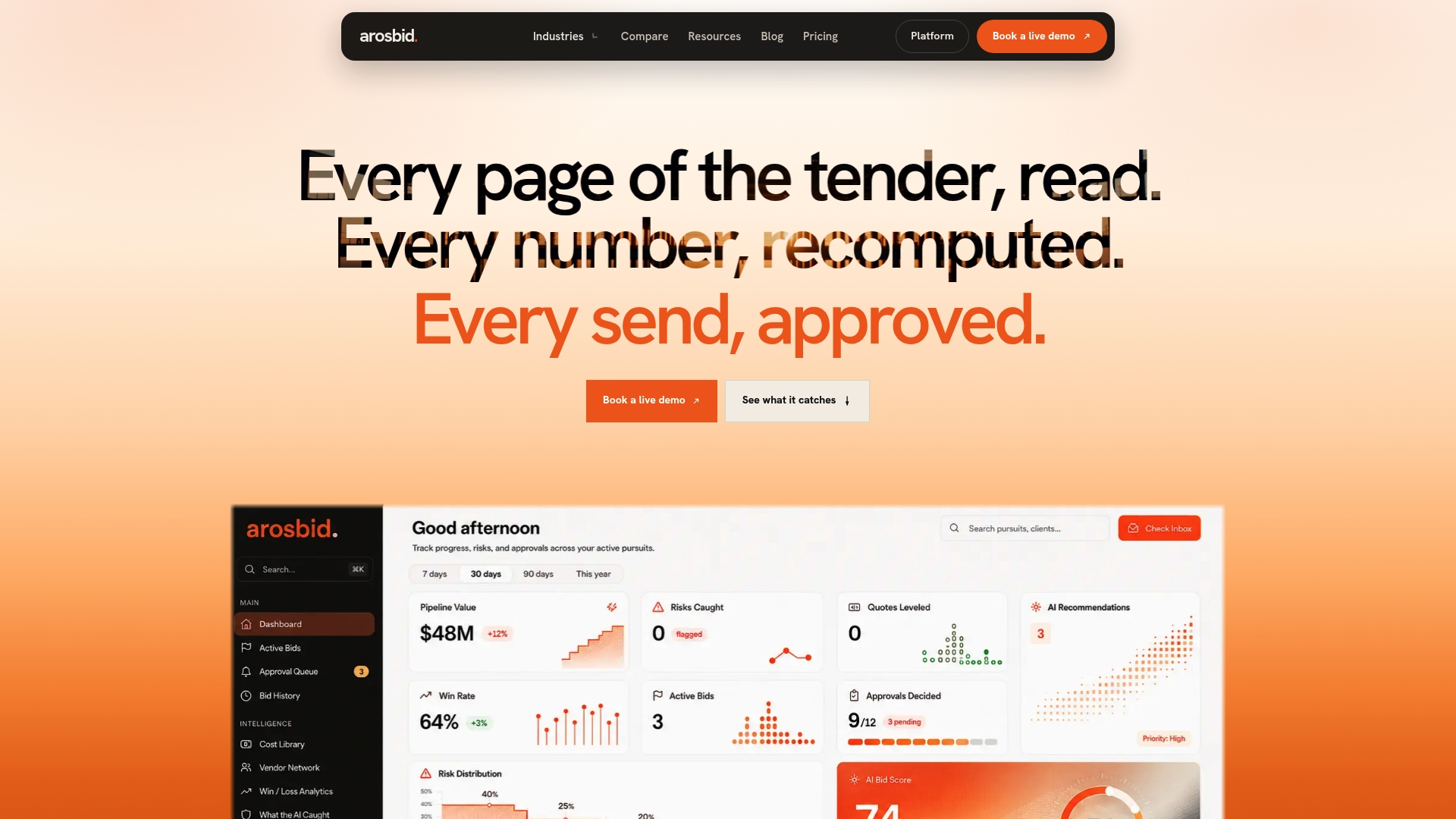
What that looks like day to day:
- Automated spec and clause checks across the entire document set, not a summary.
- Vendor quote leveling that normalizes scope and units before you compare numbers.
- Native Excel and Outlook integration so your existing habits still work.
- A structured command center tracking approvals, compliance, and buyout in one file.
If you want to see it against a real bid, book a live demo or review our plans: One Desk, The Department, and The Whole Year.
FAQ
What are common bidding mistakes to avoid?
The most common mistakes are missing addenda, failing to price owner-furnished items or allowances, and submitting without a final contract cross-check. Most of these get caught by a standardized pre-submission checklist and a peer review on high-dollar items, as described above.
Can ChatGPT do construction estimates?
General-purpose chatbots can help draft language or answer quick questions, but they are unreliable for processing full multi-document bid packages and can miss scanned pages or miscount takeoff items. Purpose-built estimating tools with spec-diff and citation tracking are built specifically to close that verification gap.
What are the most common bidding strategies?
Effective strategies combine a documented basis of estimate, digital takeoff with saved assemblies, written vendor quotes, and routine variance tracking after each job closes. Pairing these with a defined margin floor and a disciplined contingency approach keeps bids competitive without eroding profitability.
How do you ensure accuracy in your estimates?
Accuracy improves most reliably through a combination of standardized documentation, digital takeoff, and post-job variance tracking using the formula Accuracy % = (1 − |Estimated Cost − Actual Cost| / Actual Cost) × 100. Firms that track this by trade and calibrate unit rates quarterly tend to close the gap between estimated and actual cost faster than those relying on a single annual review.
Sources
- 34R-05: Basis of Estimate
- How to calculate accuracy in construction estimating for Colorado and Wyoming bids