6 Phase Bid Compliance Checklist for Construction: Pass/Fail First
6 Phase Bid Compliance Checklist for Construction: Pass/Fail First ! Construction bid compliance checklist title card A complete bid compliance checklist works as a final pass/fail gate before a proposal leaves the building.

A complete bid compliance checklist works as a final pass/fail gate before a proposal leaves the building. It confirms the submission deadline is met with proof, every mandatory form carries the right signature, bid security is attached in the correct amount, addenda are acknowledged, and pricing matches across every document. Miss any one of these and the rest of the proposal never gets read.
TL;DR:
- Timely submission with all required signatures, bid security in the correct form and amount, acknowledgment of all addenda, and matching pricing are critical to prevent disqualification.
- Failures such as missing deadlines, unsigned forms, incorrect bid bonds, or unacknowledged addenda are the most common and easily avoidable disqualifiers.
- Conducting detailed checks on eligibility, bid security, and required documentation before technical or pricing review minimizes last-minute errors.
- Automation tools like AI review platforms streamline compliance verification, track approvals, and flag inconsistencies in pricing or documentation.
- Maintaining an updated, owner-assigned compliance checklist and proper record keeping ensures readiness and legal defensibility if rejected or challenged.
Table of Contents
- 1. What a bid compliance checklist does and who owns it
- 2. Why bids get disqualified: the common failure modes
- 3. Phase 1: requirements and eligibility compliance
- 4. Phase 2: content quality and evaluation fit
- 5. Phase 3: pricing accuracy and commercial checks
- 6. Phase 4: legal, approvals, and internal sign-offs
- 7. Phase 5: formatting, packaging, and submission logistics
- 8. Phase 6: final verification and record keeping
- 9. Keep the checklist current: update cadence and triggers
- 10. How ArosBid helps enforce a compliance checklist
- 11. Steps to remediate non-compliant bids before submission
- 12. The role of compliance in bid evaluation and award outcomes
- ArosBid team’s practical view on adoption
- Try ArosBid for compliance checks that run themselves
- FAQ
- Sources
1. What a bid compliance checklist does and who owns it
A bid compliance checklist is a structured screening tool that confirms a proposal meets every mandatory administrative requirement before evaluators ever score the technical or commercial content. It exists because most procurement processes separate requirements into two buckets: mandatory, pass/fail items and point-rated criteria that get weighted and scored, as outlined in Canada. Ownership usually spans three roles on a bid team.
- The estimator confirms pricing accuracy and supporting cost data.
- The proposal manager owns document assembly, formatting, and submission logistics.
- A procurement or compliance lead signs off on legal forms, bonds, and final eligibility.
2. Why bids get disqualified: the common failure modes
Most disqualifications trace back to a short list of repeat offenders, and nearly all of them are avoidable with a checklist run early enough to fix problems.
- Submitting after the published deadline, since jurisdictional cut-offs are strict and rarely negotiable.
- Leaving a mandatory form blank or unsigned by an authorized representative.
- Omitting bid security or submitting a bond that does not match the required form or amount.
- Failing to acknowledge one or more addenda, or letting pricing drift between the summary sheet and the detailed schedule.
- Submitting the wrong file format, a mislabeled file name, or using a delivery method the solicitation does not allow.
Failure to provide required bid bonds or submit on time often results in immediate disqualification in federal and public procurement, according to bid and proposal submission requirements from The University of Texas System. Deadlines in particular are treated as jurisdictional: a bid that arrives one minute late is often rejected without any review of its content at all.
3. Phase 1: requirements and eligibility compliance
This phase covers the hard pass/fail items that determine whether a bid is even responsive. Nothing here is subjective, which is exactly why it has to be checked first and checked carefully.
- Confirm eligibility documents are current, including any required non-blacklist or good-standing declarations.
- Verify bid security is present, correctly formed, and matches the amount and validity period stated in the solicitation.
- Check that every mandatory form is complete and carries a signature from someone authorized to bind the company.
- Confirm financial capacity requirements, such as an NFCC calculation or a required line of credit, are met and documented when the solicitation calls for them.
- Record acknowledgment of every addendum, noting the source and date each update was received.
A bid security, such as a bond or guarantee, should match the form, amount, and validity period specified in the solicitation, with substitution rules such as a committed letter of credit varying by procurement rules, per sample instructions to bidders from PRC bidding documents. When financial capacity figures are required, prepare audited statements and any NFCC computation well before the deadline, since authentication requirements can add days.
Pro Tip: Keep a running log of every addendum with its issue date and your acknowledgment date side by side, so a reviewer can confirm compliance in seconds rather than hunting through email threads.
4. Phase 2: content quality and evaluation fit
Once the administrative gate is cleared, the next job is making sure the proposal actually answers what the buyer is asking for, in the buyer’s own words. A staged evaluation approach separates preliminary compliance checks from the detailed rated evaluation, and bids that fail the preliminary stage never reach the scoring table, as described in guidance on evaluating bids with rated criteria from the World Bank. That makes the mapping step below just as important as the pass/fail checks.
- Map each solicitation criterion to a specific section of the response, using the solicitation’s own language rather than paraphrasing.
- Confirm supporting evidence exists for every point-rated item, such as method statements, resumes, or safety plans.
- Cross-check technical claims against attachments so a safety record cited in the narrative matches the certificate in the appendix.
- Verify the response follows any required structure, page limits, and section headings specified in the instructions to bidders.
Buyers increasingly weight criteria like social value, sustainability, or innovation, and bidders who fail to echo the solicitation’s exact terminology often score lower even when the underlying content is strong.
5. Phase 3: pricing accuracy and commercial checks
Pricing errors are among the most common reasons a technically strong bid loses points or gets flagged for clarification, so this phase deserves a dedicated pass separate from the technical review.
- Reconcile the summary sheet, the bill of quantities, and any priced schedules line by line to confirm totals agree.
- Check unit price extensions, applicable taxes, allowances, and currency assumptions for arithmetic errors.
- Confirm the price validity period meets the solicitation’s requirement and flag any priced options or alternates clearly.
- Verify every vendor or subtrade quote used to build the price is current and consistent with what was actually included in the scope.
Pro Tip: Run your final price reconciliation at least 24 hours before submission, not the night before, so a discrepancy still leaves time to track down the source document.
6. Phase 4: legal, approvals, and internal sign-offs
A technically compliant bid still needs internal clearance before it goes out the door, since the company has to be able to lawfully perform the contract if it wins.
- Confirm legal, finance, and executive sign-off are captured, not just assumed, before the proposal is finalized.
- Log any exceptions taken to the contract’s terms and conditions, along with the business reason for each one.
- Verify insurance certificates and any performance security commitments match what the solicitation requires.
7. Phase 5: formatting, packaging, and submission logistics
Technical rejections, as opposed to content-based ones, tend to come from small formatting mistakes that have nothing to do with the quality of the proposal itself.
- Confirm every file format and file name matches the solicitation’s instructions exactly, down to capitalization if specified.
- Open every attachment to confirm it isn’t corrupted, and create an unzipped copy if the portal requires one.
- Prepare physical submission envelopes where required and label them exactly as instructed, including reference numbers.
- Test the upload portal in advance, confirm file size limits, and save a timestamped confirmation receipt once submitted.
A practical habit worth building into every submission cycle: test that every attachment opens and that its name matches the listed filename before packing the final set, since mismatched or corrupted files are a routine cause of technical rejection.
8. Phase 6: final verification and record keeping
Submission is not the end of compliance work. A timestamped proof of submission belongs in the project record immediately, before memory of the exact sequence fades.
- Capture and store timestamped proof of submission, whether that’s a portal receipt, a courier slip, or an email confirmation.
- Archive signed originals and scanned copies in a controlled, access-limited folder.
- Log who reviewed each section, what they checked, and the reasoning behind any approved exceptions.
- Build a debrief-ready folder in advance so clarification requests or standstill period questions can be answered quickly.
Well-documented records and a clear audit trail are considered best practice specifically because they support debriefs and withstand legal scrutiny, with retention periods of three years or longer common in public procurement, according to bid evaluation guidance from the UK Government.
9. Keep the checklist current: update cadence and triggers
A checklist that never changes eventually misses something new. Revisit it on a regular rhythm, not just when something breaks.
- Update the checklist after every major bid, and especially after a losing debrief that reveals a gap.
- Refresh it whenever solicitation templates or jurisdictional rules change.
- Keep a short version for small bids and a detailed version for complex, high-value ones.
10. How ArosBid helps enforce a compliance checklist
Running this checklist by hand across spreadsheets and email threads is where most of the gaps creep in. We built our AI tender review to read full solicitation documents, including front-end clauses, and flag missed items before they become disqualifications, while keeping a human in control of every decision.
- Our platform tracks approvals and sign-offs through a structured workflow instead of scattered email chains, visible from the Trade Bid Command Center.
- Vendor and subtrade quotes get leveled side by side, which catches the kind of pricing inconsistency that Phase 3 is built to find.
- Every check, approval, and exception is logged automatically, creating the audit trail that Phase 6 asks for without extra manual work.
11. Steps to remediate non-compliant bids before submission
Finding a gap during final review is not a crisis if there’s still time on the clock, but it does require a clear process rather than a scramble. Start by isolating exactly which requirement is unmet: a missing signature, an unacknowledged addendum, or a pricing mismatch each call for a different fix.
For a missing or incorrect bid security, contact the surety or financial institution immediately, since reissuing a bond can take longer than expected and the validity period has to match the solicitation exactly. For an unsigned form, confirm who holds signing authority and get the physical or digital signature captured before the portal closes, not after.
A pricing discrepancy found late usually means re-running the reconciliation between the summary sheet and the detailed schedule to find where the numbers diverged, then correcting every downstream document that referenced the wrong figure. If an addendum was missed entirely, check whether the solicitation allows a short cure period or requires a formal request for an extension, since not every jurisdiction treats this the same way.
The underlying fix, though, is catching these issues before they become last-minute emergencies. A compliance matrix built directly from the tender documents, as described in guidance on building a compliance matrix from tender documents, gives a team a single reference point to check every requirement against the draft response well before the deadline, rather than discovering gaps during a final read-through.

12. The role of compliance in bid evaluation and award outcomes
Compliance is not a separate hurdle from winning. It is the gate a bid has to clear before it is even eligible to win. A staged evaluation model filters out non-responsive bids at the preliminary stage, and those bids never reach the detailed technical and price evaluation where the actual award decision gets made, per the World Bank’s guidance on rated criteria.
This means a technically excellent proposal with strong pricing can lose entirely over a missing signature or an unacknowledged addendum, regardless of how well it would have scored otherwise. Rejection at the preliminary stage has to be justifiable, which is one reason procurement teams increasingly document their compliance decisions as carefully as their technical scoring.
On the buyer’s side, a robust evaluation process commonly involves at least two independent evaluators and a moderator working toward a consensus score, with any changes to that score documented clearly, as outlined in the UK Government’s bid evaluation guidance. For bidders, understanding this process is useful beyond compliance alone: a clean, compliant submission reaches the people scoring technical merit faster and gives them less reason to second-guess the rest of the package. Procurement reviewers often point out that compliance and persuasion work together rather than separately: clearing the compliance gate gets a proposal into the room, but scoring well still depends on tying win themes directly to the evaluation subfactors named in the solicitation.

ArosBid team’s practical view on adoption
A compliance checklist only works if people actually use it under deadline pressure. Keep the administrative gate short, give it one named owner, and update it right after every bid, win or lose.
— arosbid team
Try ArosBid for compliance checks that run themselves
The platform is designed so the checklist above doesn’t live in someone’s head or a scattered spreadsheet. Our AI tender review catches missed clauses and addenda automatically, our approvals workflow keeps legal and finance sign-off visible in one place, and our vendor quote leveling flags pricing inconsistencies before they reach your final numbers.
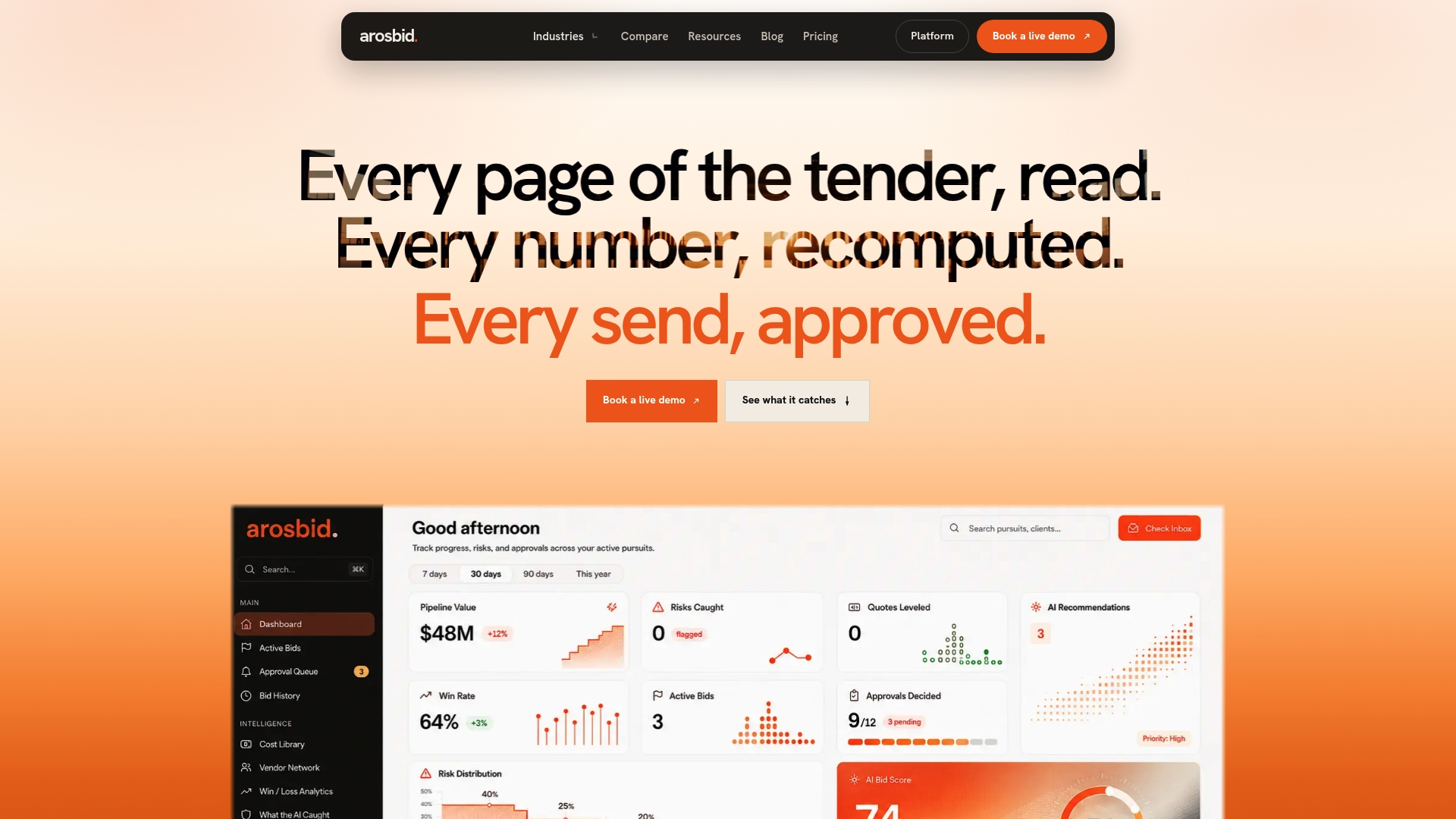
- AI tender review functionality can flag missed mandatory forms and unacknowledged addenda before submission.
- Approvals workflows replace scattered email chains with visible, logged sign-off trails.
- Vendor quote leveling features catch pricing mismatches across subtrade quotes before bids are submitted.
See how it fits your bid process on our pricing page, or book a live demo to walk through it with your own documents.
FAQ
How do you make a compliance checklist?
Start by listing every mandatory requirement from the solicitation, separating pass/fail items like deadlines and bid security from point-rated criteria that get scored. Organize the list into phases, such as eligibility, pricing, legal sign-off, and submission logistics, and assign a single owner to each phase.
What is bid compliance?
Bid compliance means a proposal meets every mandatory requirement stated in a solicitation, from deadlines and signatures to bid security and addenda acknowledgment. A compliant bid passes the preliminary screening stage and becomes eligible for detailed technical and price evaluation, per the World Bank’s rated criteria guidance.
What are the main steps in a bidding process?
A typical bidding process moves through identifying and qualifying the opportunity, preparing the technical and commercial response, running internal compliance and approval checks, submitting the bid before the deadline, and participating in clarifications or debriefs after evaluation. The exact steps and terminology vary by jurisdiction and solicitation type.
What is a due diligence checklist in bidding?
A due diligence checklist in bidding confirms a company has reviewed the contract terms, financial exposure, insurance obligations, and any exceptions before committing to a bid. It typically overlaps with the legal and approvals phase of a compliance checklist, since both confirm the bidder can lawfully and safely perform the contract if awarded.
How does ArosBid help track bid compliance?
Our platform logs approvals, flags missed addenda, and levels vendor quotes automatically through a structured command center, creating an audit trail as the bid moves through each phase. Pricing details for our One Desk, The Department, and The Whole Year plans are available on our pricing page.
Sources
- Bid and proposal submission requirements | The University of Texas System
- Evaluating bids and proposals with rated criteria | World Bank (2025)
- Bid evaluation guidance note | UK Government (May 2021)
- Canada