Run a 2–5 Bid Pilot for Automated Bid Review, Make Awards Defensible
Run a 2–5 Bid Pilot for Automated Bid Review, Make Awards Defensible ! Automated bid review title card illustration Automated bid review is software that reads submitted construction proposals, normalizes them into comparable line items, flags missing clauses or pricing outliers, and levels vendor quotes so estimators compare apples to apples before award.
Automated bid review is software that reads submitted construction proposals, normalizes them into comparable line items, flags missing clauses or pricing outliers, and levels vendor quotes so estimators compare apples to apples before award. The main payoff is speed with a paper trail: reviewers can cut manual bid prep from weeks to days while keeping a documented, human-approved decision on every flag. One platform built specifically for this pairs extraction with estimator oversight rather than replacing judgment with a black box.
TL;DR:
- Automated bid review can cut bid preparation time from weeks to days by automating data extraction and normalization, especially on large, complex projects.
- The system captures 85 to 95 percent of scope correctly on first pass, with flags for missing items, scope conflicts, and outliers linked to source documents for review.
- Estimators gain more time to focus on risk assessment and pricing accuracy, reducing costly errors like missed scope items and uncompetitive bids.
- Pilot projects should be small, involving non-critical pursuits, with success metrics tracked over one to twelve weeks before full deployment.
- Data security and confidentiality are critical, requiring role-based access, encryption, and retention policies to protect sensitive vendor and competitor information.
Table of Contents
- How Automated Bid Review Fits Your Estimating Workflow
- What’s Inside an Automated Bid Review System
- Benefits and ROI: What Actually Changes for Your Team
- Running a Pilot: Your Implementation Checklist
- Keeping Your Bid Review Defensible and Auditable
- Keeping Bid Data Secure and Confidential
- Handling Different Bid Formats Across Contractors and Regions
- Getting Your Team to Actually Trust the New Process
- ArosBid Team Perspective: Why Adopt Automated Bid Review Now
- How ArosBid Handles Extraction, Leveling, and the Audit Trail
- Sources
- FAQ
How Automated Bid Review Fits Your Estimating Workflow
Automated review doesn’t replace your estimating team. It sits between intake and award, doing the reading so your estimators can do the thinking.
The workflow generally runs in four stages: a bid package arrives, software extracts and normalizes the data, an estimator reviews the flagged items, and the team moves to award with a documented trail. Here’s what feeds in and what comes out:
- Inputs: drawings, specs, addenda, and vendor quotes in whatever format they arrive (PDF, Excel, Word, scanned pages)
- Outputs: normalized line items, a leveling matrix comparing bidders side by side, and a flag list for anything missing or inconsistent
- What it doesn’t do: set final pricing or make the award decision — that authority stays with the estimator
Estimators spend 60 to 70 percent of prep time just reading and re-keying data from disparate formats. Automated extraction attacks that specific bottleneck, not the pricing decision itself.
What’s Inside an Automated Bid Review System
Four components do the actual work, and understanding them helps you know what to inspect when something looks off.
Document parsing and scope extraction pulls scope items, quantities, and inclusions or exclusions out of drawings, specs, addenda, and vendor quote PDFs. This is the layer that turns a 40-page proposal into structured data.
Scope normalization maps whatever a vendor calls a line item to your firm’s cost codes or bid template, so “electrical rough-in” from one sub and “rough electrical” from another land in the same bucket for comparison.

The leveling matrix takes normalized data and lines every bidder up against the same scope, producing an apples-to-apples view with page-cited evidence behind each entry, so a reviewer can click a flag and see exactly which page and clause triggered it.
The most important architectural decision in any system is separating deterministic checks from AI-generated reasoning. Deterministic checks (math errors, unbalanced unit prices, missing required line items) always produce the same result for the same input. AI-generated reasoning (interpreting ambiguous scope language, flagging likely exclusions) is probabilistic and needs a different level of scrutiny.
Statistic Callout: First-pass AI extraction on construction bid packages typically captures 85 to 95 percent of scope correctly, according to industry vendor case notes. The remaining slice is exactly where estimator review earns its keep.
- Every AI-generated flag should be labeled as such and link back to the source document page
- Deterministic flags need no such caveat because the logic behind them is fixed and repeatable
- Extraction confidence scores help reviewers triage: a 98 percent confidence item needs a glance, a 60 percent item needs a real look
Benefits and ROI: What Actually Changes for Your Team
The realistic gain isn’t “automation replaces estimators.” It’s that automation reclaims the hours estimators were spending on reading instead of pricing.
Because manual prep burns 60 to 70 percent of total review time on extraction and reading, automating that layer frees estimators to spend more time on risk assessment, unit-price sanity checks, and negotiation strategy. That’s not a marginal shift. It’s the difference between an estimator who skims a spec at 11 p.m. before a deadline and one who actually has time to question a suspicious exclusion clause.
Statistic Callout: Vendor case notes and industry reporting show AI-assisted bid analysis can compress preparation time from weeks to days on large packages, with the biggest gains showing up on document-heavy, multi-trade bids.
Downstream, faster and more consistent review tends to reduce two costly problems: missed scope items that surface as change orders mid-project, and lost opportunities on short-notice bids your team simply didn’t have time to price properly.
- Firms with high bid volume see ROI fastest, since the time saved per bid compounds across dozens of pursuits a month
- Complex, multi-trade projects (mechanical, electrical, structural steel) benefit more than simple single-scope jobs, because manual leveling on those packages is where humans make the most transcription errors
- Smaller firms with low volume still benefit, but the payback period stretches out since fixed setup time gets amortized over fewer bids
Running a Pilot: Your Implementation Checklist
Don’t roll automated review out across your whole pipeline on day one. Test it on a handful of pursuits where a mistake won’t sink a relationship.
- Pick 2 to 5 non-critical pursuits as pilot projects and load historical bid packages so the system has real data to train against.
- Set success metrics before you start: extraction coverage percentage, estimator review time per bid, number of flags resolved versus dismissed, change-order incidence on awarded pilot projects, and any shift in win rate.
- Map your integration touchpoints. Most teams keep intake through Excel and Outlook, then export normalized data via CSV or API into their estimating system. Automated tools generally work upstream of your existing platform rather than forcing a system overhaul.
- Run a training and feedback loop. Expect a tuning window of roughly one to twelve weeks where estimators correct extraction misses and the system adapts to your cost code structure.
- Gate the rollout by project value or bid volume. Start automated review on bids above a certain dollar threshold or on trades where you run the highest volume, then expand once the flag accuracy holds up.
Pro Tip: Run the pilot in parallel with your normal manual process for the first two or three bids, not instead of it. Comparing the automated flags against what your estimator catches manually is the fastest way to build trust in the system, and it gives you real numbers instead of a gut feeling.
A bid/no-bid scoring framework built on location fit, contract risk, client history, trade alignment, and competitive pressure can run before any pricing work starts, screening out pursuits that don’t deserve full estimating effort in the first place.
Keeping Your Bid Review Defensible and Auditable
The whole point of automation falls apart if you can’t explain a decision six months later when a losing bidder asks why they didn’t win.
- Keep deterministic checks visually separate from AI findings, and require every AI flag to carry a document citation and page link
- Log every override with a reason, not just a checkbox, so the reviewer’s judgment is on record alongside the system’s flag
- Store the automated finding and the human override reason together in the award memo, and keep a searchable library of past flags and outcomes for post-mortem learning
- Have one person, not a rotating cast, sign off on final award decisions so accountability doesn’t get diffuse
Pro Tip: Build your reviewer routine around triage, not a linear read-through. Sort flags by severity first (missing required items, then pricing outliers, then minor formatting issues) so your best reviewer time goes where the risk actually lives.
Keeping Bid Data Secure and Confidential
Bid packages contain your vendor pricing, your markup strategy, and often a competitor’s confidential numbers if you’re leveling sub quotes across multiple trades. That’s sensitive information, and where it lives matters as much as how accurate the leveling is.
Ask any automated bid review vendor where extracted data is stored, who at the vendor can access it, and whether your bid data trains models shared across other customers. A platform that keeps your data siloed to your account, rather than pooling it into a shared training set, protects you from a competitor’s pricing intelligence leaking through a shared model.
Encryption in transit and at rest is table stakes at this point, not a differentiator. What matters more is access control inside your own firm: not every project manager needs visibility into every vendor’s pricing, and a system with role-based permissions keeps a junior estimator from seeing markup strategy reserved for leadership.
Retention policy matters too. Bid records sometimes need to survive for years to defend an award against a protest or dispute, so ask whether the platform archives full packages, including the original documents behind each flag, or only the summarized output. A leveling matrix without the underlying PDF attached is far less useful if a dispute surfaces eighteen months later.
Handling Different Bid Formats Across Contractors and Regions
No two subcontractors format a proposal the same way, and that inconsistency is exactly what makes manual leveling so error-prone in the first place.
One vendor sends a clean Excel breakdown by cost code. Another sends a scanned PDF with pricing buried in a paragraph of prose. A third references an addendum by number without attaching it. Regional differences compound this: labor classifications, unit conventions, and even what counts as a standard exclusion clause vary by market and by trade association.
A system built for this variety needs flexible parsing that doesn’t assume a fixed template, and it needs a normalization layer that maps wildly different vendor language back to your firm’s own cost code structure regardless of how the original document was organized. The leveling matrix is only as good as the mapping underneath it, and that mapping needs to be visible and correctable, not a hidden black box, when a vendor’s scope language doesn’t cleanly match any of your standard categories.
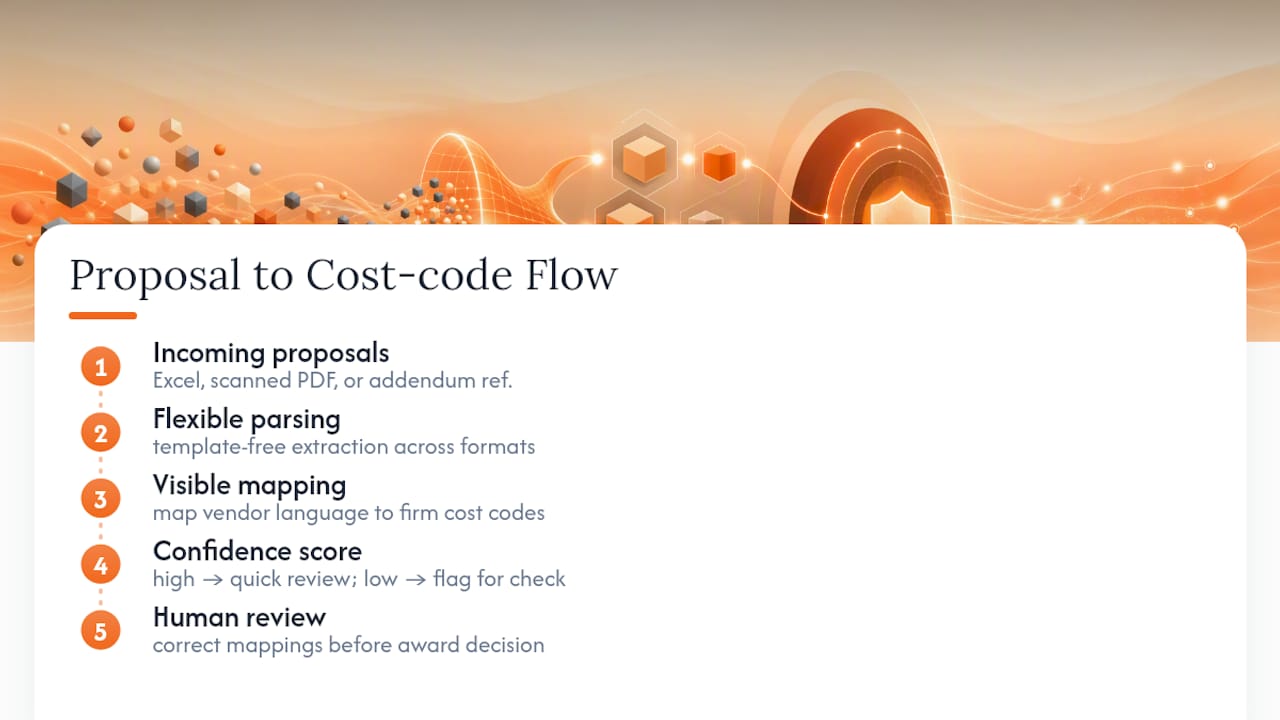
Extraction confidence scoring earns its place here too. A cleanly formatted digital proposal should score high confidence and need only a quick review. A scanned, handwritten addendum should score low confidence and get flagged for a closer look, rather than being extracted with false certainty and slipping past your estimator unnoticed.
Getting Your Team to Actually Trust the New Process
The best automated bid review platform fails if your estimators quietly go back to their old spreadsheet the moment nobody’s watching. Adoption is a people problem more than a technology problem.
Start with the estimators who are most skeptical, not the ones already excited about new tools. If a system can win over the person who trusts a highlighter and a printed spec more than any software, everyone else follows more easily. Show them the evidence link behind a flag before you ask them to trust the flag itself. Reviewers who see the exact page a discrepancy came from build confidence far faster than reviewers handed a bare conclusion.
Set a realistic expectation upfront: the tool doesn’t replace their judgment on pricing strategy or vendor relationships, it removes the reading grunt work. Framing it as “this gives you back three hours to actually think about the bid” lands very differently than “this reviews the bid for you.”
Training works best as a short, repeated loop rather than a single onboarding session. Run a few bids together, review where the system missed something, log the correction, and revisit after two or three weeks once the tuning has caught up. Momentum builds fastest when the team sees their own corrections actually changing future output, not disappearing into a support ticket.
ArosBid Team Perspective: Why Adopt Automated Bid Review Now
The most common objection we hear isn’t “does this work,” it’s “will my estimators actually trust it.” That’s the right question. Automation earns trust by showing its evidence, not by claiming to be right. A flag without a page citation is just an opinion in software form.
We think the reduction in preventable errors matters more than the raw hours saved. A missed addendum acknowledgment or an unbalanced unit price that slips through manual review costs far more than the time it would have taken to catch it. Run a paired test: pull five recent bids, review them your normal way, then run automated review alongside it and compare what each process caught. That single exercise tells you more than any sales pitch.
— arosbid team
How ArosBid Handles Extraction, Leveling, and the Audit Trail
Every component covered above maps directly to how ArosBid’s platform is built. Document parsing and scope extraction run through AI tender review that flags missing requirements and conflicting specs before they cost you a bid. Vendor quote normalization and side-by-side comparison happen through AI bid leveling, and the same engine catches missed addenda that quietly disqualify an otherwise strong proposal.
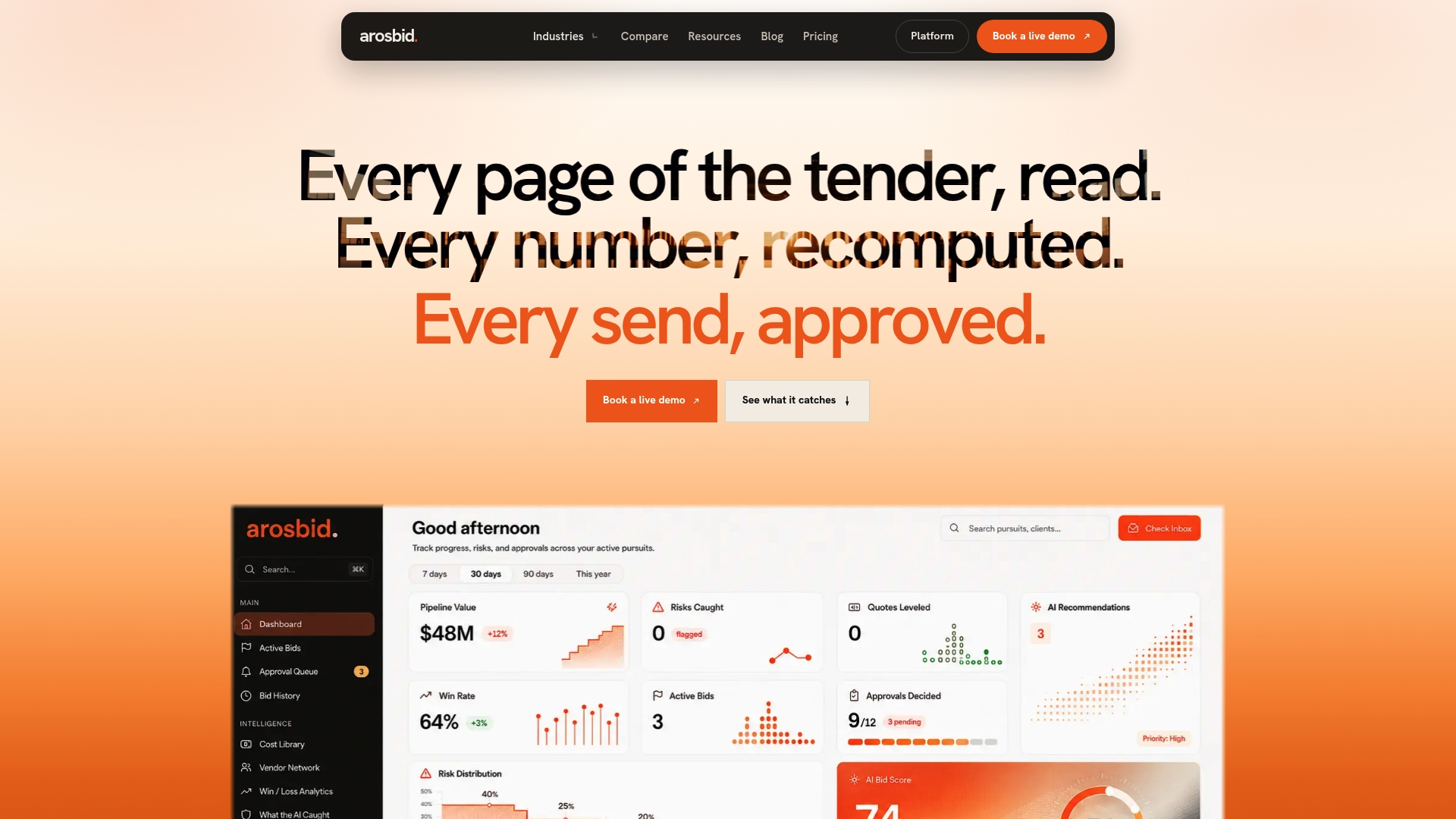
None of it requires ripping out your current setup. ArosBid connects to Excel and Outlook, so intake and review happen inside tools your team already knows, while every flag keeps a document citation and override log for a defensible award record. Trade-specific builds are available too, including setups for MEP, roofing, and steel contractors with their own scope patterns and cost code structures.
If you’re ready to see how this looks against your own bid packages, book a live demo and run it against a recent pursuit. That’s the fastest way to know whether it earns a place in your workflow.
Sources
- Winning More Work with AI: Cut Bid Prep Time by 60% — Mirage Metrics
- The struggle of bidding jobs — Acuity
- Bid No Bid Checklist for Specialty Subcontractors | BidIntell
FAQ
What Does Automated Bid Review Actually Check?
It checks for missing line items, unbalanced unit pricing, missing addendum acknowledgments, and scope conflicts across vendor quotes, then presents flags with document citations for estimator review.
Does Automated Bid Review Replace My Estimator?
No. It removes reading and extraction work so estimators spend more time on pricing strategy and risk assessment; final pricing and award decisions stay with the human reviewer.
How Long Does a Pilot Take to Show Results?
Most tuning windows run one to twelve weeks, depending on how many historical bid packages you load and how quickly estimators provide correction feedback.
Can Automated Bid Review Integrate With My Existing Tools?
Yes. Platforms like ArosBid typically sit upstream of your current estimating system, connecting through Excel, Outlook, and CSV or API exports rather than requiring a full system replacement.
Why Separate Deterministic Checks From AI Findings?
Deterministic checks always produce the same result for the same input, which makes them fully auditable, while AI-generated findings need labeling and evidence links so reviewers know to verify before acting on them.