100% Mandatory Compliance with a Construction Bid Qualification Matrix
100% Mandatory Compliance with a Construction Bid Qualification Matrix ! Construction bid qualification matrix title card A bid qualification matrix is a control table that links every mandatory requirement to its source document, the person responsible for answering it, and the proof that the answer is true.

A bid qualification matrix is a control table that links every mandatory requirement to its source document, the person responsible for answering it, and the proof that the answer is true. Its job is to catch a missing signature or an unmet threshold before a reviewer does. Before writing another line of a proposal, run a pass/fail sweep of every mandatory criterion in the tender.
TL;DR:
- Qualification matrices should explicitly track minimum eligibility criteria, such as financial capacity and experience, to prevent disqualifications for basic requirements.
- Each requirement must be copied verbatim from the tender, with actual evidence files linked, ensuring compliance can be verified during audit or review.
- Version control of matrix data is critical; tracking addenda and date-stamping changes prevent outdated or superseded requirements from influencing evaluation.
- Separating pass/fail eligibility checks from rated scoring simplifies evaluation and avoids confusing the two stages, maintaining fairness and clarity.
- Automating extraction of clauses, link evidence, and track deadlines improves accuracy and efficiency, while human verification safeguards auditability.
Table of Contents
- Qualification matrix versus compliance matrix versus requirements matrix
- Essential columns and a copy-ready template for a bid qualification matrix
- Pass/fail criteria versus rated criteria and where each belongs
- Step-by-step: how to build, populate, and operate a bid qualification matrix
- Using the matrix to make bid/no-bid decisions and estimate resource needs
- Automation and integrations: what to automate and what to keep human
- The last-24-hour checklist that stops single-point disqualification
- How ArosBid keeps qualification matrices audit-ready
- Sources
- FAQ
Qualification matrix versus compliance matrix versus requirements matrix
Bid teams use three overlapping terms, and mixing them up wastes time during a tight tender window. A requirements matrix is the broadest tool: it lists every deliverable, specification, and submission rule found in the tender documents, whether mandatory or optional. A compliance matrix is a narrower cut of that same list, built specifically to show a reviewer that each clause has been addressed, often side by side with the proposal section where it is answered. A qualification matrix narrows further still: it isolates the criteria that determine whether a bidder is even eligible to be scored, things like minimum annual turnover, bonding capacity, or years of relevant experience.
Procurement authorities treat these categories differently, and that difference shapes when each matrix gets used.
- Prequalification stage: a qualification matrix screens bidders against baseline eligibility before they are invited to submit a full proposal.
- Pre-bid screening: a compliance matrix confirms a draft response covers every clause before internal sign-off.
- Final responsiveness check: a combined matrix verifies signatures, securities, and formatting rules that determine whether a bid is even opened for evaluation.
The World Bank’s procurement guidance describes a staged model: bidders must clear minimum qualification criteria on a pass/fail basis before any rated scoring is applied, and mixing the two stages is discouraged because it blurs the line between eligibility and merit. That staging is the reason the three matrix types exist as separate tools rather than one long spreadsheet. A team that conflates a qualification check with a technical scoring exercise risks disqualifying a bidder for the wrong reason, or worse, scoring a bidder who should never have passed the eligibility gate.
Essential columns and a copy-ready template for a bid qualification matrix
A working matrix needs enough structure to survive a multi-week tender cycle with addenda, revisions, and more than one reviewer touching the file. The columns below cover what procurement guidance and practical bid management both call for.
| Column | What goes in it |
|---|---|
| Requirement ID | A short code so the item can be referenced in emails and reviews |
| Source / reference | The document name and page or clause number where the requirement appears |
| Requirement text | The exact wording of the clause, not a paraphrase |
| Mandatory (Y/N) | Whether failure disqualifies the bid outright |
| Pass rule | The specific threshold or condition that counts as a pass |
| Bidder response summary | A short note on how the response addresses the requirement |
| Evidence filename and link | The document, certificate, or form that proves the claim |
| Responsible owner | The named person accountable for that line |
| Status | Open, in progress, verified, or flagged |
| Deadline | The internal date the item must be closed, ahead of submission |
| Version / addenda notes | Which addendum changed the requirement and when |
A few notes on filling these in matter more than the column headers themselves.
- Requirement text should be copied verbatim from the tender, never summarized, because evaluators only credit evidence that matches the specified wording.
- Evidence links should point to the actual file, not a description of it: a scanned insurance certificate, not a note that says “insurance confirmed.”
- Version notes should record the addendum number and date every time a requirement changes, so nobody is working from a superseded clause.
The ADB’s prequalification guide includes sample Tables of Evaluation of Bidder’s Qualifications that follow this same logic: one row per criterion, one clear pass rule, and a place to record the evidence a bidder submitted. Building your matrix on that structure means it will look familiar to anyone who has reviewed a formal tender before.
Addenda are where most matrices fall apart. A tender that issues three or four addenda over its life cycle can silently change a bonding requirement or push back a submission deadline, and a matrix that does not track version history will keep showing the original, obsolete rule. Locking a version number into every changed row, and dating it, keeps the whole team working from the same page.

Pass/fail criteria versus rated criteria and where each belongs
Every formal evaluation runs on two different kinds of criteria, and confusing them is one of the fastest ways to lose a bid that should have won. Pass/fail, or mandatory, criteria are binary: a bidder either meets them or does not, and there is no partial credit.
- Financial capacity: minimum annual turnover or audited financial statements covering a set number of years.
- Bid securities: a bond or guarantee submitted in the correct form and amount.
- Experience thresholds: a minimum number of completed projects of similar size or type.
Rated criteria, by contrast, are scored on a scale and compared across bidders after the pass/fail gate has been cleared.
- Technical merit: methodology, staffing plan, or proposed schedule, usually scored against a rubric.
- Safety record: incident rates or safety program maturity, weighted as part of the technical score.
- Environmental approach: sustainability commitments or environmental management plans.
- Innovation: alternative methods or value engineering proposals, scored where the tender allows them.
The World Bank’s guidance is explicit that these two stages should not be duplicated: applying a pass/fail threshold and then scoring the same item again invites inconsistency and slows the evaluation down. The same discipline applies on the bidder’s side. Answering a mandatory item with polish instead of proof does nothing for the bid, because a reviewer checking eligibility is not weighing quality yet, only presence or absence of the required evidence.
Pro Tip: Lock every mandatory field and attach its evidence before anyone starts scoring the rated sections, so a missing qualification document never gets buried under technical write-ups.
Step-by-step: how to build, populate, and operate a bid qualification matrix
Building the matrix is only the first half of the job. Keeping it accurate through a live tender cycle is where most teams lose ground.
- Extract every clause at intake. Assign one reviewer to read the full tender package, including front-end conditions and appendices, and log each mandatory item with its exact source document and page number.
- Classify and set pass rules. For each row, decide whether it is mandatory or rated, and write the specific pass rule in plain language so nobody has to reinterpret the clause later.
- Assign owners and link evidence. Every row gets one named owner, a deadline ahead of the submission date, and a direct link to the file that proves compliance once it exists.
- Integrate addenda and lock versions. As addenda arrive, update the affected rows immediately, note the addendum number and date, and run a completeness check across the whole matrix before moving forward.
- Run a final audit and hand off for submission. Confirm every mandatory row shows a verified status with linked evidence, then archive the matrix as part of the submission record and the post-bid debrief.
A few habits make this workflow hold up under deadline pressure.
- Cite sources exactly: a reference like “Instructions to Bidders, Section 4.2, p. 12” is worth more than a vague note that the clause “was covered.”
- Separate open items from closed ones: a status column that only says “done” hides how much work remains.
- Keep a single owner per row: shared ownership on a compliance item is how deadlines slip unnoticed.
The ADB’s bid evaluation guide describes a preliminary completeness check that mirrors step five: before detailed evaluation even begins, reviewers confirm bid securities, signatures, powers of attorney, and joint venture agreements are present and correctly executed. Building that same check into your final audit step catches the exact errors that cause outright rejection, not just a lower score.
Handoff matters as much as the checklist itself. Whoever assembles the final submission should receive the matrix in its locked, final-version state, with every mandatory row showing verified status, so there is no ambiguity about what still needs attention in the hours before the deadline. After submission, the same matrix becomes the backbone of a debrief: a record of what was required, what was submitted, and where the margins were tight enough to revisit next time.
Using the matrix to make bid/no-bid decisions and estimate resource needs
A completed matrix is not just a compliance tool. It is also the clearest input a team has for deciding whether to bid at all, because it shows exactly how far the company is from meeting every mandatory requirement.
- Read the pass/fail rate first: a single unmet mandatory item, unresolved close to deadline, is a strong signal to walk away rather than gamble on a waiver.
- Set a resourcing threshold: if closing the remaining gaps needs more people or time than the team has available before the deadline, that gap becomes part of the no-bid case.
- Use a simple rule of thumb: require 100% of mandatory items met before submission, and reserve full effort for opportunities where the team can realistically score above roughly 80% on rated criteria.
- Document the rationale: a matrix with a flagged, unresolved mandatory row is itself the record of why a no-bid decision was made, useful for both internal review and future capture planning.
A 2024 study of 112 construction contractors found that the client’s ability to pay, clarity of the scope of work, project cash flow, the need for work, and the availability of qualified labor were the factors most often cited in bid/no-bid decisions. None of those factors live inside a qualification matrix; however, the matrix still plays a role: it tells a team quickly whether the compliance side of a bid is even achievable, freeing up time to weigh the strategic factors the study identified. A matrix that flags three mandatory gaps in the first two days of a tender period saves a team from spending three weeks estimating a job it was never going to be allowed to bid.
Automation and integrations: what to automate and what to keep human
Some parts of a qualification matrix benefit enormously from automation. Others lose their value the moment a human stops checking them.
- High-ROI automation: extracting clauses from lengthy tender documents, detecting new or revised addenda, linking evidence files to the right row, and alerting owners when a deadline is close.
- Keep humans in the loop: verifying that extracted clauses match the original wording, confirming evidence actually satisfies the pass rule, and signing off before submission.
- Integration patterns worth preserving: an Excel or CSV export path so the matrix can travel outside any single platform, Outlook-based approval alerts so owners are notified where they already work, and version-controlled documents so nobody edits a superseded copy.
Automation traps are just as real as automation benefits. Relying only on natural language processing to interpret a clause can miss context that a human reviewer catches in seconds, and a tool that hides who signed off on a mandatory item destroys the audit trail a formal evaluation depends on. The ADB’s bid evaluation guide treats that audit trail, the documented chain from requirement to evidence to sign-off, as central to a defensible evaluation, and that principle applies just as much to the bidder’s internal process.
Pro Tip: Choose automation that preserves the document-and-page citation on every extracted clause, because a paraphrased requirement with no source link is a harder thing to defend in an audit than the plain text of the original tender.
A workable human-plus-automation setup usually follows the same shape: intake and extraction happen automatically, a reviewer verifies the extracted clauses against the source document, and the named owner signs off once evidence is attached. Automated tender review tools that flag mandatory clauses and missed addenda fit naturally into that first stage, and AI-assisted bid leveling applies the same logic to vendor RFQ scoring, where consistency across responses matters as much as speed.
The last-24-hour checklist that stops single-point disqualification
Most disqualifications trace back to a handful of repeat mistakes: an unsigned form, a missed addendum, the wrong currency on a bid security, or a missing bond. The ADB’s completeness check exists precisely because these errors are common enough to warrant a dedicated review step before scoring even starts.
In the final 24 hours, verify signatures and powers of attorney first, then bid securities and their amounts, then the latest addendum log against the matrix, then arithmetic on every priced schedule. One named reviewer should sign off on the matrix itself, separate from whoever assembles the final submission package.
— arosbid team
How ArosBid keeps qualification matrices audit-ready
Building and maintaining a matrix by hand works, until a tender issues its fourth addendum and three people are editing the same spreadsheet from different laptops. It is designed to read the full bid document set, including front-end clauses, flag mandatory requirements automatically, and link evidence directly to the relevant row, so a reviewer can see the source page and the proof in one place instead of hunting through folders.
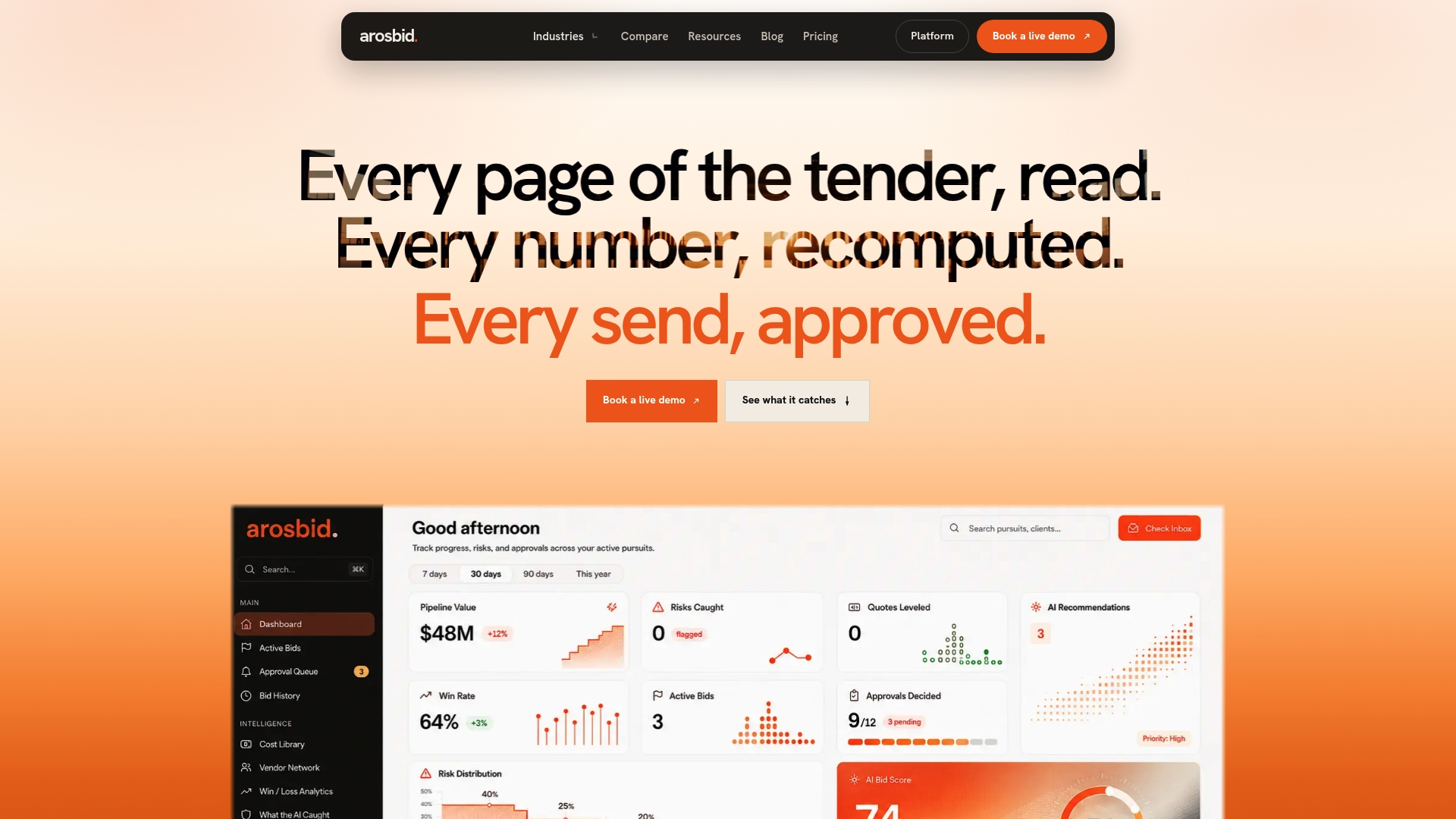
The platform detects addenda as they arrive and keeps version history intact, and can assign owners with deadline alerts that route through Outlook, so nothing depends on someone remembering to check a shared drive. Because it integrates with Excel and Outlook rather than replacing them, a team that already runs its qualification matrix in a spreadsheet can bring that same file into a bid management platform without abandoning the format they know. The construction bid management workflow carries this same logic through the rest of the bid cycle, from intake through buyout and debrief.
If a missed clause or an unsigned form has cost your team a bid before, it is worth seeing how the platform handles that check automatically. You can book a demo or view pricing for the One Desk, The Department, and The Whole Year plans directly.
Sources
The staged pass/fail-then-rated model referenced throughout this guide comes from the World Bank’s procurement guidance and the ADB’s prequalification guide, which both include sample evaluation tables worth adapting for your own matrix. The ADB’s bid evaluation guide details the completeness checks that catch signature and security errors before scoring begins. Bid/no-bid decision factors draw on a 2024 peer-reviewed study of construction contractors. Readers building matrices for specialized procurement categories may also find this vendor criteria guide useful for matching evidence to specific requirement wording.
- Exploring Bid/No-Bid Decision Factors of Construction Contractors for Building and Infrastructure Projects
- World Bank procurement guidance (excerpts)
- User Guide for Prequalification of Bidders: Standard Bidding Document (ADB)
FAQ
What are the 7 steps in an RFP?
Definitions vary by organization, but a common sequence covers planning and scope definition, drafting the RFP document, publishing and answering bidder questions, receiving proposals, evaluating them against qualification and rated criteria, selecting a vendor, and finalizing the contract. A bid qualification matrix supports the evaluation step by keeping mandatory and rated criteria clearly separated.
What are the four types of bids?
Bids are commonly grouped as open (competitive) bids, selective or invited bids, negotiated bids, and single-source or sole-source bids, depending on how many bidders are invited to compete. The right matrix structure stays similar across all four, though single-source procurement typically skips the comparative rated-scoring stage.
What are the 5 steps in the bidding process?
A typical bidding process runs through opportunity identification, bid/no-bid decision, proposal preparation, submission, and award or debrief. A qualification matrix is most useful at the bid/no-bid and proposal preparation stages, where it flags mandatory gaps before the team commits further time.
What are the criteria for bid evaluation?
Bid evaluation typically applies mandatory, pass/fail criteria first, covering items like financial capacity, bid securities, and relevant experience, before moving to rated criteria such as technical methodology, safety record, and schedule. The World Bank’s guidance treats this staged approach as standard practice, and duplicating criteria across both stages is discouraged.
How does ArosBid help with bid qualification matrices?
ArosBid extracts mandatory requirements from tender documents automatically, links evidence to each requirement, and flags addenda changes so a matrix stays current through revisions. It integrates with Excel and Outlook, so teams can keep their existing matrix format while adding automated checks and owner alerts.