Quote Scope Gaps: Protect Claim Rights Before Bids Lock
Quote Scope Gaps: Protect Claim Rights Before Bids Lock ! Sketched construction bid documents framing title A quote scope gap is work that falls into the space between contract documents, trades, or assumptions, where no one explicitly accepted responsibility.

A quote scope gap is work that falls into the space between contract documents, trades, or assumptions, where no one explicitly accepted responsibility. The single most effective way to prevent one is a formal multidisciplinary pre-bid review paired with a documented RFI log before bids lock. That combination protects your margins and keeps your right to claim additional costs intact if something still slips through.
TL;DR:
- Manual pre bid reviews miss 30 to 40% of scope conflicts, so a visual document check alone cannot reliably catch trade boundaries or mismatched addenda.
- When bidders spot an obvious document conflict, they should raise it before bidding; bidding around it can forfeit later claims for added costs.
- Quotes should separately list inclusions, exclusions, assumptions, and delivery conditions, with exclusions naming tasks such as disconnects or final wiring rather than broad trades.
- After a gap appears onsite, capture dated notes and photos, follow contract notice deadlines, and submit a detailed change order tied to the RFI log.
Table of Contents
- What a scope gap means in a contracting context
- How scope gaps form: root causes and failure modes
- Common examples: MEP and other trade interfaces where gaps appear
- How to find scope gaps early: methods, priorities, and who should do them
- How to document scope boundaries and call them out on quotes
- When you find a gap during construction: a quick mitigation and claims checklist
- Preventing quote scope gaps: a practical pre-bid review and governance checklist
- How bid management and automated review fit the checklist
- What makes checklists stick on real projects
- Getting started with a structured pre-bid review
- FAQ
- Sources
What a scope gap means in a contracting context
A scope gap shows up in three forms: an omission (nobody priced the work), an overlap (two trades both priced it, inflating the bid), or an unstated assumption (one side assumed the other would handle it). Quotes typically use four terms to manage this risk. An “inclusion” states what you are pricing. An “exclusion” states what you are not pricing. An “assumption” states a condition you relied on without verifying it. An “allowance” sets aside a placeholder dollar amount for work that cannot be fully defined yet.
Courts generally hold that bidders have a duty to inquire when they spot an obvious, or “patent,” ambiguity in the documents. According to ASCE’s analysis of flagging contract inconsistencies, bidders who notice an inconsistency and bid around it rather than raising it can forfeit their claim rights later.
How scope gaps form: root causes and failure modes
Most gaps trace back to a handful of repeatable mechanisms rather than one-off mistakes. Trade boundary drift happens when two subcontractors each assume the other covers a connection point, like a final electrical tie-in, because it was handled that way on a past job but was never confirmed for this one.
Document mismatch is the second major driver. Drawings, specifications, and bid packages are produced by different people on different schedules, and a detail updated in one set often never makes it into the others. According to Buddle Findlay’s review of scope problems in commercial contracts, strong scope language requires technical and operational input, and rushing that drafting shifts risk downstream to whoever discovers the gap first.
Phase and package handoffs create a third failure mode: work split across early and late bid packages leaves orphaned items that belong to neither. Finally, time pressure pushes some bidders toward “bidding around” an ambiguity instead of raising it, often to keep a number low enough to win.

Common examples: MEP and other trade interfaces where gaps appear
Gaps cluster at the physical and contractual seams between trades, where coordination depends on someone initiating a conversation rather than reading a single document.
- Electrical versus mechanical: who supplies and sets the disconnect switch, who runs final control wiring, and who provides motor starters.
- Equipment pads: whether the general trades pour the pad or the mechanical contractor does, and who levels it for the equipment that sits on top.
- Controls, commissioning, and functional testing: often assumed to be included in the installing trade’s price when it is actually a separate specialty scope.
- Small items like conduit sleeves, firestopping, and access panels: individually cheap, but omitted often enough that they become recurring change order line items.
Each of these examples is small enough to miss in a document review but expensive enough, once multiplied across a project, to erode a bid’s margin.
How to find scope gaps early: methods, priorities, and who should do them
Detection works best as a layered process, not a single checkpoint. Start with the highest-value method and add the others as project size and risk justify the extra time.
- Run a multidisciplinary page-turn. Gather estimators from each affected trade plus a project manager to walk the drawings and specs page by page, flagging interface points like the MEP boundaries described above.
- Cross-reference specs against drawings. Confirm every addendum has been incorporated into both documents, since a missed addendum is one of the most common sources of a patent ambiguity.
- Keep a formal pre-bid RFI log. Record every question raised, the date, and the answer received, since this log is what later supports a claim if a gap surfaces during construction.
- Level bids with an inclusion and exclusion matrix. Compare subcontractor quotes line by line so a low number isn’t actually a hidden scope reduction.
According to ASCE’s reporting on a subcontractor’s court loss over a scope gap, manual pre-bid reviews commonly miss 30 to 40 percent of scope conflicts, which is the main argument for pairing a page-turn with a structured log rather than relying on either alone.
Pro Tip: Assign one person to own the RFI log for the entire bid cycle so questions and answers never live in scattered email threads.
How to document scope boundaries and call them out on quotes
A quote earns its enforceability from specific language, not a general description of the work. Every quote should carry a scope annotation block with four fields: inclusions, exclusions, assumptions, and delivery conditions.
- State exclusions as concrete items, not vague categories: “excludes disconnects and final wiring” protects you far better than “excludes electrical.”
- Record delivery conditions explicitly, including substrate tolerances, site access hours, and whether utilities are live or need to be arranged.
- Note any allowance as a dollar figure tied to a specific undefined scope item, not a blanket contingency.
- When comparing quotes in a matrix, use category labels like “controls contractor” or “pad installer” rather than listing specific vendor names, which keeps the comparison focused on scope rather than identity.
Our guide to logging construction spec conflicts walks through the specific fields worth tracking during this stage.
When you find a gap during construction: a quick mitigation and claims checklist
Once a gap surfaces onsite, the sequence matters as much as the decision itself. Document the discovery immediately: photos, dated field notes, and a record of who was present when the issue was identified.
Next, check your contract’s notice provisions and follow them exactly, since missing a stated notice window can waive your claim regardless of the gap’s merits. Submit a change order proposal with a detailed cost breakdown rather than a lump figure, and reference your pre-bid RFI log and any addenda that touch the disputed item, since that record is what establishes you raised the issue in good faith. Decide whether the situation calls for short-term containment, continuing other work around the gap, or a complete stop, and apply cost controls appropriate to that choice rather than defaulting to the most expensive option out of urgency.

Preventing quote scope gaps: a practical pre-bid review and governance checklist
Prevention works only when it becomes a scheduled milestone with named owners, not an informal habit that slips under deadline pressure.
- Schedule the multidisciplinary page-turn before the bid due date, with estimators from every affected trade plus the project manager required to attend and sign off.
- Reconcile every drawing against the current spec set and confirm all addenda are incorporated.
- Walk every trade interface identified in your project type, such as the MEP boundaries covered earlier.
- Confirm exclusions and assumptions are written as specific items, not general statements.
- Verify allowances carry dollar figures tied to defined scope.
- Confirm testing, commissioning, and handover responsibilities are assigned to a named trade.
- Assign one owner for the final quote and one owner for the RFI log, and require a management sign-off before the bid locks.
- Check historical cost data from past similar projects for items that were missed before.
According to Hahn Loeser & Parks’ guidance on defining construction scope of work, a formal pre-bid question log and management sign-off on residual assumptions materially reduce the risk of losing entitlement to extra costs later. For readers running renovation-scale projects rather than commercial bids, House A-Z’s contractor selection criteria covers a parallel version of this screening for owners hiring a single contractor.
Pro Tip: Keep a running list of past scope gaps by trade so your next page-turn starts with known failure points instead of a blank checklist.
For teams that want a ready-made version of this sequence, our 16-point scope of work review lays out the full signoff structure, and our estimate review checklist breaks the process into three stages.
How bid management and automated review fit the checklist
Automated document review speeds up the parts of this process that are tedious by hand: catching spec and drawing mismatches, tracking vendor quotes, and leveling bids into a consistent matrix. Some platforms pair that automation with human sign-off, so a flagged inconsistency still gets a person’s judgment before it affects a submission. Integration with tools like Excel and Outlook can support workflows, and tracking bid approvals helps keep the RFI log and final quote connected. Technology speeds detection, but the final bid decision stays with your team.
What makes checklists stick on real projects
Most scope gaps aren’t caused by a missing checklist. They’re caused by a checklist that exists but isn’t mandatory, so it gets skipped the first time a bid deadline tightens. Treating the page-turn and RFI log as a required milestone, with a named sign-off, is a small upfront cost that consistently avoids larger margin losses and disputes down the line.
— arosbid team
Getting started with a structured pre-bid review
If you’re ready to make the page-turn and RFI log a permanent part of your process rather than a one-off effort, our platform is built to hold that workflow together: document review, vendor quote tracking, and approval sign-offs in one place instead of scattered spreadsheets and inboxes.
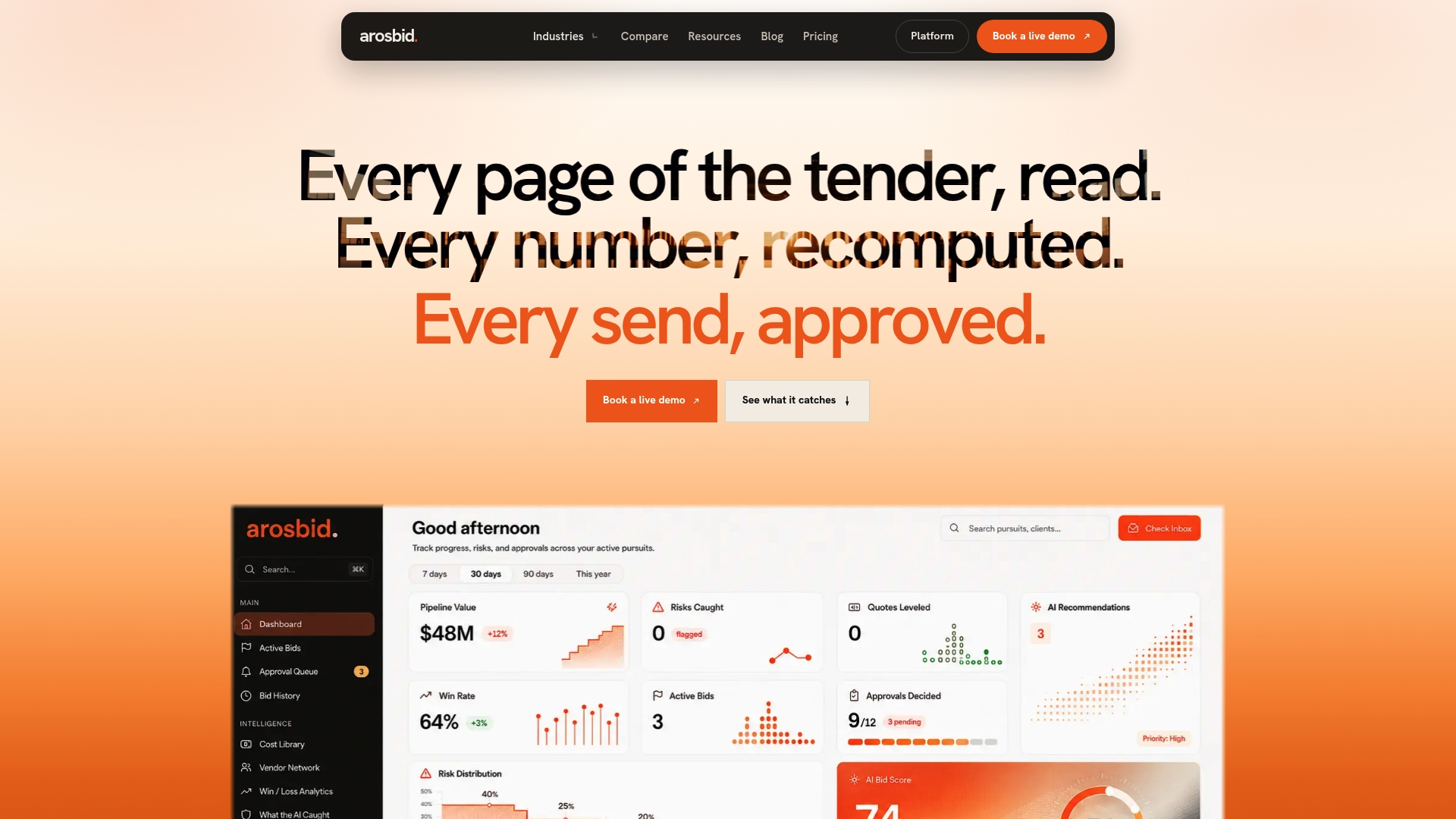
Trade-specific teams working in MEP, roofing, or steel can see how the review flow maps to their own bid packages on our trade bid software pages, and anyone evaluating cost first can check plan details on our pricing page. The fastest way to judge fit is to book a live demo and run one real pre-bid review through our templates before your next bid deadline.
| Next step | Where to go | What you get |
|---|---|---|
| Run a pre-bid review | Book a demo | A guided walkthrough using your own bid documents |
| Compare plans | Pricing | One Desk, The Department, and The Whole Year plan details |
| Check trade fit | Industries | MEP, roofing, and steel-specific workflows |
FAQ
How do I indicate gaps in quotes?
Mark them explicitly in a scope annotation block with separate fields for inclusions, exclusions, assumptions, and delivery conditions. Avoid vague category exclusions like “excludes electrical” in favor of specific line items such as “excludes disconnects and final wiring.”
What does the term “scope gap” mean?
A scope gap is work that falls between contract documents, trades, or assumptions where no party has explicitly accepted responsibility for pricing or performing it. It typically appears as an omission, an overlap between two trades, or an unverified assumption about who handles the task.
What does a parenthesis mean in a quote?
Parentheses in a quote usually flag a clarification, an exclusion, or a reference to a specific drawing or spec section tied to that line item. The exact meaning depends on the document, so any parenthetical note worth relying on should be confirmed in writing rather than assumed.
How do I choose which detection method to use first?
Start with a multidisciplinary page-turn for any project with more than one trade interface, since it catches the boundary issues that document review alone tends to miss. Add a formal RFI log and bid leveling matrix as the project size and dispute risk increase.
Sources
- Practitioners should flag contract inconsistencies before submitting bids — ASCE
- How to Define Your Construction Scope of Work & Avoid Disputes — Hahn Loeser & Parks LLP
- The problem of scope in commercial contracts — Buddle Findlay