Construction Technology Adoption: A Practical Guide for Bid Teams
Construction Technology Adoption: A Practical Guide for Bid Teams ! Construction bid tools sketched around a clear title space Construction technology adoption succeeds when a firm picks one costly, recurring problem, fixes it with a tool that fits the software the team already uses, and proves the result on a few real projects before rolling it out.

Construction technology adoption succeeds when a firm picks one costly, recurring problem, fixes it with a tool that fits the software the team already uses, and proves the result on a few real projects before rolling it out. For estimators and project managers, the bid desk is the best place to start. Bids are repeatable, they carry clear error costs (a missed clause, a conflicting spec, a disqualification), and the work already lives in Excel and Outlook. Our platform, ArosBid, is built for this case: it reads the full set of bid documents, flags problems before submission, and works with your existing tools instead of asking you to replace them.
TL;DR
- Adoption is a change in how people work, not a software purchase. McKinsey found that success depends on new ways of working, not on the technology alone.
- The biggest barriers are cost, training, resistance to change and systems that do not connect. Most are organizational, not technical.
- Start with a pain point, run a small pilot with a named owner and a success measure, then scale.
- On the bid desk, the payoff is catching compliance errors, conflicting specs and missed clauses before they cost you a job.
- Pick tools that connect to Excel, Outlook and your takeoff and project management software so nobody enters the same data twice.
Table of Contents
- What technology adoption actually means in construction
- Why firms stall: the barriers that show up in the research
- A step-by-step approach that holds up
- What good looks like: evidence on bid accuracy and compliance
- Practical lessons from other trades
- Where ArosBid fits
- See it on your own bids
- FAQ
- Sources
What technology adoption actually means in construction
Technology adoption is the process of moving a new tool from a purchase order to the way your people work every day. A license that nobody opens is not adoption.
McKinsey’s analysis of digital transformation in construction describes two kinds of change: new digitally enabled products and services, and operational improvement, meaning advanced technologies and new ways of working applied to how projects are developed and delivered. The authors stress that executives need to spend as much time on operational change as on the technology itself.
Academic work frames it the same way. A 2021 Frontiers review of 36 journal publications treats digital transformation as a process in which technology creates effects that force firms to build enablers and remove barriers, rather than a single purchase.
For a bid team, that means the question is not which tool to buy. It is which part of the bid cycle you want to change, who will work differently on Monday, and how you will know it helped.

Why firms stall: the barriers that show up in the research
The same obstacles appear across studies from different countries and years.
The Frontiers review identifies ten barriers: data processing, data access and ownership, system integration, standardization, uncertain return on investment, owner buy-in, older workers, business models, the digital divide and system attacks.
A 2026 study of UK construction quality management narrowed it to five: cost, lack of training and support, human behavior, data security and fragmentation. Cost ranked highest, followed by resistance to change and lack of training. The authors concluded that organizational and behavioral factors are harder than technological limits.
A 2023 ACM literature review found that the most-cited organizational barriers are management hesitation, missing knowledge, too few skilled people, weak stakeholder communication and lack of investment. On the technology side, high initial cost and the lack of shared digital standards led the list.
A 2022 MDPI study of German construction points to the absence of a holistic implementation process, long payback periods, thin training and management that does not monitor whether the tools are used.
Cost deserves a closer look because bid teams feel it directly. A Skanska technology executive told ENR that in a low-margin business, technology is still seen as an additive cost that is hard to justify unless a project is already open to trying something new. The answer is a small, measurable pilot, not a firm-wide leap.
What this means for a bid desk
Bid teams face a particular version of these barriers:
- Fragmentation. Takeoff lives in one tool, vendor quotes in Outlook, pricing in Excel, and addenda in a shared folder. Each handoff is a place where a clause gets missed.
- Time pressure. A bid deadline does not move for a training session, so tools that demand a new routine in the middle of a live bid get abandoned.
- Unclear payback. The cost of a tool is visible. The cost of a lost bid or a disqualification rarely is, unless you track it.
A step-by-step approach that holds up
Three independent sources converge on the same sequence. The AGC guide to selecting construction technology recommends that small and mid-size firms assess current processes and pain points, start small with pilots, work with vendors and industry experts, manage change with open communication and education, and evaluate continuously. Skanska’s eight-step process, reported by ENR, runs from defining a problem through funding, vendor assessment, a pilot and an organization-wide recommendation. McKinsey’s authors add that winners focus on fixing pain points, not installing IT.
Here is that sequence applied to the bid desk.
1. Define the problem in numbers
Pull your last 10 to 20 bids. Count how many were no-bid decisions made late, how many had addenda or clauses caught after pricing, how many vendor quotes arrived with gaps or exclusions, and how many hours went to assembling the proposal. You are looking for the one failure that repeats.
This is where our approach differs from a generic tool. ArosBid is designed to read the entire set of bid documents, including front-end clauses, and to check for the missed clauses and conflicting specifications that lead to disqualification. If your repeated failure is one of those, the problem statement and the product line up.
2. Map what you already use
List every system the bid touches: your takeoff tool, cost database, project management platform, Excel workbooks and Outlook. RSM’s guide advises building an application road map first, because no single program runs an entire business and systems that cannot talk to each other cause duplicate data entry.
This step is where many projects quietly fail. The Frontiers review describes incompatible software packages and siloed point solutions as a core integration barrier. Construction Dive reports that when cost codes in accounting or ERP software do not match the BIM model, AI insights end up trapped and deliver no value. It recommends defining data standards up front and rejecting inconsistent PDFs and spreadsheets as final deliverables.
The practical rule: choose tools that connect to what you have. ArosBid integrates with Excel, Outlook and major takeoff, cost and project management tools, so your team keeps its estimating and document habits. Our guides on takeoff software integrations and project management integration for estimators walk through which connections matter first.
3. Involve the estimators before you choose
RSM advises asking employees for input rather than dictating change, involving them early so you find real needs, avoid waste and reduce resistance. Estimators know where the bid process breaks. Ask each one for their top two time sinks and their top two near misses. Their answers become your selection criteria.
4. Ask the structured questions
AGC’s guide lists questions to settle before implementation: pilot on a live project or in a sandbox, who leads, what resources and data are needed, which integrations with existing systems are required, how success will be measured, and whether the cost sits in the project or must be budgeted into the bid. Write the answers down. A pilot with no owner and no measure becomes shelfware.
Delivery method changes the questions too. Whether you are pricing a design-bid-build package or a design-build one affects what the bid must contain, and this overview of design-bid versus design-build timelines is a quick refresher on how the two differ.
5. Pilot on a few real bids
Keep the pilot small: two to five live bids is enough to see whether document review catches things your team would have missed. We lay out how to run one in our guide to a 2 to 5 bid pilot for automated bid review, and the same logic applies to proposal assembly in our 6 to 10 bid proposal workflow pilot.
Set three rules before the first bid:
- One person owns the pilot and reports weekly.
- The estimator keeps full authority over what is submitted. The tool flags; people decide.
- Every flag is logged as useful, noise or missed, so you can judge accuracy with data.
That second rule matters for adoption. Teams resist tools that appear to replace their judgment. ArosBid automates error checking without taking authority over submissions away from your team, which is how most estimators want it to work.
6. Train on one consistent platform
RSM recommends training employees on a consistent platform rather than a patchwork. In practice, give every estimator a short walkthrough on a bid they are already pricing, not on a demo project. People learn faster when the output is something they need by Friday.
7. Measure, then scale
Review the pilot against the problem you defined in step one. If clause misses dropped and proposal assembly got faster, extend to the next set of bids, then to other trades or offices. Adoption continues after rollout; adjust training and workflows from the feedback.
What good looks like: evidence on bid accuracy and compliance
The strongest published numbers come from document review, the same activity a bid desk does under deadline.
ENR reported that when Gilbane reviewed submittals with AI agents, 72% were found non-compliant, 25% partially compliant and only 3% fully compliant. More than 2,000 submittals were reviewed in three months, re-submissions fell, and cycle times shortened by nearly 50%. Submittals are not bids, but the lesson carries over: when humans check documents by hand against dense requirements, most items have something wrong with them, and catching it early is cheaper than catching it late.

The broader productivity case is also documented. McKinsey Global Institute research cited in the McKinsey article indicates digital transformation in engineering and construction can lift productivity by 14 to 15 percent and cut costs by 4 to 6 percent. The Associated Builders and Contractors 2025 Field Tech Report found that 90% of general and trade contractors actively deploying integrated digital workflows can trace the root causes of their operational problems. That traceability is what a bid debrief needs: knowing why you won or lost, not guessing.
A useful scorecard for the bid desk:
| Measure | How to track it | Why it matters |
|---|---|---|
| Clause and spec conflicts caught before submission | Log each flag and whether it was valid | Shows whether review is finding real risk |
| Hours per bid, intake to proposal | Time the same stages on each pilot bid | Shows capacity gained |
| Vendor quote gaps found at leveling | Count exclusions and scope holes per bid | Protects margin before award |
| Bid/no-bid decisions made on criteria | Record the reasons | Directs effort to winnable work |
| Hit rate | Bids won over bids submitted, by trade and owner type | The number that pays for the tool |
Run the same measures on a baseline of past bids so the comparison is fair. Our guide to a 60 to 90 day bid management workflow shows how to stage these checkpoints.
Practical lessons from other trades
Technology adoption in neighboring trades follows the same pattern: a clear problem, a short trial, a named owner. A restoration contractor’s overview of technology in property recovery shows how equipment and software earn their place when they shorten a specific job step. Bid teams can borrow that discipline: pick one step, shorten it, then move on.
Where ArosBid fits
Our view from the bid desk
Most advice on technology adoption starts with culture and training. We agree, and we add one thing: begin where a mistake is most expensive and the work is most repeatable. For trade contractors, that is the bid.
A bid fails in small ways. A clause on page 12 of the front end contradicts the spec on page 340. A vendor quote leaves out a scope item. An addendum lands after pricing. None of these is a technology problem at first. They are attention problems, and attention runs out at 4:45 p.m. on bid day.
That is why we built ArosBid to read the whole set of documents, including the front-end clauses, and to scrutinize details before submission. Our design keeps human authority over what goes out the door. We run the complete bid cycle in one place, from intake through bid/no-bid evaluation, takeoff, estimate, vendor quote tracking and leveling, proposal assembly, buyout and debrief, with a historical cost library so each bid teaches the next one.
We also believe a tool should fit the team, not the other way around. ArosBid works with Excel, Outlook and major takeoff, cost and project management tools, so your estimators keep the habits that already work and add a structured command center for tracking approvals, vendor quotes and document compliance.
The research says adoption is mostly about people and process. We agree, which is why we suggest a small pilot on a handful of live bids, with your estimators in charge of every submission.
arosbid team
See it on your own bids
If your next step is to pilot a bid process tool, start with our construction bid management software page, which covers the full cycle from intake to debrief. Plans are listed on the pricing page as One Desk, The Department and The Whole Year. If you would like to see how it handles your documents, you can book a live demo.
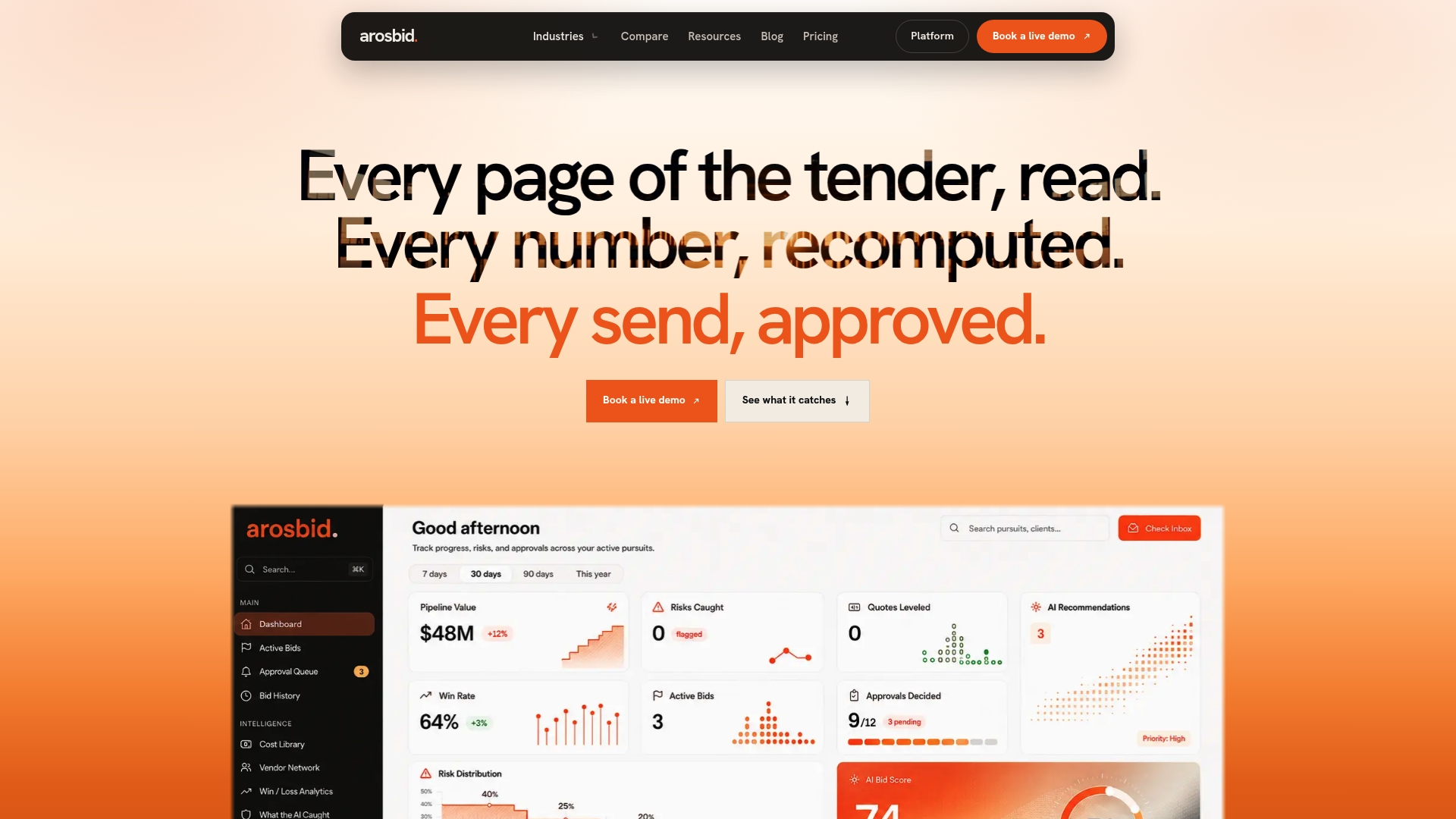
For estimating, takeoff and vendor quote leveling specifically, see our construction estimating and bidding software and vendor quote leveling pages.
FAQ
What does technology adoption mean in construction?
It means a new tool becomes part of how people do their daily work, not just something the company bought. McKinsey describes success as instituting new ways of working alongside the technology. For a bid team, that means estimators actually use the tool on live bids and the process measurably improves.
What are the biggest barriers to adopting construction technology?
Research repeatedly names cost, lack of training, resistance to change, poor system integration and weak data standards. A 2026 study of UK construction found cost the most significant barrier, with organizational and behavioral factors proving harder than technical ones. Starting with a small pilot and choosing tools that connect to your existing software addresses most of them.
How long should a pilot run?
Long enough to cover a handful of real bids, so you can compare results with your past ones. We suggest two to five bids for automated bid review and six to ten for proposal assembly. Set the success measures before you begin and review them weekly.
Do we have to replace Excel and Outlook to adopt bid software?
No. ArosBid integrates with Excel and Outlook, as well as major takeoff, cost and project management tools, so your team keeps its familiar tools while gaining a structured way to track approvals, vendor quotes and compliance. This also avoids the duplicate data entry that RSM warns about when systems cannot communicate.
How do we know the technology is paying off?
Track errors caught before submission, hours per bid, vendor quote gaps found at leveling and your hit rate, and compare them with a baseline from past bids. A debrief step at the end of each bid keeps the lessons in a historical record you can use on the next one.
Sources
- Decoding digital transformation in construction, McKinsey
- Facilitating Digital Transformation in Construction, Frontiers in Built Environment
- Perceived barriers to digital technology adoption in UK construction
- Digital Transformation in the Construction Industry, ACM
- Implementation of Digital Technologies in Construction, MDPI
- Skanska tech adoption plan deployed at LaGuardia Airport, ENR
- Selecting Construction Technology, AGC
- 6 steps towards digital transformation in the construction industry, RSM
- How a lack of data standardization is holding AI back in construction, Construction Dive
- Gilbane rolls out AI agents across its jobsites, ENR
- ABC 2025 Field Tech Report