15–25% At Concept: Contingency Planning for Estimators and PMs
15–25% At Concept: Contingency Planning for Estimators and PMs ! Contingency planning title card illustration Contingency is the reserve inside your cost baseline that covers risks you've already identified but can't fully price.
Contingency is the reserve inside your cost baseline that covers risks you’ve already identified but can’t fully price. Size it from your risk register using expected monetary value (EMV) or Monte Carlo simulation when data supports it. When it doesn’t, use percentage bands tied to how mature your estimate actually is. Either way, the number is worthless without documented drawdown rules and a clear line between what a project manager can approve and what needs a sponsor’s signature.
TL;DR:
- Using a percentage-based contingency is practical for small, low-risk projects but can lack accuracy for complex or high-risk estimates.
- EMV and Monte Carlo methods provide more defensible contingency figures by quantifying known risks and interactions but require reliable data and specialized tools.
- Proper governance involves predefined approval thresholds, linking each draw to a specific risk, and regular re-evaluation to prevent contingency from becoming a hidden slush fund.
- Contractors often embed risk allowances into bids, so cross-check these against your risk register before adding extra contingency to avoid double-counting.
- Structured estimating platforms improve data quality, audit tracking, and compliance, ultimately supporting more disciplined and transparent contingency management.
Table of Contents
- What Is Contingency vs. Management Reserve?
- How Do You Choose a Contingency Estimation Method?
- How Do You Calculate an EMV-Based Contingency Estimate?
- How Does Estimate Maturity Change Your Contingency Percentage?
- How Should You Govern and Update Contingency During Execution?
- What Mistakes Undermine Contingency Estimates?
- How Do Estimating Platforms Support Contingency Discipline?
- What Do Estimators Get Wrong About Presenting Contingency?
- Put Contingency Discipline Into Your Estimating Workflow
- Sources
What Is Contingency vs. Management Reserve?
Contingency covers the risks you can name. If your risk register flags a chance that soil conditions require extra shoring, or that a vendor quote comes in above your allowance, that’s contingency territory. Management reserve is different: it’s money set aside for unknown-unknowns, the risks nobody wrote down because nobody saw them coming. Mixing the two is one of the fastest ways to lose control of a budget, because contingency draws should trace back to a specific risk line item, while management reserve draws typically require executive sign-off precisely because there’s no register entry to point to.
There’s a third trap: contractor pricing). Subcontractors and vendors often build their own risk cushion into unit rates or lump-sum bids, especially on trades with volatile material costs. If you layer project-level contingency on top of that without checking, you’re paying for the same risk twice. The fix is a line-item review comparing contractor allowances against your own risk register before you finalize the contingency line.
Control matters too. On most projects, AIA guidance recommends that design contingency stay owner-held rather than handed to the design team or contractor to manage, precisely so it can’t quietly absorb scope creep.
- Contingency reserve: tied to identified risks, sits inside the cost baseline, drawn against specific line items.
- Management reserve: covers unforeseeable risk, sits outside the baseline, usually controlled by the sponsor or program office.
- Contractor-embedded risk pricing: already baked into bid rates; check for it before adding your own layer on the same exposure.
How Do You Choose a Contingency Estimation Method?
Percentage heuristics are fast. You take a benchmark number, apply it to your estimate, and move on. That works fine on a small project with a stable scope, but it falls apart the moment a reviewer asks you to justify the number against actual risk exposure. Quantitative methods take longer to build but survive scrutiny, and they let you show your work instead of citing a rule of thumb.
Expected monetary value is the workhorse for most mid-size projects. You take each risk from your register, multiply its probability of occurring by its cost impact if it does, and sum the results across the register. It requires a maintained risk register with realistic probability estimates, which means someone has to own the register and update it as risks close out or new ones surface. AACE’s recommended practice is explicit that the method should fit the client’s objectives and project context rather than defaulting to whatever spreadsheet template is on hand.
Three-point estimating (PERT) works when you have subject matter experts but not much hard data. You ask for optimistic, most likely, and pessimistic cost figures for each major work package, then use a weighted formula to produce a single expected value with a defensible spread. The DOE’s guidance on contingency reserve inputs treats three-point inputs as the bridge between rough heuristics and full probabilistic modeling, useful when you don’t yet have enough historical data for a real distribution.
Monte Carlo simulation earns its complexity on large, schedule-sensitive projects where cost and schedule risks interact. You run thousands of iterations across your risk distributions and read off a percentile, say P70 or P80, as your contingency-adjusted cost. It takes modeling software and time most small projects don’t have, but on a nine-figure infrastructure job it can be the difference between a defensible number and a guess dressed up in decimals.
A 2023 literature review on budget contingency methods for construction found no single best method across the field. Choice depends on project complexity, data availability, and how much confidence stakeholders demand.
Here’s a rough decision path:
- Small project, stable scope, thin risk data: use a maturity-linked percentage.
- Medium project with a maintained risk register: build EMV from that register.
- SME input available but limited historical data: use three-point/PERT to bound your estimate.
- Large, schedule-linked project with real risk correlation: run Monte Carlo and report a percentile.
- Any project where a client or regulator demands a defensible methodology: default to the most quantitative method your data supports, not the fastest one.
Pro Tip: Don’t let method choice become a stalling tactic. If you don’t have the risk data for EMV or Monte Carlo yet, use a maturity-tied percentage now and flag it as provisional pending a completed risk register. A documented placeholder beats an undocumented guess.
How Do You Calculate an EMV-Based Contingency Estimate?
Start with your risk register, not your gut.
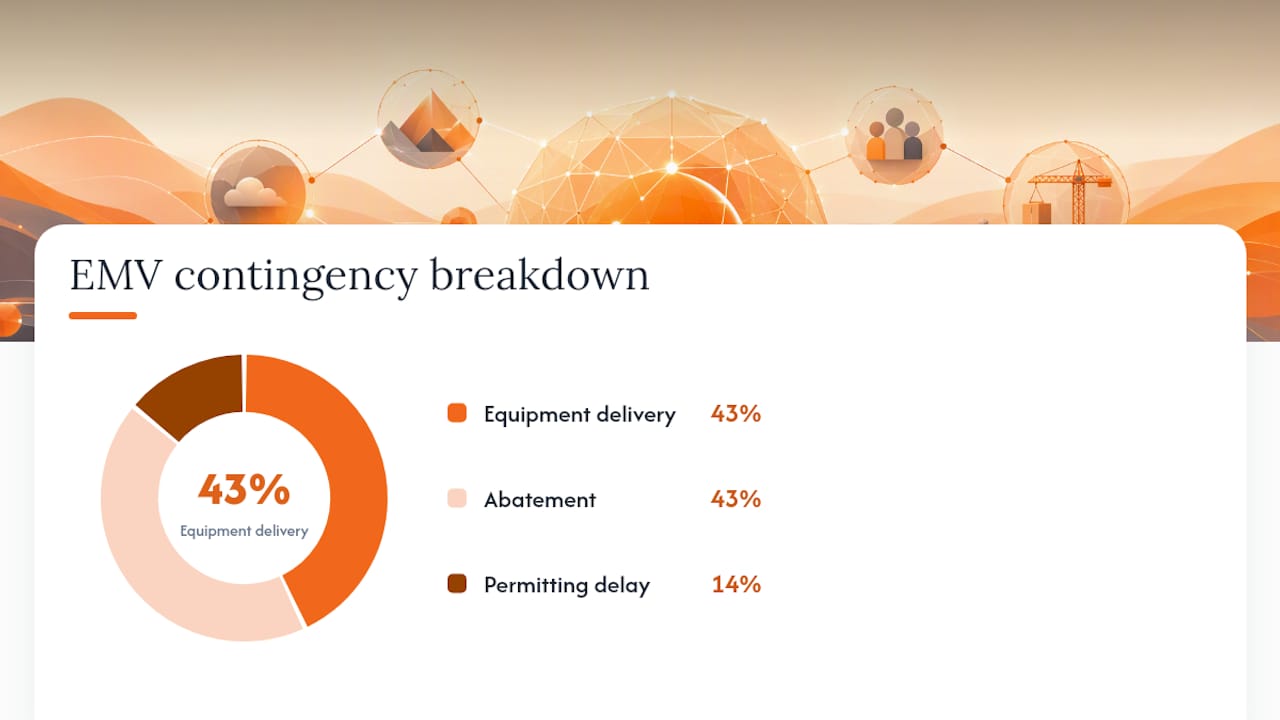
- Equipment delivery: 0.30 × $40,000 = $12,000
- Abatement: 0.20 × $60,000 = $12,000
- Permitting delay: 0.15 × $25,000 = $3,750
Summed, that’s $27,750 in EMV-derived contingency. Most estimators then add a residual buffer on top of the EMV total to cover minor risks too small to individually register but collectively real, often within a generally recommended range. This brings total contingency to a slightly higher figure on this risk set.
If you have the modeling capacity to run Monte Carlo instead, you’d feed these same risk distributions in along with schedule dependencies and look at where the cost curve lands at P70 or P80. The DOE’s approach frames contingency as the gap between your base estimate and that chosen percentile; a P80 selection means you’re comfortable that 80% of simulated outcomes land at or below your budgeted figure. Present P50 to sponsors who want the median case, but P70 or P80 when the project can’t tolerate overrun, and say so explicitly rather than burying the confidence level in a footnote.
How Does Estimate Maturity Change Your Contingency Percentage?
A concept-stage estimate built on a one-page program and a napkin sketch carries far more uncertainty than a fully detailed design ready for permit submission.
Rough bands that hold up across sectors:
- Concept/feasibility: 15 to 25%, reflecting near-total scope uncertainty.
- Preliminary design: 10 to 20%, once major systems are selected but details remain open.
- Design development: 5 to 15%, as drawings firm up and quantities get more reliable.
- Final/locked design: 3 to 8%, when scope is essentially fixed and remaining risk is execution risk.
Industry guidance on contingency tracks these same bands and notes that software projects often run higher than well-defined construction scopes, because requirements tend to shift later in the process. Construction-specific work, particularly structural steel and other trades with long lead times, deserves adjustment upward when material markets are volatile or when design development is still resolving conflicting specifications. Where you have solid historical cost data from comparable projects, lean on it over generic bands; a track record beats a benchmark every time.
How Should You Govern and Update Contingency During Execution?
Contingency without governance turns into a slush fund fast. Set approval thresholds up front: a project manager might approve draws up to a set dollar figure or percentage of the total reserve, while anything larger requires sponsor sign-off. Put this in writing before the first draw request arrives, not after a dispute over who authorized what.
Every draw needs a paper trail. At minimum, log the risk register item it ties to, the dollar amount, the date, and who approved it. FHWA’s guidance on contingency fund management treats this kind of reporting as standard fiscal planning practice on major projects, not an optional nicety, and recommends quarterly re-evaluation as a baseline cadence.
- Set PM and sponsor approval thresholds before the project starts drawing on contingency.
- Require every drawdown request to reference a specific risk register line, not a general “cost pressure.”
- Track consumption rate (dollars drawn versus dollars remaining) as an ongoing health metric, not a year-end surprise.
- Re-evaluate contingency at project gates or on a quarterly cycle, whichever comes first.
- Release unused contingency back to the budget as scope firms up and risks close out, rather than letting it sit as a hidden cushion.
Pro Tip: A consumption rate that’s running ahead of project percent-complete is an early warning sign, not just a budget line to watch. If you’ve burned 60% of contingency at 30% completion, that’s a signal to re-run your risk assessment, not to hope the trend reverses.
What Mistakes Undermine Contingency Estimates?
The most common failure is using contingency to absorb scope changes that should go through formal change control. A client asking for an upgraded finish is a change order, not a contingency draw, and blurring that line erases your ability to track what contingency was actually for.
Double-counting is the second big one: contractor bids that already price in risk, then getting an additional layer of project contingency stacked on top without anyone checking. A quick line-item comparison against contractor allowances before finalizing your number closes that gap.
- Never draw on contingency without linking the draw to a documented risk.
- Cross-check contractor pricing for embedded risk allowances before adding your own layer.
- Treat undocumented draws as a governance failure, not a rounding error.
- Use consumption-rate spikes as a trigger to reassess, not as something to explain away after the fact.
How Do Estimating Platforms Support Contingency Discipline?
Contingency discipline depends on data quality, and most estimating teams lose that quality to spreadsheets that drift out of sync. A structured command center changes that by keeping vendor quotes, approvals, and compliance checks in one auditable place instead of scattered across email threads.
Vendor quote leveling gives estimators consistent, comparable pricing data, which sharpens the probability and impact inputs that feed EMV calculations. Automated approval routing and drawdown logging build the audit trail that FHWA’s reporting standards call for, without someone manually reconciling a spreadsheet after the fact. And because the platform integrates with Excel and Outlook, teams keep their existing habits while gaining a historical quote library that turns next quarter’s percentage heuristic into something backed by real project data instead of instinct.
What Do Estimators Get Wrong About Presenting Contingency?
Too many estimators treat contingency as a number to defend rather than a story to tell. A flat percentage invites pushback; a number tied to named risks, each with a probability and dollar impact, rarely does.
When your risk register is thin, a maturity-tied percentage is honest and defensible. When it’s not, sponsors respond better to EMV totals or historical draw patterns than to round numbers pulled from habit. Push for traceability and clear approval limits before the project starts, not after the first disputed draw.
— arosbid team
Put Contingency Discipline Into Your Estimating Workflow
Spreadsheets and email threads make contingency tracking a manual chore, and manual chores are where draws go undocumented and risk registers go stale. arosbid gives estimating teams a structured alternative: a command center where vendor quotes get leveled automatically, approvals route with a clear audit trail, and every drawdown links back to the risk it was meant to cover.
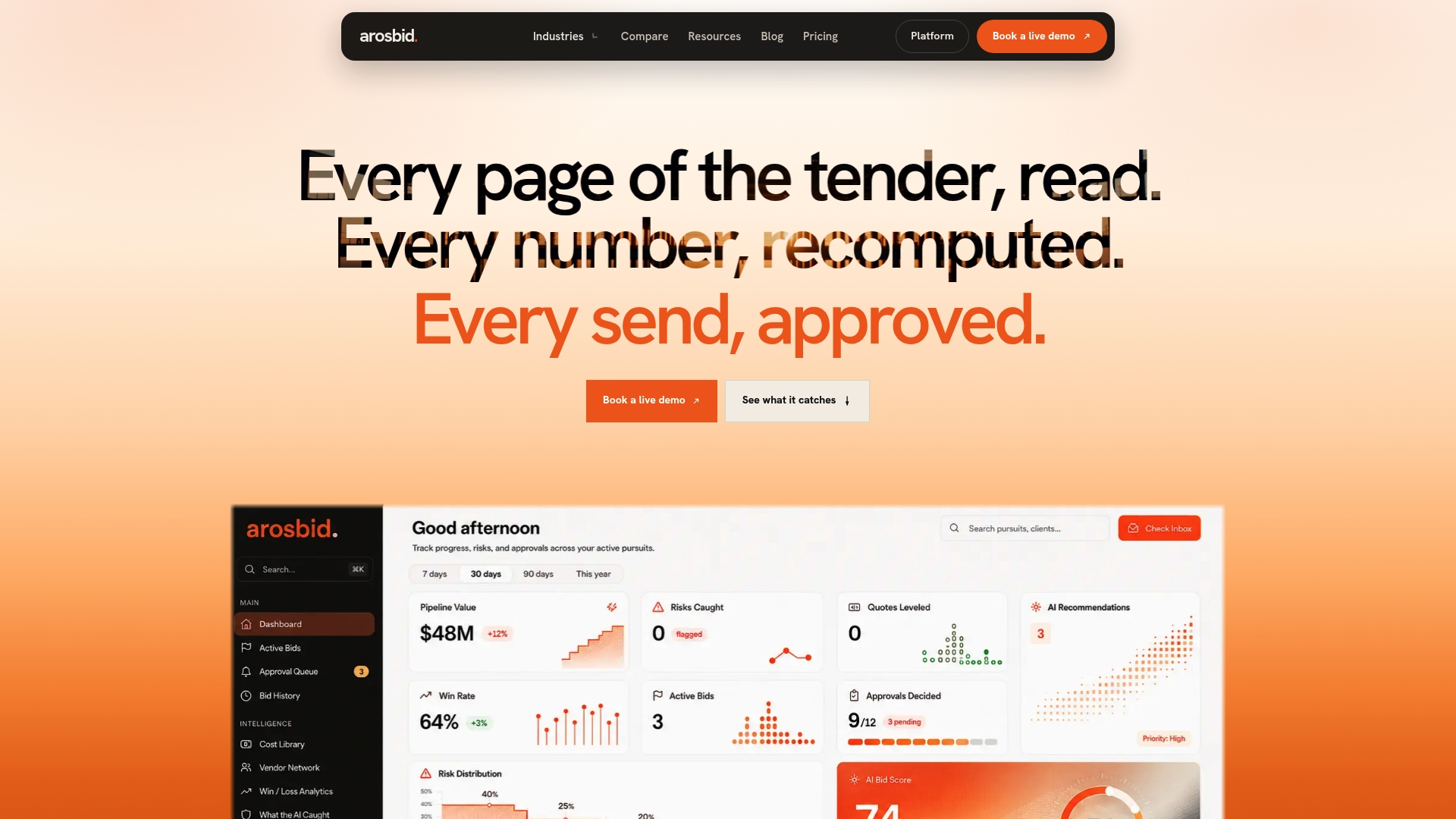
That structure pays off twice. First, cleaner vendor data sharpens the probability and impact figures that feed your EMV calculations. Second, an audit-ready draw log means you’re never scrambling to explain a contingency line to a sponsor or auditor months later. Teams managing mechanical or electrical trade bids also cut down on missed addenda that quietly inflate risk exposure after award, and firms weighing alternatives to legacy takeoff software often move over specifically for this kind of governance layer. If you’re ready to see how it fits your estimating process, book a live demo and walk through your own risk register with the team.
Sources
- Managing the contingency allowance | AIA
- Contingency Fund Management for Major Projects - Resources
- AACE recommended practice on contingency and quantitative risk impact
- Curating the Inputs for a Contingency Reserve Calculation (U.S. DOE)
- What is Contingency – Project Management Formula