Human Review in Construction Bids: 3 Stages Before Final Sign Off
Human Review in Construction Bids: 3 Stages Before Final Sign Off ! Sketch accents frame the article title Human review in bidding is the authoritative checkpoint where a qualified person inspects AI-generated or AI-assisted content against the source documents, corrects or rejects errors, records the decision, and authorizes the bid to move forward.

Human review in bidding is the authoritative checkpoint where a qualified person inspects AI-generated or AI-assisted content against the source documents, corrects or rejects errors, records the decision, and authorizes the bid to move forward. It covers eligibility, contractual commitments, pricing assumptions, and technical deliverability, not just spelling. NIST’s AI risk guidance and UK procurement guidance both point the same direction: oversight has to be designed, assigned, and documented, not assumed.
TL;DR:
- Require named specialists to sign off on eligibility, mandatory forms, contractual terms, pricing, and technical deliverability; routine formatting and spellcheck can receive lighter review.
- Check administrative eligibility first, map requirements to evidence, verify deliverability and prices independently, then complete a fresh red team review before recorded approval.
- Two UK contractor case studies devoted 6% to 9% of tender time to review meetings, including 108 and 180 working hours; schedule reviews early.
- Use AI for requirement matching and unsupported claim flags, but keep eligibility decisions, commitments, risk pricing, and final legal and commercial approval with people.
- Retain document versions, evidence links, reviewer and conflict declarations, corrections, and approval logs; buyers may request AI disclosure or verification proportionate to risk.
Table of Contents
- What human review means: roles, responsibilities, and authority
- When human sign-off is mandatory: risk-based thresholds
- Staged checkpoints: a practical sequence for your team
- Practical human-AI configuration: what to automate, what to decide
- Planning human review into the tender programme
- Documentation and audit readiness when AI is involved
- Three-stage checklist: a printable quick reference
- ArosBid team perspective: pitfalls and a pilot worth running
- How ArosBid supports human review and what to do next
- FAQ
- Sources
What human review means: roles, responsibilities, and authority
Human review works as a staged control, not a final proofread. A reviewer pauses the process, inspects the AI output beside the original source document, then corrects, approves, or rejects it before recording the decision. Only after that approval does the bid move to the next stage.
Getting this right means assigning distinct roles rather than collapsing everyone into one generic “checker.” Government procurement guidance on AI use recommends multidisciplinary teams because each specialist catches different failure modes:
- Bid manager: owns the overall timeline and sign-off sequence.
- Estimator: verifies quantities, rates, and pricing assumptions.
- Technical lead: checks method, programme, and deliverability claims.
- Commercial or contracts reviewer: flags unusual terms and liability exposure.
- Delivery lead: confirms resourcing and capacity commitments are realistic.
- Independent red-team reviewer: checks the submission fresh, without having drafted any of it.
Authority has to be defined before anyone touches an AI draft: who can correct wording, who can override a technical call, and when an issue must escalate rather than get resolved informally. NIST’s generative AI profile recommends documenting these human-AI configurations explicitly, including who owns each decision class.
Pro Tip: Write reviewer authority into the bid plan before the tender opens, not while the clock is running.
When human sign-off is mandatory: risk-based thresholds
Not every AI-touched item needs the same scrutiny. Low-risk automation, like formatting, spellcheck, or indexation, can run largely unsupervised. High-risk items cannot.
Human sign-off should be mandatory whenever an item falls into one of these categories:
- Responsiveness and eligibility determinations that could disqualify the bid.
- Mandatory forms and declarations required by the tender documents.
- Contractual commitments, including liability, warranty, or delivery terms.
- Pricing assumptions and unusual commercial conditions.
- Technical deliverability claims about programme, resources, or method.
- Any clause interpretation that could trigger rejection if misread.
UK procurement guidance treats AI-assisted responses as something that may require proportional due diligence, meaning the contracting authority can ask for clarification or verification where AI use creates specific risk. That cuts both ways: a bidder who cannot explain how a pricing figure or technical commitment was reached is exposed on both sides of the table.
The practical rule is proportionality. Match the depth of review to the consequence of getting it wrong, and document that sign-off criteria exist, which is exactly what NIST’s generative AI profile recommends for risk-based human-AI configurations.
Staged checkpoints: a practical sequence for your team
A defensible review process runs in sequence, not all at once. Each stage has a different purpose and a different owner.
- Freeze the controlling version. Lock the tender documents and draft response so everyone works from the same baseline, with confidentiality and conflict-of-interest controls in place.
- Check administrative responsiveness first. Run mandatory forms and pass/fail eligibility checks before anyone spends time on technical content; this avoids wasting specialist hours on a bid that fails on paperwork.
- Trace each requirement to the draft answer. Map every criterion in the tender to the evidence that supports it, rather than reading the response as prose.
- Review technical method and resourcing. Subject specialists check programme, resources, exceptions, and deliverability claims against what the team can actually commit to.
- Run independent price and quantity checks. Arithmetic, rates, and quantities get verified by someone who did not build the original estimate. ADB’s procurement guidance and the Maryland Procurement Manual both call for separating technical and price evaluation where the procurement method requires it.
- Hold a final red-team and approval gate. A fresh reviewer checks the completed submission end to end and records formal sign-off before it goes out.
This sequence mirrors how construction bids actually get built, where document reviews catch missed clauses before anyone finalizes pricing. Our own guide on bid document review for estimators walks through the administrative stage in more detail.
Pro Tip: Run the pass/fail admin check before the technical review. It is a useful early filter.
Practical human-AI configuration: what to automate, what to decide
AI earns its keep on volume work: exhaustive first-pass requirement-finding, mapping draft answers to tender criteria, flagging unsupported claims, summarizing long clauses, and prioritizing the gaps most likely to cost points. That is comparison and pattern-matching at scale, and it is where AI is genuinely fast.
Humans keep the decisions that carry consequence:
- Whether an eligibility interpretation is correct, not just plausible.
- Whether a contractual commitment is deliverable given actual capacity.
- How commercial or technical risk should be priced into the bid.
- What final wording the business is prepared to stand behind.
- Final legal and commercial sign-off before submission.
The configuration that works in practice pairs AI-generated findings with evidence links back to the source document, so a reviewer can check the claim in seconds rather than hunting for it. Add role-based approvals, escalation that scales with risk, and active monitoring for automation bias, which is the tendency to accept an AI output simply because it looks finished. NIST’s generative AI profile names automation bias specifically as a risk to manage through documented oversight.
AI accelerates first-pass review work, but NIST’s framework ties human oversight to the AI system’s risk context rather than treating it as optional polish. That distinction decides where your team’s review hours should actually go. Our AI tender review guide covers the evidence-linking pattern in more depth for construction bids specifically.
Planning human review into the tender programme
Review meetings are not a rounding error in the schedule. In two observed UK contractor case studies, review meetings consumed 6 to 9 percent of the total tender period, amounting to 108 working hours in one contractor and 180 in another. Those figures are case-specific, not a universal benchmark, but they make a clear point: review time needs a line in the programme, not leftover minutes before submission.
Construction tender research found that four review meetings in particular, at launch, mid-tender, clarification, and finalization, materially affected the submission. Build your schedule around the key review moments and protect the people who need to be in the room:
- Reserve calendar blocks for reviewers at each key stage, not just at the end.
- Set a hard cut-off for content submission ahead of the final red-team, so it reviews a finished draft rather than a moving target.
- Protect technical and commercial reviewers from last-minute pricing changes that bypass the sequence.
Documentation and audit readiness when AI is involved
Keep a record that would survive a challenge or a clarification request. At minimum, retain the controlling document version, the evidence trace linking each answer to its requirement, reviewer declarations and conflict-of-interest statements, arithmetic corrections, scoring notes, and the final approval log. ADB’s procurement guidance frames this kind of trail as necessary for fairness and audit readiness, not optional paperwork.

UK procurement guidance on AI disclosure confirms that using AI is not automatically disqualifying, but contracting authorities may add disclosure questions to tender documents and request proportional verification, such as clarifications or a supplier presentation, where AI use creates specific risk. Bidders who can show exactly where AI assisted and where a human signed off are far better positioned to answer those questions quickly.
A simple file structure helps: one folder per bid stage, with metadata on each reviewer action recording who reviewed it, what was checked, what changed, and when it was approved. Our bid compliance checklist lays out a pass/fail-first structure that pairs well with this kind of audit trail.
Three-stage checklist: a printable quick reference
Paste this into your bid calendar or review pack for live use.
- Stage 1, freeze and admin. Freeze the controlling documents, run responsiveness and mandatory form checks, confirm confidentiality and conflict declarations are on file.
- Stage 2, technical and commercial. Trace every requirement to its supporting evidence, review deliverability against actual resourcing, and record any exceptions or deviations in writing.
- Stage 3, price and red-team. Run independent arithmetic and rate checks separate from the original estimator, complete a fresh red-team pass, and log the final approval.
Pro Tip: Keep Stage 3’s price check and red-team review with two different people. A single reviewer checking both tends to miss the same error twice.
Our 3-stage estimate review checklist breaks Stage 3’s price and quantity checks into finer detail if your team wants a deeper reference.
ArosBid team perspective: pitfalls and a pilot worth running
The recurring problems we see are not about AI quality. They are about structure: reviewer authority that was never written down, sign-off happening in the last hour before submission, teams trusting an AI-generated summary without checking the source clause, and audit trails that exist only in someone’s inbox.
The fix does not require a full process overhaul. Run a pilot on a few bids with the staged checkpoints above, track review hours and the types of errors caught at each stage, then adjust your sign-off thresholds based on what actually shows up. Document the pilot results and turn them into your standing oversight rules rather than relying on memory next tender cycle.
— arosbid team
How ArosBid supports human review and what to do next
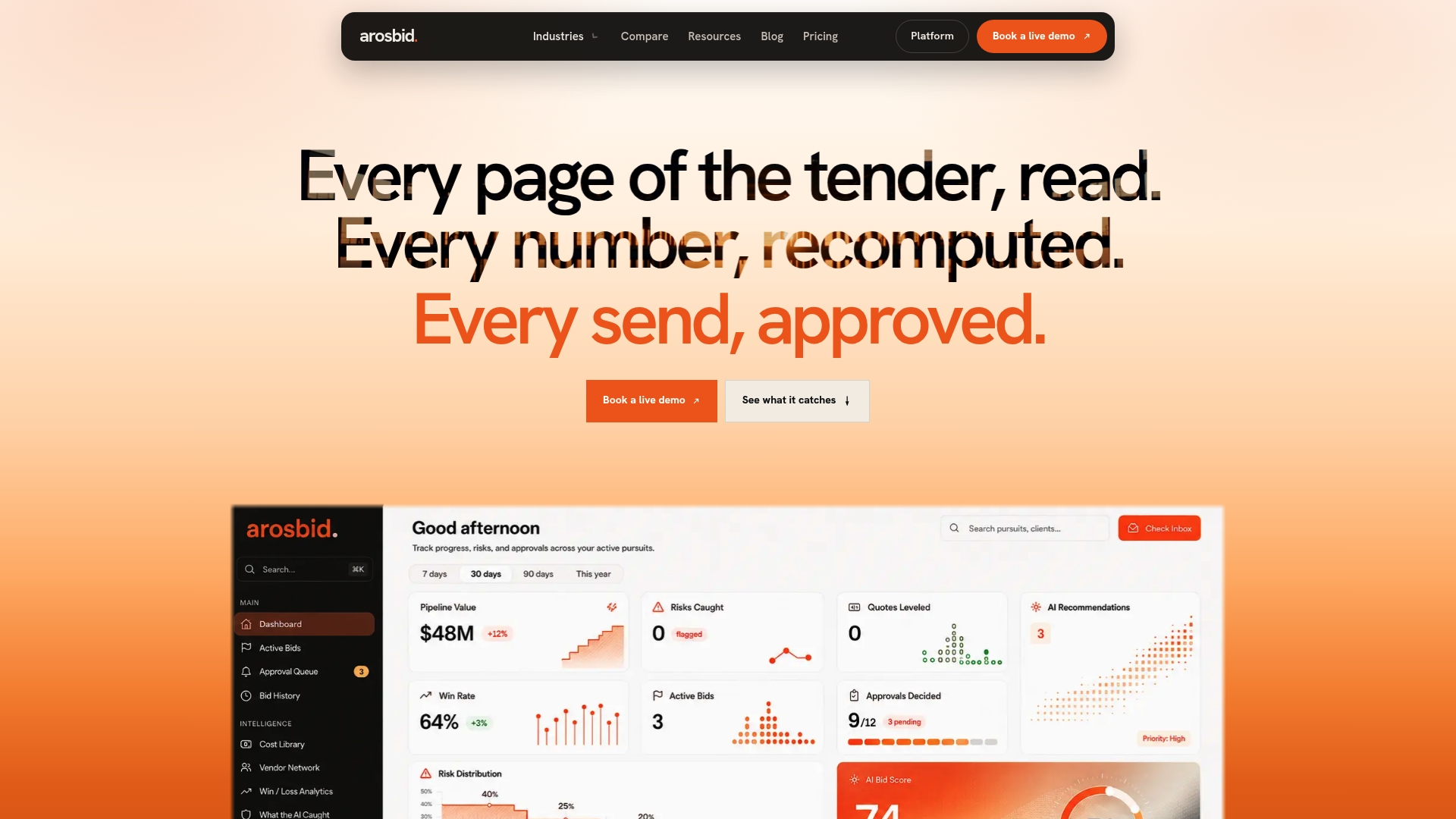
A platform can handle first-pass document review and compliance checks, while sign-off authority stays exactly where it belongs: with your team. That is the structure our Trade Bid Command Center is built around, reading the full document set, including front-end clauses, and surfacing what needs a human decision without taking that decision away from you.
If you want to test this on real bids, our guide to running a bid pilot walks through measuring review hours and error types before you commit. When you are ready to see the workflow directly, you can book a live demo or check plan details on our pricing page, which lists One Desk, The Department, and The Whole Year.
FAQ
What is a human review?
A human review is a checkpoint where a qualified person inspects content, in bidding specifically an AI-generated or AI-assisted draft, against the source documents before it moves forward. The reviewer corrects or rejects errors, records the decision, and authorizes the next stage, rather than simply reading for style.
What are the two main methods of bidding?
Bidding generally runs on price-led evaluation or quality and value-led evaluation, sometimes combined through weighted scoring. Human review matters in both, since compliance, pricing assumptions, risk, and supporting evidence all affect the outcome regardless of which method a buyer uses.
What are the steps involved in a bid review process?
A defensible process freezes the controlling document version, checks administrative responsiveness and mandatory forms first, then traces each requirement to supporting evidence. From there it reviews technical deliverability, runs independent price and arithmetic checks, and finishes with a red-team pass and a recorded approval before submission.
Is it true that AI lacks human judgment?
AI can classify, summarize, compare, and draft content quickly, but it does not hold an organization’s authority to accept deviations, commit capacity, or approve legally binding submissions. NIST’s guidance recommends documented human oversight proportional to risk because those judgment calls stay with people.
Sources
For readers who want the original guidance: UK procurement guidance on AI disclosure, NIST’s generative AI risk profile, ADB and Maryland procurement guidance on staged evaluation, and the construction tender review meetings study. For engineering-specific context on where AI genuinely helps, see this practical look at AI in structural engineering.