Stop Late Change Orders: Bid Document Review in 5 Steps for Estimators
Stop Late Change Orders: Bid Document Review in 5 Steps for Estimators ! Bid document review title card illustration A bid document review finds the ambiguities, missing quantities, and coordination conflicts hiding between the specifications, drawings, and Bill of Quantities before you commit a price to paper.
A bid document review finds the ambiguities, missing quantities, and coordination conflicts hiding between the specifications, drawings, and Bill of Quantities before you commit a price to paper. Catch them early and you price the actual scope instead of a padded guess. The fastest path there combines a scoped checklist with an automated first pass, tools like arosbid included, followed by a human sign-off before submission.
TL;DR:
- A bid document review identifies scope ambiguities, missing quantities, and design conflicts early, enabling accurate pricing and reducing change orders.
- Key documents to scrutinize include the Bill of Quantities, drawings, specifications, and contract terms, with the BoQ responsible for nearly half of quality issues.
- The review process should be completed within one to three weeks, involving intake, detailed checks, cross-discipline coordination, and early RFI routing.
- Automated tools can assist with pattern matching and flagging issues, but human validation is essential for evaluating risk and context.
- A comprehensive, audit-ready report prioritizes risks, annotates conflicts, and includes cost impact estimates to support defendable and transparent bid decisions.
Table of Contents
- What Bid Document Review Means and When to Run One
- Which Tender Documents Deserve the Closest Look
- A Review Workflow You Can Actually Run on a Bid Deadline
- The Defects That Actually Change Your Price
- Where Automation Fits and Where It Doesn’t
- Turning Findings Into an Audit-Ready Report
- What Disciplined Reviews Actually Change
- How ArosBid Handles Bid Document Review
- Where This Article Draws Its Evidence
- Sources
- FAQ
What Bid Document Review Means and When to Run One
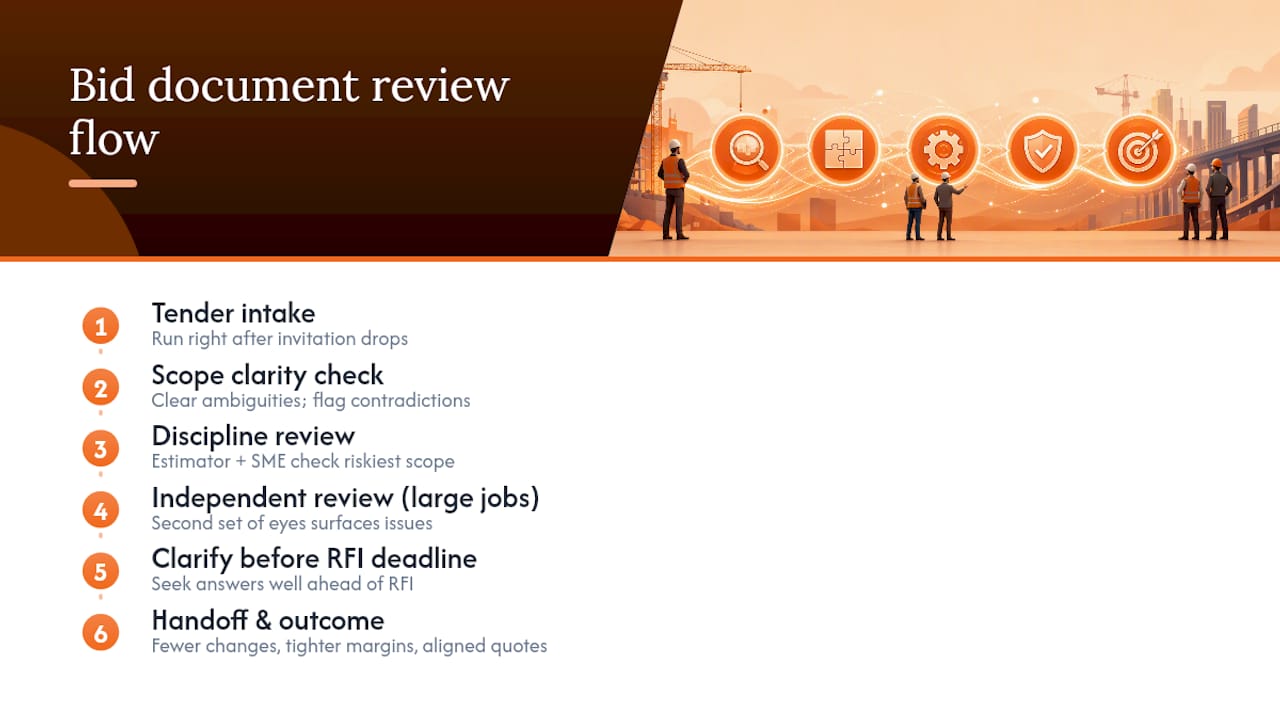
Bid document review is the structured check of every tender document before pricing, aimed at clearing up scope ambiguity, flagging contradictions between disciplines, and tightening price accuracy before a number leaves your office. Done well, it also produces a paper trail you can defend if a bid gets challenged.
Most shops put the estimator in charge, backed by a discipline subject-matter expert (mechanical, electrical, structural, whoever owns the riskiest scope) or, on larger jobs, an independent reviewer with no stake in the number. That second set of eyes matters. Independent reviews of tender packages tend to surface issues that reduce surprises for contractors, which lets teams price against a clear scope instead of stacking contingency on top of contingency.

Run the review right after the invitation to bid drops, before takeoff starts and well ahead of the RFI deadline. Wait until pricing is underway and you’re just confirming assumptions you’ve already baked into the number. The payoff shows up later: fewer change orders, tighter margins, and vendor quotes that actually match what you bid.
Which Tender Documents Deserve the Closest Look
Not every page in a bid package carries equal risk. Research into tender document quality found that the Bill of Quantities drives roughly 46.7% of quality problems, with design drawings responsible for another 27.5%, terms and conditions at 13.8%, and specifications at 12%. That’s your triage order right there.
Start with the documents that move the needle most, then work down:
- Bill of Quantities. Check for missing line items, quantity math errors, and gaps between BoQ units and what the drawings actually show.
- Drawings and specifications. Cross-reference every discipline. A spec calling for one material and a drawing detailing another is the single most common conflict reviewers catch.
- Invitation to bid and instructions. Confirm submission format, bonding requirements, and deadline logic; a missed formatting rule can disqualify an otherwise strong bid.
- Contract terms and conditions. Flag ambiguous liability clauses, unusual retainage terms, and payment schedules that don’t match your cash flow.
- Addenda. Verify every addendum is logged and incorporated. Addenda issued late in the cycle are the most frequently missed items on a bid team’s checklist.
- Geotechnical reports and site data. Look for gaps between reported soil conditions and what the drawings assume for foundation work.
Public-sector checklists, including the Montana CDBG bid document review checklist, also flag bid security, bond forms, and wage-rate references as items reviewers routinely skip under deadline pressure. Treat those as high priority, not paperwork.
A Review Workflow You Can Actually Run on a Bid Deadline
A review that isn’t scoped to your bid calendar just becomes another task nobody finishes. Here’s a workflow that fits inside a normal turnaround:
- Intake and triage (24 to 48 hours). Log every document received, confirm the package is complete, and flag any missing exhibits immediately, since a request to the owner takes time to answer.
- Detailed discipline checks (one to three weeks, scaled to project size). Assign each trade scope to the estimator or SME who owns it; run BoQ and drawing checks in parallel rather than sequentially.
- Coordination sweep. Cross-check findings across disciplines to catch conflicts no single reviewer would spot alone, like a mechanical clash buried in a structural detail.
- Cost-impact log. Attach a dollar or schedule estimate to every open issue so leadership can see which ones actually matter before bid submission.
- Final report and RFI routing. Convert unresolved issues into formal RFIs early enough that the owner’s answer arrives before your bid is due, not after.
Route every clarification through one channel, whether that’s a shared log or a platform, so nothing gets answered twice or missed entirely.
The Defects That Actually Change Your Price
Some review findings are cosmetic. Others reshape your number entirely. Watch for these:
- Spec-versus-drawing contradictions. A specified material that doesn’t match the drawn detail forces a pricing assumption you’ll have to qualify or absorb.
- Missing quantities in the BoQ. A line item left blank or a quantity that doesn’t reconcile with the drawings means someone is about to underprice a scope.
- Ambiguous terms and conditions. Vague liquidated-damages language or undefined retainage terms shift risk onto the bidder without pricing it in.
- Coordination conflicts between trades. Ductwork routed through a structural member the drawings never flagged is the kind of clash that surfaces as a change order six months into construction.
- Absent approvals or permits. A bid package missing permit status or pre-approval documentation can delay mobilization even after award.
Pro Tip: When you can’t resolve an ambiguity before the bid deadline, don’t guess. Write a qualifier directly into your proposal (“Bid assumes structural steel per Detail 4/S3; conflicting Spec Section 05120 excluded pending clarification”) so your price is defensible if the discrepancy surfaces later.
Where Automation Fits and Where It Doesn’t
Automated scans are good at pattern matching across hundreds of pages fast, flagging where a spec section references a drawing detail that doesn’t exist, or where a BoQ quantity doesn’t reconcile with the drawings. What they can’t do is judge context, weigh contractual risk, or decide which conflict is worth an RFI versus a pricing note.
The workflow that works: automated first pass, ranked issue list, human validation, then the finding gets folded into the estimate. Vendors promoting AI-assisted bid review are upfront that human reviewers still need to validate every flagged item and own the legal accountability for the final number. An audit trail matters here as much as the scan itself:
- Every flagged issue needs a reviewer name and timestamp attached.
- Sign-off should happen before the finding is dropped from the register, not after.
- Keep the original scan output alongside the human notes, not overwritten by them.
Platforms like ArosBid’s AI tender review run this exact pass, surfacing missed clauses and conflicting specs across trade modules like structural steel and roofing before a human ever opens the file.
Turning Findings Into an Audit-Ready Report
A review that lives in someone’s inbox doesn’t help anyone. Structure the deliverable so an owner, a legal reviewer, or your own team can follow it months later. The ADB’s procurement guidance recommends disclosing evaluation methodology and keeping records that hold up under audit, and UK bid-evaluation guidance points to a multi-year retention window, at least three years, to support debriefs or challenges.
Build your report around these sections:
- Executive summary of top risks
- Prioritized issue register with severity ratings
- Annotated drawings showing exact conflict locations
- Suggested clarifications or addenda language
- Cost and risk exposure table
| Issue | Discipline | Severity | Estimated Cost Impact |
|---|---|---|---|
| BoQ quantity gap, Section 3 | Concrete | High | To be priced |
| Spec/drawing conflict, roofing membrane | Roofing | Medium | To be priced |
| Ambiguous retainage clause | Contract terms | Medium | Not applicable |
Version-control every draft, timestamp each sign-off, and store the final package somewhere your team can retrieve it fast if a dispute surfaces later.
What Disciplined Reviews Actually Change
Teams that institutionalize this process stop discovering scope problems on-site, months after award, when they’re expensive to fix. They also debrief better, because a documented issue register gives you a real answer when an owner asks why your price came in where it did. Keep your checklist templates current every bid cycle. A stale template misses the addendum pattern that just changed on your last three jobs.
— arosbid team
How ArosBid Handles Bid Document Review
Manually cross-checking a Bill of Quantities against forty pages of drawings on a Friday afternoon before a Monday bid deadline is where most teams lose margin, not on the job site. arosbid runs an AI tender scan against your full document package, flags missing clauses and conflicting specs, and builds a ranked issue register your estimator reviews and signs off on before the number goes out.
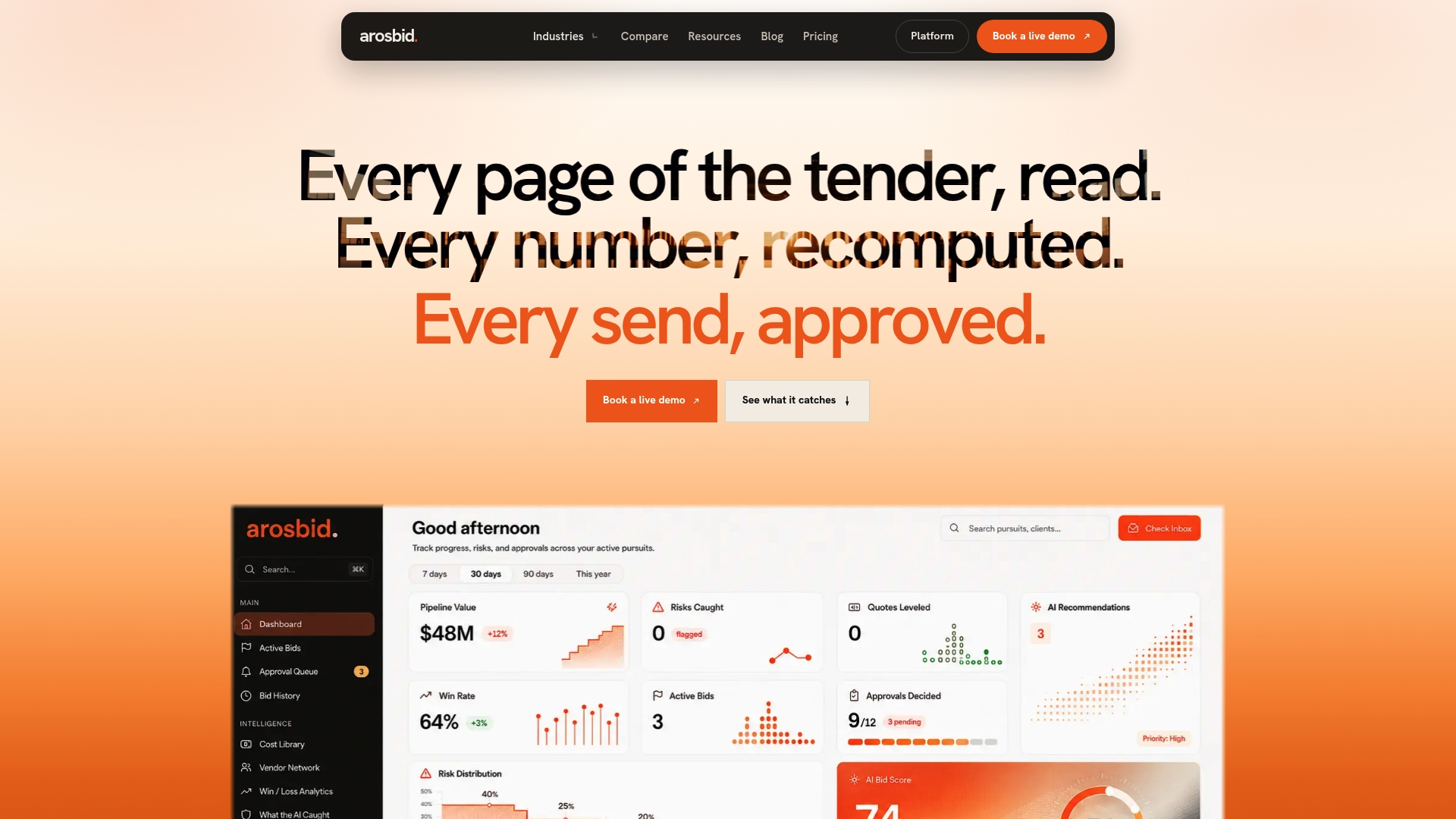
The platform tracks vendor quotes and approvals in one command center, so a clarification raised during review doesn’t get lost between an email thread and a spreadsheet. It connects to Excel and Outlook directly, so your team isn’t abandoning the tools they already trust. Trade-specific modules cover roofing, structural steel, and electrical scopes, each tuned to the conflicts that show up most often in that discipline’s documents.
If your team is still catching coordination conflicts after submission instead of before it, book a live demo and see how the construction bid management platform handles your next package.
Where This Article Draws Its Evidence
The ADB procurement guidance note covers documented evaluation methodology. UK bid-evaluation guidance sets retention standards. The Tender Documents Quality Index study supplies the BoQ and drawing weighting. The Montana CDBG checklist informs the item-by-item checks. For due diligence practices beyond document review itself, SzopaLabs’ contractor verification guide covers what to check before signing a contract.
Sources
- Assessment of Tender Documents Quality Index
- Bid evaluation: Procurement guidance note (ADB)
- Bid evaluation guidance note (UK government)
- CDBG bid document review checklist (Montana)
FAQ
How Do You Evaluate a Bid Document?
Evaluate a bid document by cross-checking the Bill of Quantities against drawings and specifications, confirming terms and conditions are unambiguous, and logging every discrepancy in a prioritized issue register before pricing.
What Is the Process of Document Review?
The process runs from intake and triage through detailed discipline checks, a coordination sweep across trades, a cost-impact log, and a final report, typically taking one to three weeks depending on project size.
What Is a Bid Review?
A bid review is the structured examination of tender documents, specifications, drawings, and contract terms to catch ambiguities and conflicts before a contractor submits a price, reducing the risk of underbidding or disqualification.
How Much Does It Cost to Have a Legal Document Reviewed?
Costs vary widely by document complexity and reviewer type, from an in-house estimator’s time to outside legal counsel billing by the hour; most construction teams handle bid document review internally or with software like arosbid rather than paying per-document legal fees.
Who Should Perform a Bid Document Review?
The estimator typically leads the review, supported by discipline subject-matter experts for complex scopes, or an independent reviewer on larger projects where a second, unbiased set of eyes reduces the risk of missed conflicts.