Project Managers: Run a 16 Point Scope of Work Review Before Signing
Project Managers: Run a 16 Point Scope of Work Review Before Signing ! Construction scope review title card A scope of work review checks that a document's boundaries, deliverables, and acceptance criteria are clear enough to protect both sides once work starts.
A scope of work review checks that a document’s boundaries, deliverables, and acceptance criteria are clear enough to protect both sides once work starts. The first thing to check: does every deliverable have a matching acceptance test, and does the SOW state what’s excluded, not just what’s included? From there you land on one of three calls: proceed, ask for clarification, or walk away.
TL;DR:
- Critical sections like acceptance criteria and change control clauses often omit named approvers or response timelines, which can lead to silent rejections or uncontrolled scope changes.
- Cross-referencing discovery findings, referenced drawings, and contractual terms before review helps identify gaps, contradictions, or unsupported assumptions early.
- Using automated clause checks alongside team judgment improves detection of missing signatures, inconsistent dates, or contradictory obligations, streamlining the review process.
- The SOW should stay between five and fifteen pages, with explicit roles, clear milestones, and recorded decisions to prevent delays caused by unresolved blockers.
Table of Contents
- What a Scope of Work Review Checklist Should Cover
- What to Inspect in Each Key SOW Section
- How to Run a SOW Review Step by Step
- Common Red Flags That Derail Projects
- A Structured Workflow for Reviewing Bid Documents
- Team Policies Worth Adopting for Every SOW Review
- A Structured Alternative to Manual Bid Tracking
- Sources
- FAQ
What a Scope of Work Review Checklist Should Cover
A scope of work is the document both sides point to when there’s a disagreement about what was promised. That makes a scope of work review less about reading comprehension and more about pressure testing. You’re looking for the places where two reasonable people could read the same sentence and walk away with different expectations.
Run through this order when you sit down with a SOW:
- Project overview and objectives. Does the stated goal match what came out of discovery calls or a pre-bid walkthrough? A mismatch here usually means someone edited the SOW after the scoping conversation and forgot to update the summary.
- Tie to discovery. Check that any site visit, survey, or intake findings actually show up in the document. If discovery flagged asbestos risk or an unusual access point, that detail needs to appear in writing, not just live in someone’s notes.
- Deliverables. List every output by name. Vague deliverables (“provide design support”) are a warning sign.
- Formats. Confirm the file types, drawing standards, or reporting formats required for handoff.
- Acceptance criteria. Every deliverable needs a defined approver and a test for “done.”
- Timeline. Separate hard dates (contractual, penalty-bearing) from soft ones (target, estimate).
- Milestones. Confirm each milestone ties to a deliverable, not just a calendar date.
- Dependencies. Flag anything that depends on another party’s timeline, permit, or delivery.
- Roles and responsibilities. Name who does what, not just which company is responsible.
- Assumptions. Every assumption should trace back to something documented in discovery.
- Exclusions. List what’s explicitly out of scope, in the same level of detail as what’s in.
- Handovers. Identify every point where one trade or team hands work to another.
- Access and protection. Confirm site access terms and who protects finished work from damage.
- Change control. Verify there’s a real process for requesting, pricing, and approving changes.
- Payment triggers. Confirm what event releases each payment, not just a date.
- Sign-off authority. Name the specific person who can approve or reject deliverables.
As you go, mark each item Blocker, Clarify, or Accept, and note the evidence behind each call: a quoted sentence, a missing section, a contradiction with the referenced drawings. That running log becomes your scope review packet, and it should include a short discovery alignment note, your open questions, and a recommended decision. Handing a stakeholder a one-page packet beats sending a marked-up PDF and hoping they read it the same way you did.
Pro Tip: Keep a running tally of “Clarify” items in a shared doc as you read, instead of stopping to email each question separately. Batching questions into one request respects the other side’s time and usually gets you faster answers.
What to Inspect in Each Key SOW Section
Some sections of a SOW carry more risk per sentence than others. Here’s what “good” looks like when you inspect each one closely.
Deliverables. A strong deliverable is a measurable output with a stated format and a named handoff artifact, not a description of effort. “Deliver a structural framing plan in PDF and native CAD format, stamped by a licensed engineer” tells you exactly what arrives and how you’ll know it’s real. “Provide structural engineering support” tells you nothing you can hold anyone to.
Acceptance criteria. This is where most disputes start, according to the checklist guidance from ContractHQ, which flags named approvers, cure periods, and deemed-acceptance timeouts as the pieces most often left out. Check for four things: who approves, how they verify the work, how long they have to respond, and what happens if they say nothing. A SOW that’s silent on that last point often defaults to “deemed accepted” after a set window, which can quietly waive your right to reject bad work.
Exclusions and assumptions. These two sections should read like mirror images of the discovery findings. If the site survey noted uneven subfloor conditions, the assumptions section should state that pricing assumes normal subfloor conditions, and the exclusions should state that remediation for abnormal conditions is billed separately. When exclusions are missing entirely, Atlassian’s breakdown of SOW components treats that gap as one of the most common sources of disputes, because everyone assumes their own version of “included.”
Timeline and milestones. Look for language that addresses what happens when a milestone slips. Does a delay in one trade’s handover push the whole schedule, or does the SOW specify float? A timeline with no slippage language is a timeline that will generate a change order the first time something runs a day late.
Roles, responsibilities, and handovers. This is where Build Design Hub’s document review checklist earns its place: it recommends physically walking the boundary between rooms, floors, or trades to find handovers nobody assigned. A door frame installed by one trade and painted by another sounds simple until the SOW never says who patches the wall around it.
Change control. A workable change-control clause names four things: how a change gets requested, who estimates the cost and time impact, who approves it, and how the new price gets documented against the original contract. If the SOW just says “changes will be handled via written agreement,” that’s not a process. That’s a placeholder for a future argument.
One more thing worth checking: whether the SOW and the Master Service Agreement contradict each other. ContractHQ’s guidance on this is blunt: general legal terms like indemnity and confidentiality belong in the MSA, and engagement-specific terms belong in the SOW. When a SOW duplicates or rewrites MSA language, you get two documents saying slightly different things about liability, and lawyers will bill hours sorting out which one wins.
How to Run a SOW Review Step by Step
- Prepare. Pull the discovery notes, any referenced drawings or specifications, and the MSA if one exists. Cross-reference the SOW against all three before you read a single line of scope language.
- First pass, read for edges. Read the whole document once looking only for scope boundaries, exclusions, and assumptions. Mark anything unclear with a question, not a guess.
- Second pass, map deliverables. Read again, this time matching every deliverable to an acceptance criterion and a place on the timeline. Flag any deliverable with no test for “done,” and flag any work you can’t trace to an owner.
- Workshop the blockers. Bring your marked-up list to a short session with the team. Rank open questions by how much they’d change price or schedule, and assign a specific owner to chase each one.
- Decide and record. Land on proceed, clarify, re-scope, or decline, and write down why. That record is what protects you later if someone asks why the project started under these terms.
Pro Tip: Time-box the workshop pass to 30 minutes for a typical trade SOW. If you can’t resolve the blocker list in that window, the SOW usually needs a re-scope conversation with the client, not more internal debate.
Common Red Flags That Derail Projects
Most scope of work disputes trace back to a handful of repeat offenders. Watch for these:
- Vague deliverables with no acceptance test. If you can’t describe what “done” looks like in one sentence, the SOW doesn’t say it either. Push for specific, testable language before you sign.
- Unstated exclusions. Silence on exclusions isn’t neutral. It usually means the client will assume it’s included and you’ll assume it isn’t.
- Unassigned handovers between trades. Anywhere two trades meet, someone needs to own the standard of preparation. If nobody’s named, that gap becomes a change order.
- Deemed-acceptance traps. A response window with no stated consequence for silence tends to default in the drafting party’s favor. Read that clause twice.
- Change control with no named approver. A change process that doesn’t say who signs off isn’t a process. It’s a delay waiting to happen.
Lawyers reviewing SOWs on behalf of clients tend to check exactly these points first, according to Sprintlaw’s overview of SOW legal review, which frames scope specificity, exclusion lists, and sign-off rules as the levers that determine who’s protected when something goes wrong. When a SOW has more than two or three of these gaps at once, that’s usually the signal to bring in legal counsel or propose a short paid discovery phase before committing to a fixed price.
A Structured Workflow for Reviewing Bid Documents
Pairing a checklist with tracked approvals catches more than either does alone. Human reviewers are better at judgment calls, spotting a contradiction between an exclusion clause and a drawing note, or sensing that an assumption doesn’t match what a site visit turned up. Automated checks are better at the repetitive scanning work: flagging every deliverable missing an acceptance clause, or catching a mismatched date between the SOW and the referenced contract.
- Automate the mechanical checks: clause presence, date consistency, missing signature blocks, cross-document contradictions.
- Reserve human judgment for anything involving risk interpretation, pricing exposure, or ambiguous language.
- Build your scope review packet around five pieces: a discovery summary, the deliverables list, exclusions, open questions, and a recorded decision.
Pro Tip: Run your automated clause check before the human read-through, not after. It clears the mechanical noise so your reviewers spend their time on judgment calls instead of typo-hunting.
Team Policies Worth Adopting for Every SOW Review
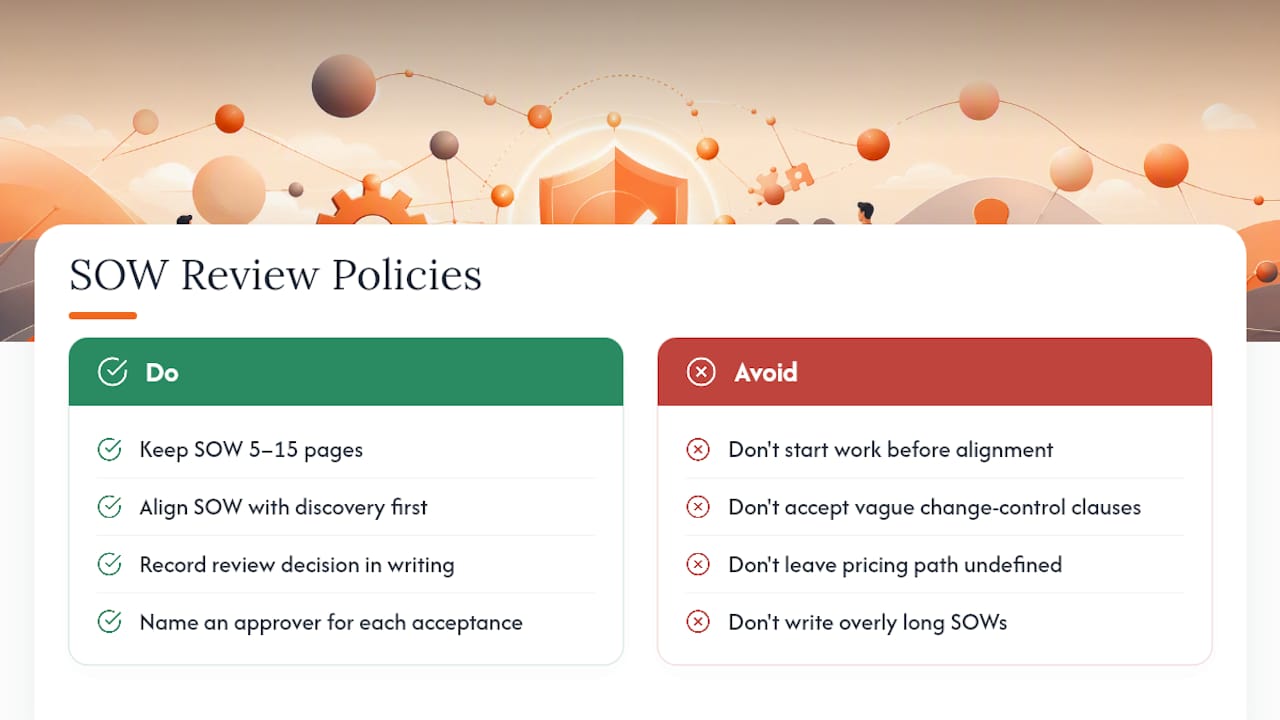
Target 5 to 15 pages for a SOW. Long enough to be complete, short enough that people actually read it. Adopt a firm rule: no work starts until the SOW and discovery findings align and someone has recorded the review decision in writing. Require a named approver for every acceptance point, and never accept a change-control clause without a clear path for requesting and pricing changes.
(attributed to the team behind the guidance)
A Structured Alternative to Manual Bid Tracking
arosbid is built for teams that are done chasing scope gaps across spreadsheets, email threads, and marked-up PDFs. It reads the full set of bid documents, front-end clauses included, and flags missed clauses or conflicting specifications before they cost you a disqualification or a change order fight.
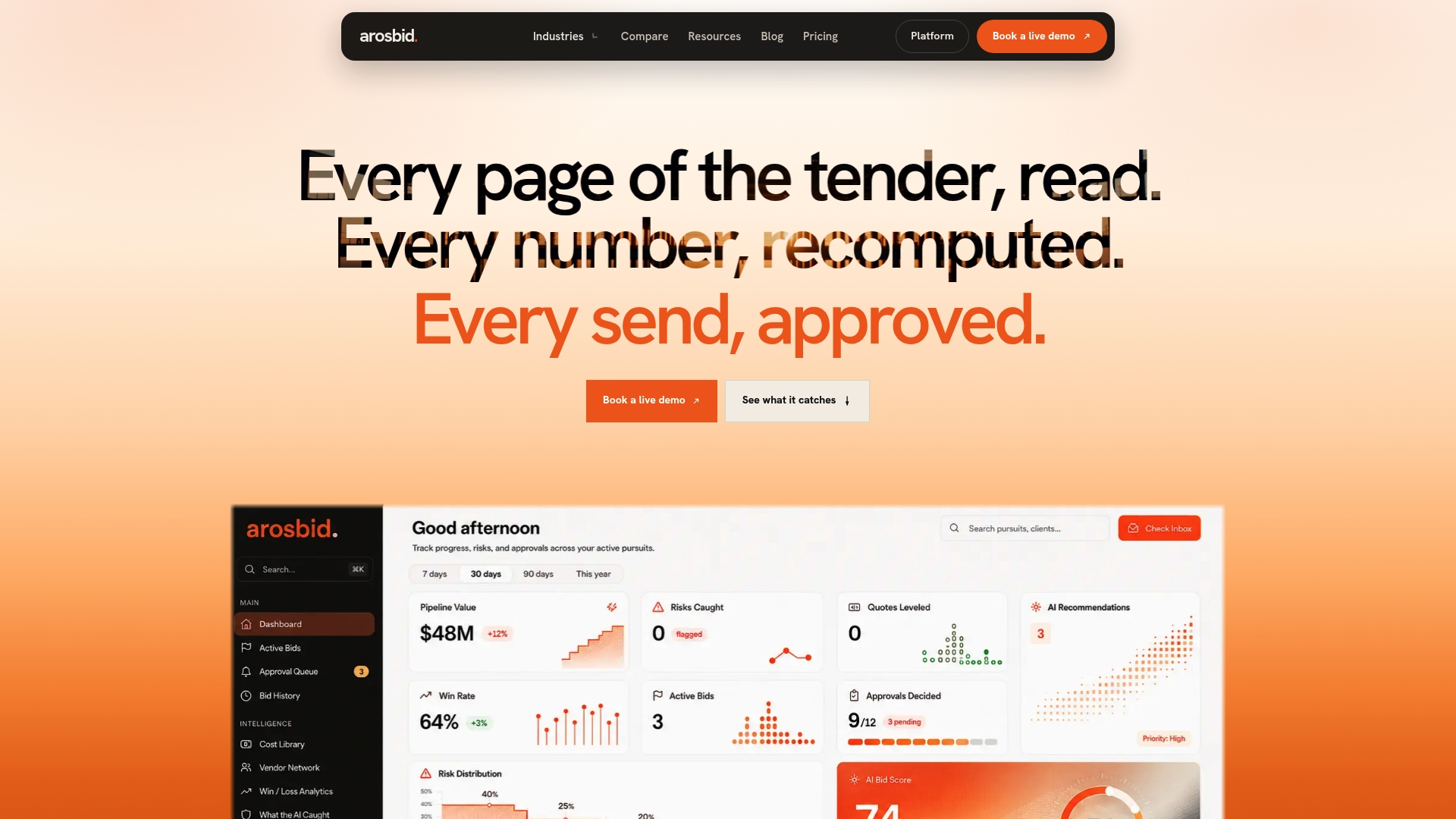
The platform tracks vendor quotes, levels them side by side, and routes approvals through a structured command center that integrates with Excel and Outlook, so your estimators and bid teams aren’t forced to abandon tools they already know. It fits construction estimators, bid managers, and subcontractors who review SOWs and bid packages on a recurring basis and need a documented, repeatable process rather than a fresh spreadsheet every time. ArosBid offers three plans, One Desk, The Department, and The Whole Year, scaled to how many bids your team runs. If your next SOW review is riding on catching every exclusion and acceptance clause the first time, book a live demo and see the command center on your own bid documents.
Sources
- Scope of work: definitions and components — Atlassian
- Scope of Works Document Review Checklist — Build Design Hub
- SOW checklist: what belongs in the Statement of Work vs the MSA — ContractHQ
FAQ
How Do You Describe the Scope of Work?
A scope of work describes the specific tasks, deliverables, timeline, and boundaries of an engagement, along with who’s responsible for what. Good SOW language states measurable outputs and named approvers rather than general descriptions of effort, according to Atlassian’s SOW framework.
What Is the Scope of a Review?
A scope of work review checks whether the deliverables, timeline, exclusions, and acceptance criteria in a SOW are specific enough to prevent disputes once work begins. It ends in one of three calls: proceed, request clarification, or decline the project.
How Do You Write a Scope of Work Statement?
Start with a clear project overview tied to discovery findings, then list deliverables with formats and acceptance tests, a timeline with hard and soft dates, named roles, and explicit exclusions. Keep the document between roughly 5 and 15 pages so it stays complete without becoming unreadable.
What Is a SOW Review?
A SOW review is the process of checking a scope of work document against discovery notes, referenced drawings, and contract terms to confirm the boundaries and deliverables are clear before work starts. Teams using a structured approach, including platforms like arosbid, combine a manual checklist with automated clause checks to catch missed exclusions and conflicting specifications before submission.
What Happens If a SOW Review Finds a Blocker?
A blocker means the project shouldn’t start until the issue is resolved, usually through a clarification request, a paid discovery phase, or a re-scope of the pricing and deliverables. The decision and the reason behind it should be recorded in writing before any work begins.