Nine Step Pre Bid Agenda and Job Walk Checklist for Construction PMs
Nine Step Pre Bid Agenda and Job Walk Checklist for Construction PMs ! Construction bid checklist title card illustration A pre-bid meeting checklist secures three things: a signed attendance record, a documented Q&A log, and any addenda triggered by the discussion.
A pre-bid meeting checklist secures three things: a signed attendance record, a documented Q&A log, and any addenda triggered by the discussion. Nothing said in the room changes the bid documents. Only written addenda do that. Whether you’re chairing the meeting or showing up to bid, that checklist is what protects the paper trail you’ll need weeks later.
TL;DR:
- Ensuring a signed attendance record, documented Q&A log, and written addenda during pre-bid meetings protects against later compliance issues.
- Following a fixed agenda covering scope, deadlines, document control, and site safety streamlines communication and reduces time-wasting questions.
- Bringing or having accessible the full, current set of bid documents, including drawings and addenda, prevents bid disqualification due to version mismatches.
- Assigning specific roles for the chair, engineer, and procurement ensures clear answers, avoids informal commitments, and maintains document authority.
- Using structured site walk and question procedures, including timestamped photos and logged queries, minimizes surprises and errors during bidding.
Table of Contents
- Master Pre-Bid Meeting Agenda and Checklist
- Documents and Materials to Bring
- Who Runs the Meeting and Who Can Commit Changes
- Site Visit and Job Walk Checklist
- Running the Q&A: Live, Pre-Submitted, and Deferred Questions
- Minutes, Addenda, and What Happens Next
- Pro Tips and Common Pitfalls to Avoid
- What Structured Checklists Change About Bid Risk
- A Faster Way to Track Attendance, Q&A, and Addenda
- Sources
- FAQ
Master Pre-Bid Meeting Agenda and Checklist
A pre-bid meeting agenda works best when it follows a fixed order every time, because bidders start recognizing the pattern and stop wasting time on logistics questions that belong in the documents. The Tennessee A52 template builds around exactly this structure: attendance first, technical content second, procedural rules third, and open questions last.
Here’s a copyable sequence with suggested timing for a typical commercial project:
- Welcome and sign-in (5 minutes) — collect name, firm, phone, and email for every attendee; this becomes your attendance record.
- Project summary and scope highlights (10 minutes) — technical lead walks through drawings, key systems, and any unusual scope items.
- Bid deadline, location, and submission format (5 minutes) — procurement lead confirms date, time, portal or physical drop location, and the required format (sealed envelope, electronic upload, etc.).
- Document control review (5 minutes) — clarify which document set is authoritative if versions conflict.
- BOQ, alternates, and unit price items (10 minutes) — walk through how bidders should reference line items in their proposal.
- Insurance, bonds, and required certificates (5 minutes) — state minimum coverage amounts and certification deadlines.
- Site access, staging, and safety constraints (10 minutes) — cover hours of operation, badge requirements, and any occupied-space restrictions as outlined in the OSHA restroom requirements guidelines.
- Question-and-answer block (15 to 20 minutes) — open floor, numbered by query.
- Closing remarks and corrigendum timetable (5 minutes) — tell bidders when to expect written answers.
A typical mid-size project pre-bid meeting lasts about an hour to an hour and a half. Complex jobs with multiple trades often split the Q&A block into two rounds, one after the technical overview and one at the end.
Documents and Materials to Bring
Both hosts and bidders need the same paper trail in front of them, or the meeting turns into a document-hunting exercise instead of a substantive conversation. NC State’s pre-bid conference checklist treats this as a pre-meeting responsibility, not something to sort out live.
Bring or have accessible:
- Full tender drawing set and specifications, current revision
- Bill of quantities, general conditions, and special conditions
- Site investigation or geotechnical reports, if issued
- Bid form, bid security instrument, and any required affidavits
- Insurance and bonding certificates
- Subcontractor identification forms, where required
- Prior correspondence and any addenda already issued
- A list of pre-submitted questions, numbered for reference
Version control matters more than most teams admit. Stamp every document with a revision date and keep one shared folder as the single source of truth. When a document updates mid-bid, distribute the new file to every registered bidder the same day. A mismatched drawing set is one of the most common reasons a bid gets flagged during compliance review later.
Who Runs the Meeting and Who Can Commit Changes
Confusion about who answers what wastes meeting time and, worse, creates informal commitments nobody can actually back up. NC State’s checklist assigns individual role duties for exactly this reason.
- Chair or issuing officer — opens the meeting, confirms attendance, and publishes the official minutes afterward.
- Technical lead or engineer — answers design and scope questions on the spot, or flags them for the written corrigendum if the answer needs review.
- Procurement lead — owns submission format, deadline, and bid security rules; this person, not the engineer, should field procedural questions.
- Consultant or designer — reviews drawings during the walk and notes any discrepancy between the documents and actual site conditions.
- Bidder representatives — should state their name and firm before speaking, and only one person per firm should be recognized as authorized to ask binding questions.
No one in that room, including the chair, can verbally change the bid documents. That authority sits with the written addendum, full stop.
Site Visit and Job Walk Checklist

The job walk is where assumptions get tested against reality, and it’s also where most estimating surprises get caught before they turn into change orders. A complete guide to pre-bid site visits recommends treating the walk as a separate, structured event rather than a casual tour.
Work through this sequence on site:
- Confirm staging and laydown areas, including size limits and any shared-access conflicts with other tenants or trades.
- Trace access routes for delivery trucks and check whether crane placement options match what the drawings assume.
- Verify utility locations, drainage paths, and existing structures against the drawing set, and flag any mismatch immediately.
- Photograph every discrepancy with a visible reference point, and note the drawing sheet number in your caption.
- Record safety restrictions, including occupied-building rules, event schedules, or limited operating hours that affect your sequencing.
Pro Tip: Keep one timestamped photo folder named by drawing sheet number, not by date. When a dispute comes up three months into construction, you want to find the “existing conditions at Sheet A-104” photo in ten seconds, not scroll through 200 images sorted by the day you took them.
Running the Q&A: Live, Pre-Submitted, and Deferred Questions
A well-run pre-bid meeting treats every question the same way: log it, number it, and answer it in a way that becomes part of the record. The CanadaBuys bid preparation checklist recommends routing questions through the contracting officer specifically so answers can be issued as formal amendments, not left as verbal understandings.
- Request questions in writing before the meeting whenever possible, and index each one so it maps cleanly into the minutes.
- During live Q&A, require the speaker to state name, firm, and a specific reference (tender clause number or drawing sheet) before asking.
- If an answer needs engineering review or legal sign-off, mark it “response pending corrigendum” rather than guessing out loud.
- Never let a side conversation after the meeting stand in for a documented answer. If it matters, it goes in writing.
Time-box each Q&A round. A meeting that runs long usually isn’t covering more ground, it’s just repeating the same three questions from different bidders.
Minutes, Addenda, and What Happens Next
The minutes are the official record, and they need specific fields to hold up under scrutiny. The Bureau of Engineering’s procurement manual treats minutes and addenda as the procedural backbone of the whole pre-bid process, not paperwork to clean up later.
Every minutes entry needs:
- Query number, tender section referenced, and the question text itself
- Attendee name and firm who asked it
- The official response, or “pending corrigendum” if deferred
Addenda get issued through the same portal or issuing office named at the meeting, and bidders should check that channel the same day the meeting ends. Once addenda land, your immediate checklist for bid submissions looks like this: update your estimate for any scope change, confirm affected subcontractor quotes, incorporate every addendum into your final documents, and run one last compliance sweep before you submit. Missing an addendum is one of the fastest ways to get disqualified over a clause you never saw.
Pro Tips and Common Pitfalls to Avoid
Treat the meeting itself as reconnaissance. Side conversations with the engineer or facilities manager often surface context you won’t find in the drawings, but none of it changes your bid unless it shows up in writing later. Bring the current drawing revision, not last week’s printout, and photograph every site discrepancy with a timestamp.
The mistakes that sink bids are almost always avoidable:
- Failing to incorporate a published addendum into the final submission
- Submitting a conditional bid when the tender explicitly prohibits qualifications
- Assuming subcontractor lead times without confirming them after the site walk
- Treating a verbal answer at the meeting as binding when it was never issued in writing
Pro Tip: If a subcontractor’s quote assumes site access that contradicts what you saw on the walk, flag it before you build it into your number, not after you’ve already submitted.
What Structured Checklists Change About Bid Risk
Bid disqualifications rarely come from bad pricing. They come from missed clauses, addenda nobody logged, or a Q&A answer that lived in someone’s memory instead of the minutes. Consistent attendance records and searchable question logs close that gap before it becomes a problem, and centralizing document versions means nobody bids off a stale drawing set by accident.
— arosbid team
A Faster Way to Track Attendance, Q&A, and Addenda
Running a tight pre-bid meeting is half the battle. The other half is making sure nothing from that meeting gets lost between the job walk and the day you hit submit. arosbid centralizes attendance records, Q&A logs, and addenda alerts in one command center, so a change buried in corrigendum number three doesn’t slip past your estimating team the way it would in a scattered email chain.
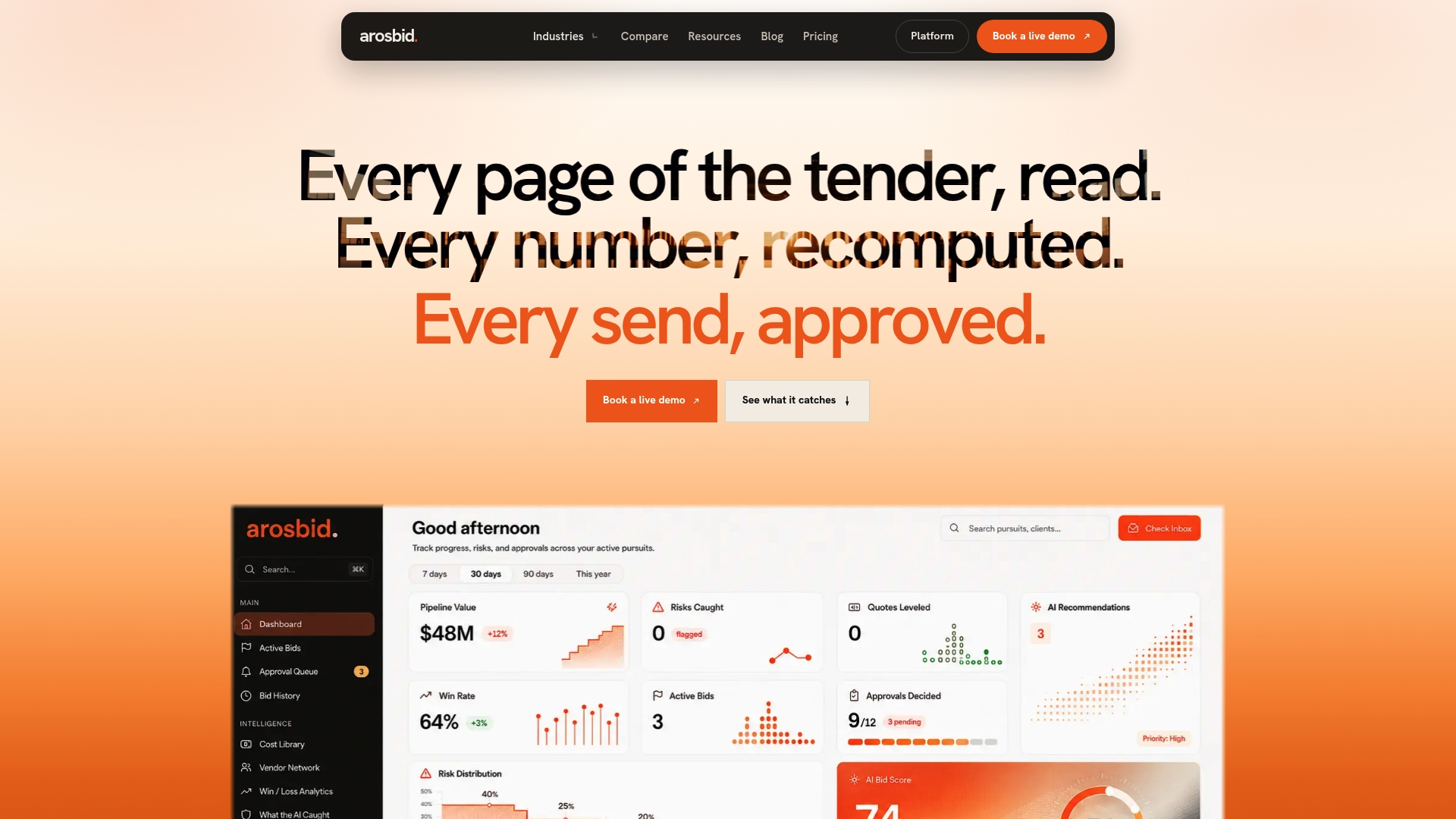
Instead of tracking revisions across five inboxes, your team sees every addendum flagged against the original scope the moment it’s issued, with automated tender review catching clauses that conflict with what you already priced. That matters most on trade bids where one missed unit price or one overlooked certificate requirement is the difference between a clean submission and a disqualified one. See how the bid command center handles it, or book a live demo and walk through your next pre-bid meeting on the platform before you submit.
Sources
- A52 PRE-BID MEETING AGENDA (Tennessee Appx1_A52)
- Checklist for an Informal Project Pre-Bid Conference with Contractors (NC State)
- Checklist for preparing a bid — CanadaBuys
- 13.4 Pre-Bid Meeting and Job Walk | Bureau of Engineering
FAQ
What Happens During a Pre-Bid Meeting?
The chair reviews scope, deadlines, and submission rules, then opens the floor for questions that get logged by number and answered either on the spot or through a later addendum.
What Should Bidders Discuss at a Pre-Bid Conference?
Bidders should raise scope ambiguities, document conflicts, site access constraints, and bonding or certificate requirements, since these are the items most likely to trigger a written addendum.
How Do You Run an Effective Pre-Bid Meeting?
Follow a fixed agenda, take a signed attendance record, number every question as it’s asked, and issue formal minutes with addenda for anything that changes the bid documents.
What Should I Expect at a Preconstruction Meeting?
Expect a role-by-role review of scope, schedule, and site logistics, plus a walk-through of documentation and safety requirements before work or bidding proceeds.