8 Week Workback: Bid Schedule Management for Construction Teams
8 Week Workback: Bid Schedule Management for Construction Teams ! Construction bid schedule title card illustration Bid schedule management is the practice of mapping every deadline, document, and approval in a construction bid from invitation to submission, then assigning someone to own each step.
Bid schedule management is the practice of mapping every deadline, document, and approval in a construction bid from invitation to submission, then assigning someone to own each step. The single most useful thing you can do today is build a dated workback schedule from the submission deadline, name a bid manager to run it, and let software handle the reminders and version tracking so nothing slips through email threads.
TL;DR:
- A structured bid schedule reduces disqualifications caused by late addenda, vendor quotes, or conflicting specifications by providing clear checkpoints.
- Assigning a dedicated owner to each stage and maintaining a shared, central schedule with built-in buffers prevents chaos and last-minute errors.
- Using software that integrates with existing tools and automates compliance checks streamlines coordination and minimizes manual tracking errors.
- Maintaining detailed metrics such as cycle time, submission timeliness, and approval SLA helps identify stages that bottleneck the process and improve overall performance.
- Building a workback schedule from the deadline, with specific tasks and owners, enhances bid accuracy and allows shorter timelines for smaller or parallel tenders.
Table of Contents
- What Bid Schedule Management Covers in Construction Bidding
- Why a Disciplined Bid Schedule Actually Pays Off
- The Core Bid Management Process, Step by Step
- A Bid Schedule Template You Can Copy Today
- Getting the Right People to Actually Follow the Schedule
- What Software Should Actually Do for Your Schedule
- Metrics That Tell You If Your Schedule Is Actually Working
- How ArosBid Supports Schedule Discipline in Practice
- Where Bid Scheduling Fits Into Broader Project Management
- Comparing Software Features for Bid Schedule Management
- Handling Last-Minute Changes Without Blowing the Deadline
- A Few Honest Lessons From Watching Bid Teams Work
- Get a Live Look at ArosBid Before Your Next Bid
- Sources
- FAQ
What Bid Schedule Management Covers in Construction Bidding
Bid schedule management touches five moving parts: the invitation itself, the documents that come with it, the deadlines attached to each deliverable, the internal approvals required before anything goes out, and the vendor quotes that feed your final price. Miss one, and the whole bid can get disqualified regardless of how competitive your pricing was.
This matters most in three situations. Public tenders come with fixed statutory deadlines and rigid submission formats, so a missed addenda notice can knock you out before anyone reads your number. Subcontractor RFQs move fast and often overlap, meaning your estimating team is juggling five schedules at once with different owners on each. Phased package bids, common on large commercial or healthcare jobs, split scope into stages that each carry their own clarification window and pricing deadline.
The failure modes are predictable once you’ve seen them a few times:
- Addenda released late in the cycle that nobody flags before pricing locks
- Vendor quotes that arrive after the internal pricing deadline, forcing a rushed re-check
- Conflicting specifications between architectural and MEP drawings that surface during final review instead of week one
- Approval bottlenecks where a single sign-off holds up submission with hours to spare
A schedule with clear checkpoints catches these before they become the reason you lose a bid you should have won.
Why a Disciplined Bid Schedule Actually Pays Off
Teams that run a structured schedule submit more bids per cycle, not because they work faster, but because they aren’t burning hours re-doing work caused by missed details. Fewer compliance errors mean fewer disqualifications on technicalities, and a faster bid cycle means your estimators can chase more opportunities in the same quarter instead of getting stuck rescuing one troubled submission.
The risk side is where most firms actually feel the pain. Missed clauses, late clarifications, and pricing errors caused by outdated vendor numbers are the three most common reasons a technically strong bid gets tossed. A subcontractor quote that comes in after your estimate is locked, or a spec revision buried in an addendum nobody circulated, costs you the bid before your price is even compared.
Pro Tip: Run a quick internal audit of your last five losing bids. If three or more failed on a procedural issue rather than price, your problem is schedule discipline, not estimating skill.
Centralizing the schedule into one shared source of truth is the single biggest lever here. When everyone from the estimator to the finance lead pulls from the same calendar and document set, rework drops sharply because nobody is working off a stale version. Coordination practices built around a single source of truth, clear communication channels, and version control are consistently what separates teams that win from teams that scramble.
The Core Bid Management Process, Step by Step
A workable bid management process runs in seven stages, each with a clear owner and a deliverable that has to exist before you move to the next one.
- Qualify. The bid manager or estimating lead makes the bid/no-bid call based on fit, capacity, and risk. Deliverable: a documented go decision with a reason.
- Plan. Build the workback schedule from the submission deadline. Deliverable: a dated calendar with named owners for every task.
- Coordinate. Assign intake tasks, distribute the RFQ to vendors, and confirm who’s writing what. Deliverable: a task assignment sheet everyone can see.
- Build. Pricing, scope narratives, and proposal content get drafted. Deliverable: a priced, draft-complete bid package.
- Review. Compliance gates check for missing clauses, spec conflicts, and pricing math errors. Deliverable: a signed-off, submission-ready package.
- Submit. The package goes out through the required channel, confirmed received. Deliverable: submission confirmation, logged.
- Debrief. Win or lose, the team reviews what worked and what didn’t. Deliverable: a short debrief note added to the historical record.
The Loopio framework assigns these stages to specific roles: a proposal manager who owns content, a bid manager who owns the calendar and compliance, a content or estimating lead who owns pricing accuracy, and an executive sign-off for final approval. Skipping a named owner at any stage is usually where things fall apart, because tasks default to “whoever has time,” and nobody has time during bid week.
Build the schedule wherever your team actually looks every day, whether that’s a shared calendar, a physical bid board in the office, or a digital timeline inside a platform. What matters more than the tool is the contingency buffer: block at least two full business days between your internal deadline and the actual submission deadline. That buffer is what saves you when a vendor quote comes in late or a reviewer finds a clause that needs rewriting.
Pro Tip: Tender timelines should always reserve dedicated time for a final quality assurance pass, separate from the person who wrote the section. Internal review cycles catch errors that the original author is too close to see.
A Bid Schedule Template You Can Copy Today
Working backward from the submission date is the approach that holds up best across tender lengths. A workback schedule built from the deadline, with an owner on every task, is what keeps pricing accurate instead of rushed.
Here’s an 8-week version adapted for a mid-size construction bid:
| Week | Focus | Owner | Deliverable |
|---|---|---|---|
| Week 1 | Bid/no-bid decision, RFQ review | Bid manager | Go decision, kickoff notes |
| Week 2 | Vendor RFQs sent, scope review | Estimator | Vendor list, scope breakdown |
| Week 3 | Site visit, clarification questions logged | Project manager | Question log submitted |
| Week 4 | Vendor quotes collected, initial leveling | Estimator | Leveled quote comparison |
| Week 5 | Pricing draft, proposal content drafted | Estimator + proposal lead | Draft pricing, draft narrative |
| Week 6 | Internal compliance review | Bid manager | Compliance checklist signed |
| Week 7 | Final QA, executive sign-off | Executive | Approved final package |
| Week 8 | Submission and confirmation | Bid manager | Submitted, confirmation logged |
For short-window tenders of two to three weeks, compress by running tasks in parallel rather than in sequence, and pull finance into the process on day one instead of week five. For long-window tenders of eight weeks or more, add staged stakeholder workshops midway through to catch scope creep before it hits final pricing.
Before you submit, run through this list every time:
- Confirm every addendum has been reviewed and incorporated
- Verify vendor quotes match the current scope, not an earlier revision
- Check that all required forms and certifications are attached
- Get final sign-off logged, not just verbally confirmed
- Submit with time to spare for technical or portal issues
Getting the Right People to Actually Follow the Schedule
A schedule only works if the people on it know exactly what they own. The bid manager runs the calendar and compliance gates. The proposal lead owns the written narrative and formatting. Finance or the lead estimator owns pricing accuracy and vendor quote review. Subject matter experts handle technical sections specific to their trade. Executives or principals give final sign-off before submission.
Communication rules matter as much as the roles themselves:
- Keep one single source of truth for documents and deadlines, not scattered email threads
- Set a fixed status cadence, like a short daily check-in during bid week
- Use version control so nobody is pricing off yesterday’s spec sheet
- Define an escalation path for when a task is running late, before it becomes a crisis
Overcommitment is the quiet killer here. A team that’s already stretched thin on active projects will treat bid deadlines as flexible, and that’s exactly when clauses get missed. Check actual team capacity before you commit to a bid timeline, not after you’ve already told the client you’ll submit.
What Software Should Actually Do for Your Schedule
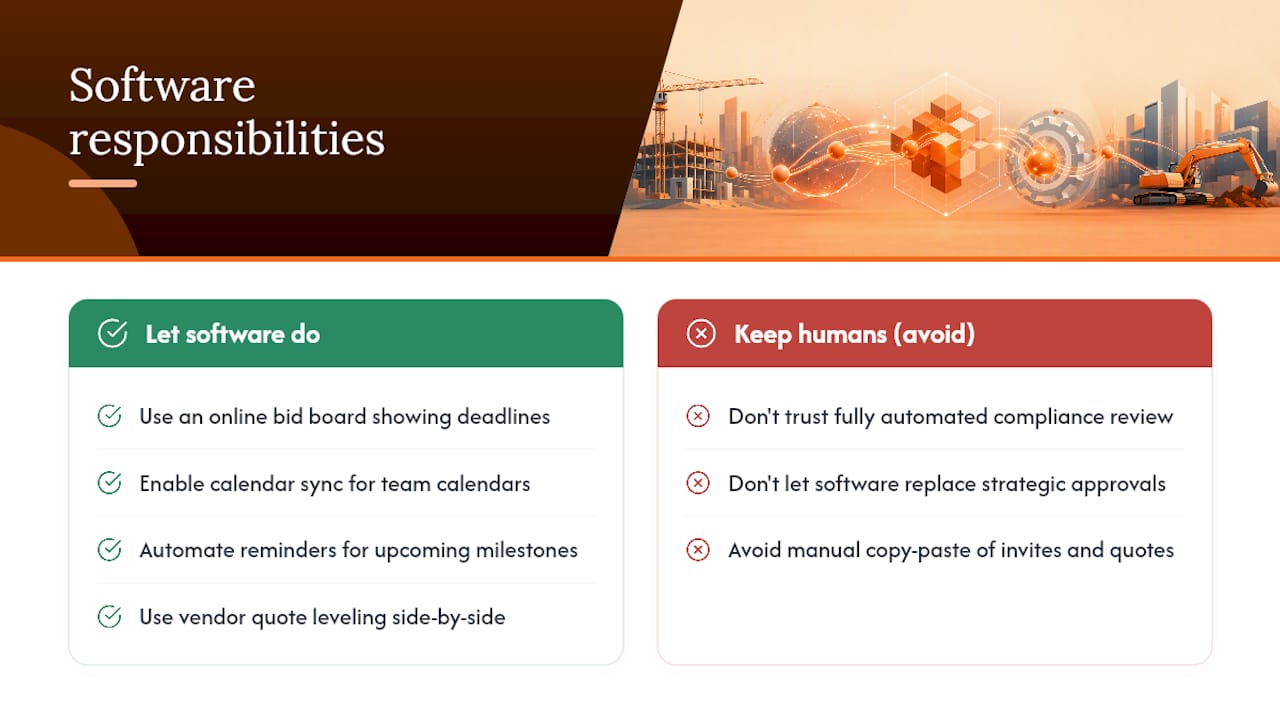
The features worth paying for are the ones that remove manual tracking, not the ones with the flashiest dashboard. Look for an online bid board that shows every active bid and its deadline at a glance, calendar sync so deadlines show up where your team already works, automated reminders for upcoming milestones, version control on documents, vendor quote leveling for side-by-side comparison, and built-in compliance checklists.
Construction bid platforms that centralize invites and allow side-by-side quote leveling cut down on the manual copy-paste work that eats an estimator’s week, and they make it easier to catch a pricing outlier before it becomes your final number.
The right split is automation for coordination, humans for judgment. Reminders, intake forms, and initial vendor quote leveling are exactly the kind of repetitive task software should own. Strategic approvals and compliance red-flag reviews still need a person looking at the actual clause language, because software can flag a missing signature page, but it can’t judge whether a scope exclusion is a real risk.
Pro Tip: If a platform promises to fully automate compliance review with no human check, be skeptical. Automated flags are a starting point, not a final answer.
For trades with heavy vendor coordination, like mechanical or roofing scopes, the leveling step matters even more because a single missed line item across a dozen subcontractor quotes can shift your final price by a wide margin.
Metrics That Tell You If Your Schedule Is Actually Working
Four numbers tell you almost everything about your bid schedule’s health. Bid cycle time measures the days from invitation to submission, and a shrinking number over several quarters means your process is tightening. Submission timeliness percentage tracks how many bids go out before the deadline versus scrambling at the wire. Approval SLA measures how long sign-off actually takes versus how long you budgeted for it. Win rate, tracked over a rolling set of bids, tells you whether schedule discipline is translating into actual wins.
Using a historical library of past bids to compare pricing and cycle time against current jobs is one of the most reliable ways to spot whether a specific stage, like vendor quote turnaround, is consistently the bottleneck.
Run this checklist before every submission:
- All addenda incorporated and initialed off
- Vendor quotes leveled against current scope
- Compliance items checked against the RFP requirements list
- Final sign-off logged with a timestamp, not just a verbal okay
And run this one after, win or lose:
- What caused any schedule slip, and at which stage
- Whether pricing held up against final vendor numbers
- One change to make before the next bid cycle
How ArosBid Supports Schedule Discipline in Practice
A command-center approach puts every open bid, vendor quote, and compliance item in one place instead of scattered across email and spreadsheets. This model tracks approvals, vendor quotes, and document checks in a single structured view so a missed clause surfaces before submission instead of after a disqualification notice.
A few specifics worth knowing:
- Native integration with Excel and Outlook means your team isn’t abandoning tools they already trust
- Trade-specific modules exist for mechanical, roofing, and structural steel bids, where scope details and vendor coordination differ significantly
- Automated document review checks for missed clauses and conflicting specifications before human sign-off
- Historical bid data feeds into future estimates, shortening the planning stage over time
Teams evaluating this kind of platform typically want to see it against a live bid, not a slide deck, which is where a demo walkthrough earns its place before rollout.
Where Bid Scheduling Fits Into Broader Project Management
Bid schedule management doesn’t exist in a vacuum. Once you win a bid, the same schedule discipline carries directly into the buyout phase, where you’re locking in the vendor quotes you leveled during bidding and turning them into actual purchase orders. A bid schedule that tracked vendor pricing accurately makes buyout faster because the numbers are already validated.
The connection runs deeper than handoff timing. The compliance checklist you ran before submission becomes the baseline for the submittal log once the project starts. The vendor list you qualified during the RFQ stage becomes your subcontractor roster for the actual job. And the debrief you ran after a win or loss feeds directly into how you scope and price the next similar project, which is why treating bid management as a disconnected front-end process, separate from project execution, usually creates duplicate work down the line.
Firms that run both under one system, or at least one shared data source, avoid re-entering vendor information, re-verifying specs that were already checked, and re-building schedules from scratch for the execution phase. The practical move is treating your bid schedule as the first chapter of the project schedule, not a separate document that gets archived once you win.
Comparing Software Features for Bid Schedule Management
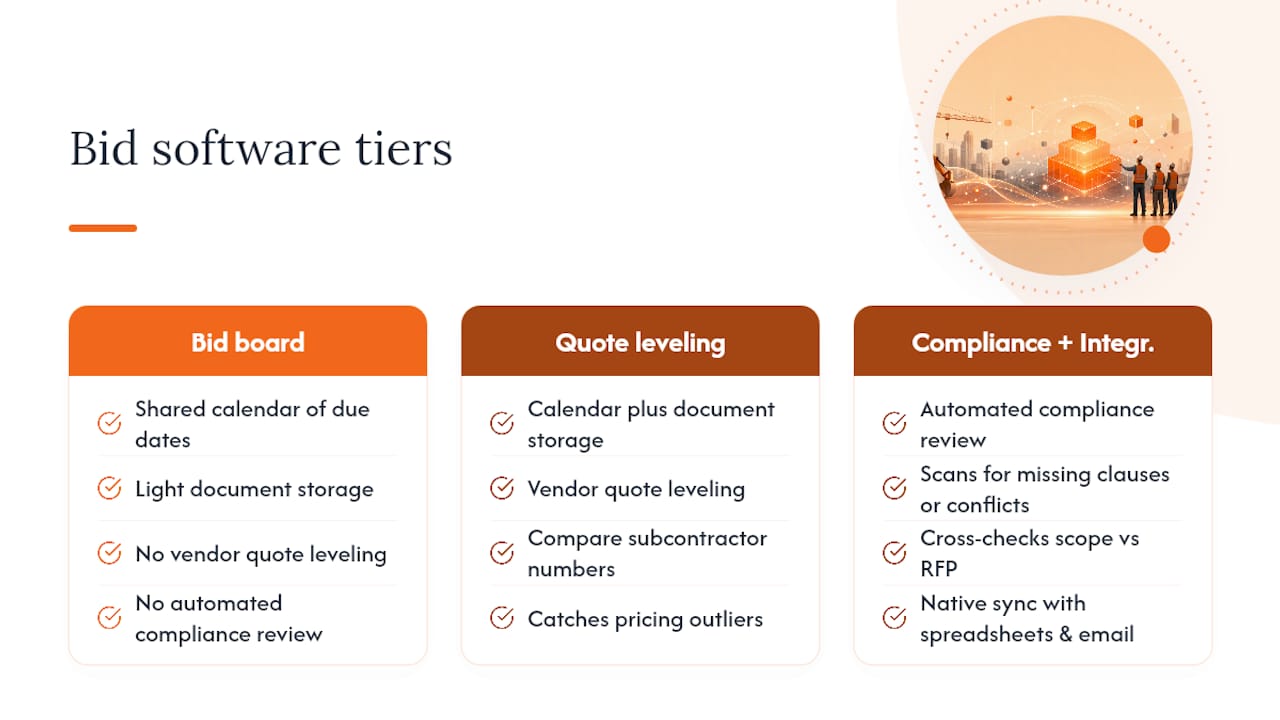
Not every platform built for construction bidding solves the same problem. Some tools are essentially bid boards, a shared calendar showing what’s due and when, with light document storage attached. Others go further and add vendor quote leveling, letting you compare subcontractor numbers side by side to catch pricing outliers before they become your final bid.
A smaller group of platforms add automated compliance review on top of scheduling, scanning documents for missing clauses or conflicting specs rather than relying entirely on a human reviewer to catch them during a rushed final pass. That’s a meaningfully different capability than a calendar with reminders attached, and it’s worth asking directly whether a platform does this or just tracks dates.
The feature that separates entry-level tools from more capable ones is integration depth. A platform that only works as a standalone app forces your team to duplicate data entry in Excel or Outlook anyway, which defeats the purpose. Look for native sync with the spreadsheet and email tools your estimators already use daily, plus trade-specific handling for scopes like mechanical or steel bids where vendor coordination gets complicated fast.
When evaluating any platform, ask what happens at the compliance gate specifically: does it flag a missing form, or does it actually cross-check scope language against the RFP for conflicts? That distinction is usually where the real value, or the real gap, shows up.
Handling Last-Minute Changes Without Blowing the Deadline
Addenda released three days before submission are common enough that your schedule needs to assume they’ll happen, not treat them as a surprise. Build a standing rule: any addendum received triggers an immediate review by the bid manager within four hours, not at the next scheduled check-in.
Keep a floating half-day buffer somewhere in your workback schedule that isn’t assigned to a specific task. That buffer absorbs a late vendor quote, a scope clarification, or a spec revision without forcing you to compress your final QA pass, which is the step most likely to get skipped under pressure.
Flexibility also means knowing which tasks can run in parallel if you’re compressed. Pricing review and proposal formatting can often happen simultaneously if you have two people available, even though they’d normally run sequentially. Know in advance which stages have that flexibility so you’re not figuring it out during a crisis.
Finally, protect the compliance gate no matter what. When a schedule gets tight, the review stage is the one teams skip first, and it’s the one most likely to cause a disqualification. If a last-minute change forces a choice between rushing the final review or missing the deadline entirely, missing a soft internal deadline by a few hours is almost always the better outcome.
A Few Honest Lessons From Watching Bid Teams Work
Most schedule failures aren’t caused by bad planning. They’re caused by no one clearly owning the plan once bid week gets chaotic. The fix is almost embarrassingly simple: name one person as schedule owner, build in a two-day internal buffer before the real deadline, and make the compliance gate mandatory, not optional when things get tight.
Teams that adopt just those three habits see fewer disqualifications almost immediately, often before they change anything else about how they estimate or write proposals. If your team is ready to see what a structured command center looks like against a live bid, a demo is a faster way to judge fit than reading another framework.
— arosbid team
Get a Live Look at ArosBid Before Your Next Bid
This platform replaces the scattered spreadsheet-and-email approach most estimating teams default to with one command center where every deadline, vendor quote, and compliance check lives in a single place your whole team can see. Instead of hunting through email threads for the latest addendum or manually re-typing vendor numbers into a leveling spreadsheet, your team works from one structured view that flags gaps before they become disqualifications.
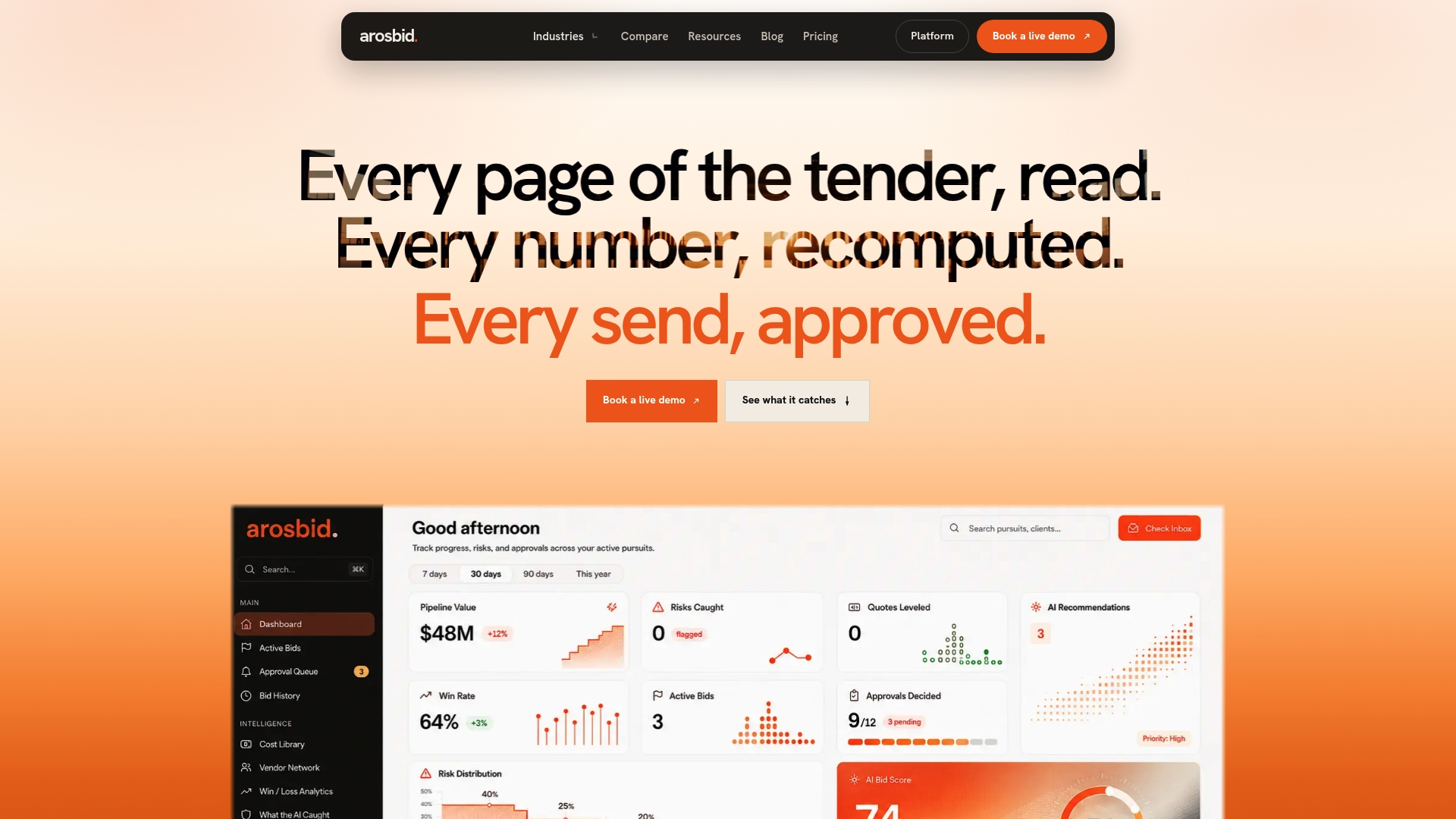
A demo walks through the actual command center: how bid invites get tracked, how vendor quotes get leveled side by side, and how the platform ties into Excel and Outlook without forcing your team onto new tools. If your trade involves heavy subcontractor coordination, like mechanical, roofing, or structural steel bids, ask to see that specific workflow during the walkthrough. Teams evaluating vendor comparison tools more broadly, including partners like Vic Sawing for specialty subcontractor quotes, will notice how much time side-by-side leveling saves versus manual comparison.
Before booking, pull together one recent bid package, your last vendor quote comparison, and a rough sense of your current cycle time. That gives the demo something real to work against. Book a live demo to see it firsthand.
Sources
- Bid Management Process: 5 Steps to Win More Deals
- The Bid Management Process: Unleash Your Team’s Potential | Loopio
- Construction Bid Management Software | Procore
FAQ
What Is the Bid Management Process?
It’s the sequence of steps a team follows to decide whether to bid, build the schedule, price and write the proposal, review it for compliance, and submit it on time, typically running through qualify, plan, coordinate, build, review, submit, and debrief stages.
What Software Is Best for Bid Schedule Management in Construction?
The strongest options combine a shared bid calendar with automated compliance checks and vendor quote leveling rather than just a bare-bones scheduling tool. arosbid is built specifically around that combination, with integrations into Excel and Outlook so teams don’t have to change their existing workflow.
Is Bid Management a Stressful Job?
It can be, particularly during compressed submission windows when multiple vendor quotes, compliance checks, and approvals converge on the same deadline. A disciplined schedule with a named owner and built-in buffers is the most reliable way to reduce that pressure.
What Does a Bid Manager Typically Earn?
Bid manager compensation varies widely by region, company size, and project scope, and no single figure applies across the industry. Larger commercial and industrial firms generally pay more for the role given the financial risk tied to bid accuracy and compliance.
How Long Should a Bid Schedule Be?
It depends on the tender’s complexity, but a typical mid-size construction bid works well on an eight-week workback schedule, while smaller RFQs can compress to two or three weeks by running tasks in parallel and pulling finance in earlier.