Bid Tabulation for Estimators: 7 Steps, Unit Price Checks, Automation
Bid Tabulation for Estimators: 7 Steps, Unit Price Checks, Automation ! Sketches of bid forms and estimating tools A correct bid tabulation records bidder name, receipt time, line-item or vendor-level prices, base total, and attached bonds or affidavits.

A correct bid tabulation records bidder name, receipt time, line-item or vendor-level prices, base total, and attached bonds or affidavits. If you are still verifying numbers, post preliminary vendor totals now and hold the detailed tab until every line item is checked and the abstract of offers is certified.
TL;DR:
- Post preliminary vendor totals promptly when required, but publish detailed line items only after checking every extension against the certified abstract of offers.
- Compare unit prices item by item against each item’s three lowest bids, because the lowest contract total may conceal inflated prices on overrun prone items.
- Once certified and published, never alter the tabulation quietly; document any correction, timestamp it, name its approver, and preserve the original bid and verification notes.
- Record bidder questions and answers for all bidders, track each addendum acknowledgment, and flag missing acknowledgments of material changes before comparing prices.
Table of Contents
- What a bid tabulation records: fields, versions, and attachments
- Step-by-step workflow to build an auditable bid tabulation
- How to compare and analyze bids: unit pricing, low-three benchmarks, and MEAT basics
- Compliance, certification, and audit trail requirements
- How automation can speed tabulation while preserving an audit trail
- Documenting communication with bidders for transparency
- Managing bid amendments and addenda during tabulation
- Updating tabulations after post-submission clarifications or corrections
- Practitioner perspective: quick fixes that prevent common tabulation errors
- Faster, auditable bid tabulations with ArosBid
- FAQ
- Sources
What a bid tabulation records: fields, versions, and attachments
A bid tabulation is the written record procurement teams create immediately after bids are opened, showing what each bidder submitted and whether the submission met the requirements. The format depends on whether you are publishing an early snapshot or the final, audit-ready version.
At minimum, every tabulation needs:
- Bidder name and the exact time the bid was received, so late submissions are clear.
- Bid bond or security documentation, noted as present or missing for each bidder.
- Line-item unit prices for every pay item in the schedule.
- Extended totals calculated from unit price times quantity.
- Base bid total and any alternates or allowances listed separately.
Preliminary tabulations usually show vendor totals only, published promptly to meet transparency rules while the team verifies arithmetic. Final tabulations expand every bid item into its own row, cross-checked against the certified abstract of offers, which formally records bidder name, receipt time, and totals for federal-style procurements. Attachments like W-9 forms, affidavits, and performance or payment bond confirmations get a simple yes or no column rather than full text, keeping the tab readable without losing the compliance trail.
Step-by-step workflow to build an auditable bid tabulation
Converting a stack of opened bids into a certified tabulation goes smoothly when the same sequence runs every time.
- Set an official timepiece before bids open and log each sealed envelope as it arrives, recording bidder name and exact receipt time.
- Enter preliminary vendor totals first if your agency requires fast public posting, leaving detailed line items blank until verified.
- Build the final grid with bidders as columns and pay items as rows, so every unit price lines up across vendors for easy scanning.
- Normalize units and scope before entering numbers: confirm every bidder priced the same quantity and unit (square foot versus square yard, for example).
- Run arithmetic checks on every extension. When a unit price times quantity does not match the bidder’s stated total, the unit price governs, per standard bid evaluation guidance on arithmetic discrepancies.
- Flag anomalies for manual review rather than silently correcting them, and document who verified each flagged line.
- Certify the abstract with the opening official’s signature once every line is checked, then post the final tabulation and lock it against further edits.
A clean spreadsheet layout speeds every step above. Put bidder names across the top, pay items down the left column, and reserve a final column for your calculated low-three average so outliers stand out immediately. Our Excel bid template guide covers five tab layouts built for safe takeoff imports, and a ready-made bid tabulation template can cut the setup time from days to hours.
Pro Tip: Color-code flagged cells before you circulate the tab for internal review, so reviewers see exactly which numbers need a second look.
How to compare and analyze bids: unit pricing, low-three benchmarks, and MEAT basics
The lowest total bid can still hide a problem: a bidder might lowball the base total while loading unit prices on items likely to see quantity overruns. Checking unit prices item by item catches this before award, not after change orders start arriving.
- Run a unit bid analysis on every major pay item rather than relying on the bottom-line total alone.
- Compare each bidder’s unit price against a low-three average, built from the three lowest bids on that specific item, following the method WSDOT’s unit bid analysis tool uses to flag outliers.
- Use historical bid-item data to set a realistic baseline cost before bids even open, so you recognize an outlier the moment it appears.
- When award criteria include quality, apply a MEAT or price-quality-points formula that divides evaluated price by a quality score, but test the formula against sample bids first to confirm it ranks the way you expect.
- Choose weighted averages when project sizes vary widely in your dataset and medians when the dataset is small or contains extreme values.
The low bidder on total contract value is rarely the low bidder on every pay item. WSDOT’s bid history data confirms this pattern, which is exactly why low-three benchmarking by line item matters more than ranking by total alone.
A fast actionable check: add a variance column that flags any unit price more than a set percentage above the low-three average for that item, so your eye goes straight to the lines that need a closer look.
Compliance, certification, and audit trail requirements
Public procurement rules exist to keep the award defensible if it is ever challenged, and the tabulation is the document that proves the process was fair.
- The opening official certifies the abstract of offers, confirming it accurately reflects what was received and opened publicly, consistent with federal bid opening rules requiring certified tabulations showing at least the low three acceptable bids.
- Preliminary tabulations can be edited before the final version posts, but once a tabulation is certified and published, changes require documented justification rather than a quiet correction.
- Retain evaluator notes, moderation rationale, and every change log for the period your jurisdiction requires, often several years, so the file supports the decision long after award.
- When a bidder requests withdrawal or claims a mistake, follow a documented verification process: recalculate the disputed figure, confirm the unit price and quantity, and record the outcome regardless of which way it resolves.
How automation can speed tabulation while preserving an audit trail
Manual transcription is where most tabulation errors start, not in the math itself but in retyping numbers from PDF bids into a spreadsheet. Software built for this step removes the retyping without removing the human sign-off that certification requires.
- Centralized intake pulls bidder submissions into one command center instead of scattered email threads and attachments.
- AI-assisted leveling normalizes vendor quotes and surfaces arithmetic or scope mismatches for a human to confirm rather than auto-correcting them.
- Native Excel and Outlook integration means the tabulation still lives in a format your team already reviews and signs.
- Humans retain final authority: automation flags and organizes, but a person verifies and certifies before anything posts.
Teams evaluating a bid management platform for this workflow typically start with the intake and leveling features before expanding to full bid-cycle tracking.
Documenting communication with bidders for transparency
Every question a bidder asks during the bid period, and every answer you give, belongs in a written log tied to the project file, not buried in someone’s personal inbox. This matters for two reasons: it keeps every bidder working from the same information, and it gives you a record to point to if a bidder later claims they were not told something.
Log the bidder’s name, the date and time of the inquiry, the question as asked, and the answer given, ideally distributed to every bidder at once rather than answered privately. A single bidder getting clarification that others never received is one of the fastest ways to make an award vulnerable to protest.
Keep this log separate from the tabulation itself but referenced by addendum number, so anyone reviewing the file later can trace a specific tabulation entry back to the clarification that produced it. When a question reveals an ambiguity in the specifications, issue a formal addendum rather than answering informally, and note the addendum number next to any tabulation line it affects. This turns an ordinary email exchange into part of the official record instead of a loose thread that disappears when the project closes out.
Managing bid amendments and addenda during tabulation
Addenda issued after bids are advertised but before the opening date change what bidders are pricing, and your tabulation needs to reflect that clearly rather than treating every bid as if it answered the original scope.
Track every addendum by number and date, and require bidders to acknowledge each one on their bid form. A bid that fails to acknowledge a material addendum is a compliance flag worth noting on the tabulation itself, not something to quietly overlook. When an addendum changes a pay item’s quantity or specification, update the tabulation template before bids open so every column reflects the current scope, rather than trying to retrofit the grid after submissions arrive.
If an addendum arrives close to the bid date, confirm it gave bidders reasonable time to adjust pricing before you accept submissions. A rushed addendum with no extension to the bid date is a common source of post-award disputes, and documenting the timeline protects the record either way. Once bids are in, your tabulation should show which addenda each bidder acknowledged, giving reviewers a quick way to confirm every submission priced the same scope before any comparison of totals means anything.
Updating tabulations after post-submission clarifications or corrections
Sometimes a clarification surfaces after bids are opened, whether it is a bidder flagging a typo in their own submission or your team catching a unit mismatch during verification. The protocol here needs to be as consistent as the intake process itself.
Never edit a certified, posted tabulation directly. Instead, document the correction request, verify it against the original bid documents, and record the outcome as an amendment to the file with a timestamp and the name of who approved it. If the correction changes the ranking of bidders, that change needs its own documented justification, not a quiet swap of numbers on the existing tab.

A bidder claiming a mistake in their own bid gets evaluated against your jurisdiction’s rules for bid withdrawal or correction, generally allowing correction only when the error is clear on the face of the bid documents and verifiable without negotiation. Keep the original submission, the correction request, and your verification notes all attached to the same record so a reviewer months later can follow exactly what happened and why. This is also where a clean audit trail pays off: a tabulation with every version preserved shows a transparent process, while one that was simply overwritten raises more questions than it answers.
Practitioner perspective: quick fixes that prevent common tabulation errors
Most tabulation errors trace back to three habits. Use one official timepiece and an intake checklist so late-bid disputes never start. Run unit prices before you ever copy a bidder’s stated total, since that is where arithmetic mistakes hide. Require two-person verification on the final tab, with scanned originals attached to the record, before anyone signs the certification.
Faster, auditable bid tabulations with ArosBid
Teams spending hours retyping bid documents into spreadsheets get that time back when intake, leveling, and compliance checks run through one command center instead of scattered files.
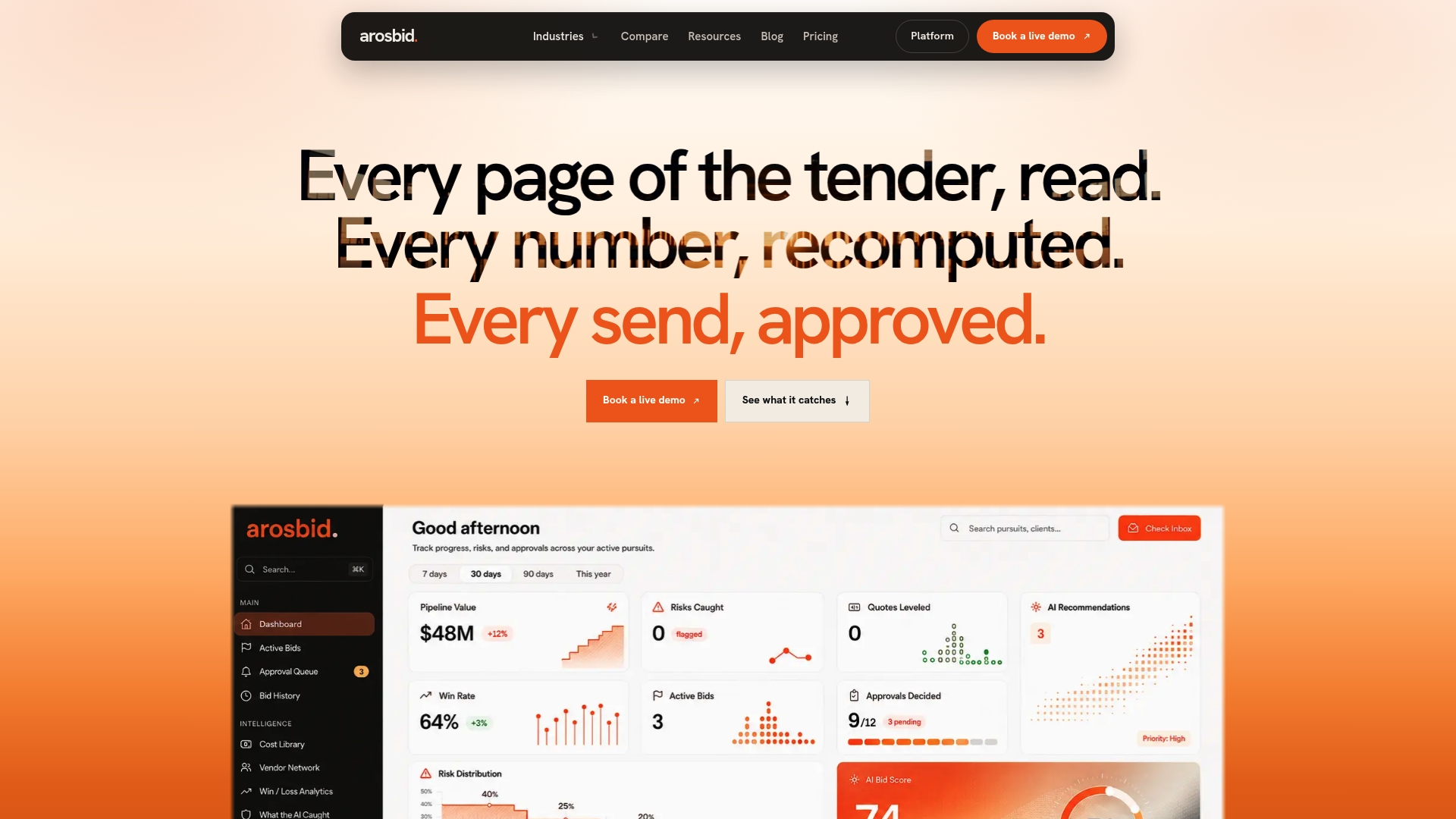
- Centralized intake and AI-assisted leveling cut manual entry while keeping arithmetic checks and anomaly flags in front of a human reviewer.
- Native integration with Excel and Outlook means your team keeps working in familiar formats instead of learning a new system from scratch.
- Plans include One Desk, The Department, and The Whole Year, with pricing available on request.
See the full platform overview or book a live demo to see how a tabulation moves from intake to certification inside the system.
FAQ
Who prepares bidding documents?
Bidding documents are typically prepared by the owner’s procurement team, design professional, or a construction manager, depending on the project delivery method. On public projects, the agency’s procurement or contracts office usually assembles the final package, incorporating technical specifications from the design team.
What is the 3 bid system?
The three-bid system refers to soliciting at least three competitive bids for a project or purchase before award, a common procurement policy meant to demonstrate fair competition. Many public agencies require documenting why fewer than three bids were received when that happens, rather than skipping the requirement silently.
How long should it take to get a bid from a contractor?
Turnaround time varies widely by project size and complexity, and no single standard duration applies across trades or contract types, as explained in this commercial cabling cost per drop guide. Simple scopes can return a price in days, while detailed commercial bids with many pay items often take weeks to price accurately.
How do you write a bid?
A complete bid states the scope priced, unit and total prices for every required pay item, exclusions or alternates, and any required bonds or certifications, submitted in the format the solicitation specifies. Matching the owner’s bid form exactly, rather than substituting your own format, is one of the most reliable ways to avoid disqualification on a technicality.
Sources
- GSA — Abstract of offers / bid tabulation guidance
- WSDOT — Unit bid analysis and bid history tools
- eCFR § 635.113 — Bid opening and bid tabulations