10 Bid Checks Help Contractors Reduce Estimating Errors
10 Bid Checks Help Contractors Reduce Estimating Errors ! Sketch of estimating tools framing title Cutting estimating errors comes down to four disciplines working together: tighten scope and your work breakdown structure before pricing anything, calibrate your numbers against historical cost data and parametric models, run every estimate through staged review gates, and attach contingency to a documented risk analysis rather than a gut feeling.

Cutting estimating errors comes down to four disciplines working together: tighten scope and your work breakdown structure before pricing anything, calibrate your numbers against historical cost data and parametric models, run every estimate through staged review gates, and attach contingency to a documented risk analysis rather than a gut feeling. The sections below break each of these into steps you can apply on your next bid.
TL;DR:
- Use analogous estimates when comparable projects and time are limited, parametric models when historical data supports correlations, and bottom up pricing for complex or high risk scopes.
- A Class 5 concept estimate may range from minus 20% to plus 30%, widening to minus 50% to plus 100% when scope definition is weak.
- PMI findings link one in five estimating errors to missing or undocumented assumptions, so log exclusions and submit assumptions for approval with the estimate.
- Run estimates through three gates: self check, peer review, and management signoff, plus independent checks on major cost lines and version control for revisions.
Table of Contents
- Why estimates go wrong: root causes you should check first
- Practical checklist: 10 controls that cut common estimating errors
- How data, parametrics, and reference classes reduce random and systemic error
- Risk, contingency, and estimate classes: set appropriate accuracy expectations
- Integrating tools and workflows to make checks auditable and repeatable
- Treating estimates as living documents
- How ArosBid helps reduce estimating errors
- FAQ
- Sources
Why estimates go wrong: root causes you should check first
Most estimating errors trace back to a handful of repeatable failures rather than bad luck. The first is mismatched expectations: teams often force an early, loosely defined scope into a narrow accuracy band that only a detailed design can support. The GAO Cost Estimating and Assessment Guide lists documented assumptions, structured data collection, and sensitivity analysis as core best practices precisely because skipping them produces estimates nobody can defend later.
Data quality is the second failure point. Unit prices pulled from memory, undocumented vendor quotes, or historical rates that were never adjusted for scope differences all introduce bias before a single number reaches the summary sheet. Inconsistent unit definitions compound the problem: one estimator’s “linear foot installed” is another’s “linear foot delivered.”
Organizational pressure adds a third layer. Teams under deadline or margin pressure tend toward optimism bias, rounding toward a number that wins work rather than one that reflects real risk. Finally, operational causes such as incomplete drawings, rushed takeoff timelines, and poor measurement practice quietly scale errors across an entire estimate. Each of these causes has a specific, checkable control, which is what the next section covers.

Practical checklist: 10 controls that cut common estimating errors
Treat this as a working checklist rather than a reference document. Running through it on every bid catches the errors that slip past a single reviewer.
Pre-estimate controls:
- Confirm scope against contract documents and build a work breakdown structure before pricing starts.
- Log assumptions and ground rules in writing, including what is explicitly excluded.
- Validate site conditions and calibrate drawing scales against a known dimension on each sheet.
Data controls: 4. Build or maintain a historical cost library rather than relying on memory or scattered spreadsheets. 5. Timestamp every rate so stale pricing doesn’t get reused on a new bid. 6. Normalize vendor quotes to the same scope and unit basis before comparing them.
Process controls: 7. Run estimates through a staged review gate, ideally three stages: self-check, peer review, and management signoff. 8. Require an independent cross-check on major cost lines, with version control on every revision.
Risk controls: 9. Tie contingency explicitly to a risk or uncertainty analysis rather than a flat percentage pulled from habit. 10. Document assumptions and present them for approval alongside the number, not buried in an appendix.
A 3-stage review checklist gives teams a repeatable structure for item 7, and logging spec conflicts as you go, as outlined in guidance on construction spec conflicts, prevents the kind of scope gaps that cause disqualification later.
Pro Tip: Calibrate your takeoff scale against a known dimension printed on every sheet, not just the cover page: drawings are sometimes plotted at slightly different scales within the same set, and an uncaught scaling error silently biases every quantity pulled from that page.
How data, parametrics, and reference classes reduce random and systemic error
Which estimating method you choose should depend on how much historical data you have and how unique the project is. Analogous estimating works when you have a similar past project and limited time. Parametric methods, built from cost estimating relationships (CERs), work best when you have enough historical data points to find a reliable correlation between a driver, such as square footage or linear feet of duct, and cost. Bottom-up, detailed estimating earns its higher cost and time investment on complex or high-risk scopes where the other two methods carry too much uncertainty.

Whichever method you use, calibrate it. Test your parametric CERs against completed projects before trusting them on a live bid, a process explained in more depth in a guide on building defensible parametric CERs. Reference Class Forecasting takes an outside view, comparing your estimate against a class of similar completed projects rather than your own optimism, which helps offset the bias that affects even experienced estimators.
Pro Tip: Re-validate your historical cost data on a schedule, not just when a project forces you to; rates and productivity assumptions drift over months, not years.
Risk, contingency, and estimate classes: set appropriate accuracy expectations
Accuracy expectations should match how far along your scope definition is, not how much pressure you’re under to deliver a tight number. AACE International’s estimate classification guidance ties expected accuracy to project-definition maturity:
- Early concept-stage (Class 5) estimates can carry ranges as wide as -20%/+30%, and up to -50%/+100% when scope definition is weak.
- Detailed-design estimates, built from more complete drawings and quantities, support much tighter bands.
- Contingency should scale with this maturity: wider ranges at concept, narrowing as design develops.
Guidance on contingency planning by project stage walks through contingency planning at concept versus detailed design.
Integrating tools and workflows to make checks auditable and repeatable
A structured intake process catches the errors a single reviewer misses. When every bid document, including front-end clauses, runs through a command-center review gate, missed clauses and conflicting specifications surface before submission rather than after disqualification. Vendor quote leveling that normalizes scope and units automatically removes the manual reconciliation errors that creep in when estimators compare quotes line by line under deadline pressure.
Linking a historical cost library directly into the estimating workflow, rather than keeping it in a separate spreadsheet, speeds up audits and makes rate calibration something the team does routinely instead of occasionally. A six-phase takeoff to estimate workflow shows how these pieces connect from measurement through final review, and the benefits of consolidating them are covered in more detail in a piece on cloud construction software.
Treating estimates as living documents
An estimate frozen at bid submission and never revisited is already out of date by the time buyout starts. We think the healthiest estimating teams formally update their numbers as scope matures, logging every change rather than quietly adjusting a total. Separating baseline cost from contingency, and resisting pressure to collapse both into one convenient number, protects the integrity of both figures and builds the kind of data literacy that compounds across projects.
— arosbid team
How ArosBid helps reduce estimating errors
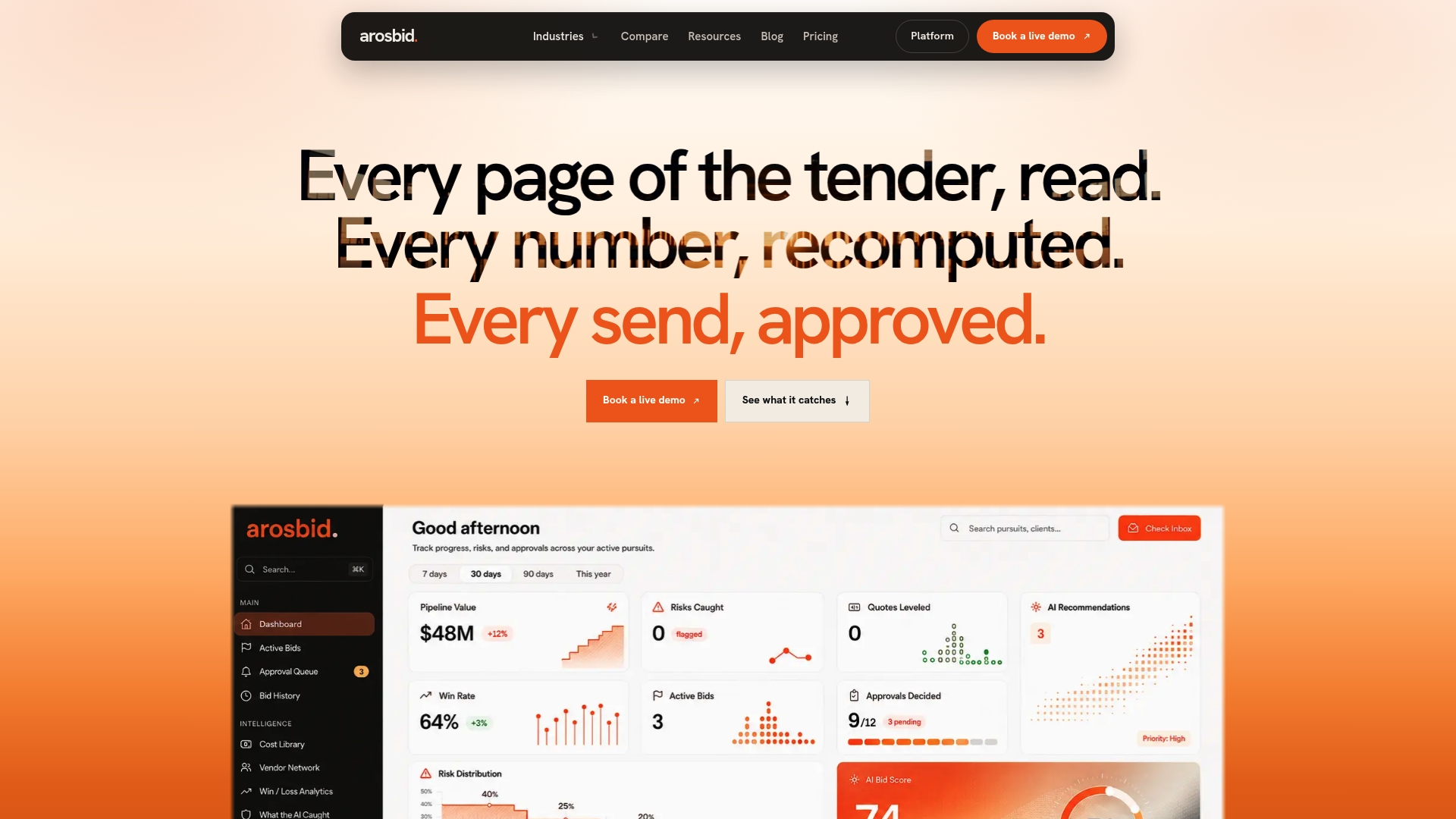
Our platform is designed to support controls such as structured bid intake, automated spec and compliance checks, vendor quote leveling, and a historical cost library integrated with live estimates rather than maintained separately. Using a structured review gate can help catch conflicting specifications before submission, reducing the risk of disqualification.
One in five estimating errors traced in PMI case study findings relates to missing or undocumented assumptions, a gap that a structured review workflow is built to catch before submission.
| Plan | Fit |
|---|---|
| One Desk | Suitable for individual estimators or small teams |
| The Department | Designed for multi-estimator teams requiring shared review gates |
| The Whole Year | Intended for organization-wide bid management over a full year |
Check pricing for details on each plan, or book a demo to see the review workflow on a live bid set.
FAQ
How can random error be minimized?
Random error in estimating is minimized by calibrating measurement tools, such as takeoff scales, against a known dimension and by normalizing data inputs like vendor quotes to the same unit basis before use. Building a historical cost library and re-validating it on a schedule also reduces the scatter that comes from stale or inconsistent rates.
How do you solve estimation problems?
Solving recurring estimation problems starts with identifying the root cause: unclear scope, weak data, process gaps, or organizational pressure for a target number. The GAO Cost Estimating and Assessment Guide recommends addressing this through a documented work breakdown structure, consistent data collection, and staged independent review before submission.
What are the four main types of estimating?
The four commonly used estimating methods are analogous (comparing to a similar past project), parametric (using cost estimating relationships built from historical data), bottom-up (detailed, line-by-line pricing), and three-point or range estimating, which accounts for uncertainty with a low, likely, and high value. Which method fits best depends on how much historical data is available and how far the project scope has developed.
How do you estimate error in a cost estimate?
Estimate error is typically measured by comparing the original estimate to the final actual cost, often expressed as a percentage deviation or mean absolute percentage error across a portfolio of projects. A PMI retrospective analysis found that about 80% of original estimates fell within a ±10% margin, showing that disciplined process controls can keep errors within a predictable range.
What accuracy range should I expect from an early estimate?
Early, concept-stage estimates, classified as Class 5 under AACE guidance, can carry accuracy ranges as wide as -20%/+30%, and up to -50%/+100% when scope definition is weak. Tighter accuracy only becomes realistic once the design and quantities are more fully developed.
Sources
- PMI: Estimating errors and minimizing risk (case study findings)
- AACE International 56R-08 / 18R-97: Estimate classification and accuracy ranges
- GAO-20-195G Cost Estimating and Assessment Guide