Project Managers: Protect Margin with 30, 60, 90 Day Buyout Checkpoints
Project Managers: Protect Margin with 30, 60, 90 Day Buyout Checkpoints ! Buyout checkpoint title card illustration The best approach to buyout tracking combines a prioritized buyout schedule with a single source-of-truth buyout log tied directly to committed costs and WIP reporting.

The best approach to buyout tracking combines a prioritized buyout schedule with a single source-of-truth buyout log tied directly to committed costs and WIP reporting. That pairing locks in pricing before markets move, creates an audit trail finance can trust, and surfaces scope gaps while there’s still time to fix them cheaply. Skip either half, and margin erosion becomes a matter of when, not if.
TL;DR:
- Accurate buyout tracking requires a prioritized schedule focused on long-lead and critical-path trades, starting early to prevent project delays.
- Linking each committed purchase order or subcontract to its specific Schedule of Values line item ensures clear cost control and auditability.
- Using a centralized platform that integrates vendor quotes, approvals, and compliance documents reduces errors and improves real-time visibility across multiple projects.
- Regular checkpoints at 30, 60, and 90 days verify bid status, award progress, and highlight scope or schedule gaps before they escalate.
- Routing savings into a dedicated account and tracking them by line item maintains transparency and prevents disputes over profit sharing on GMP projects.
Table of Contents
- What Is Buyout Tracking in Construction?
- How to Build a Buyout Schedule That Protects Long-Lead Items
- Buyout Logs, Templates, and Tracking Tools That Actually Work
- Buyout Savings, WIP Reporting, and GMP Financial Controls
- Buyout Pitfalls and a Checklist That Catches Them Early
- Connecting Buyout Tracking to Your Broader Project Management System
- How to Keep Stakeholders Aligned on Buyout Status
- Managing the Risk of Buyout Delays and Cost Overruns
- What Successful Buyout Tracking Looks Like on Real Projects
- How Arosbid’s Command-Center Workflow Supports Buyout Tracking
- Put Buyout Tracking on Rails With Arosbid
- Sources
- FAQ
What Is Buyout Tracking in Construction?
Buyout in construction is the process of converting estimated costs into committed costs. It happens after you win the job and before crews mobilize, when the general contractor negotiates and finalizes subcontracts and purchase orders against the numbers baked into the original bid. Buyout tracking is the discipline of monitoring that conversion, line by line, so the team knows exactly where committed costs stand against the estimate at any given moment.
This matters because the estimate is a guess made under time pressure, often before final drawings exist. Buyout is where that guess gets tested against real vendor pricing, real subcontractor capacity, and real market conditions. A disciplined buyout process that starts early and levels scope carefully protects margins and shortens the gap between estimate and signed commitment. Get buyout tracking wrong and you inherit two problems at once: cost overruns you can’t see coming, and no paper trail to explain them when the owner or your own CFO asks.
Buyout sits at the hinge point of preconstruction. Everything before it is assumption. Everything after it is contract. Here’s how project managers and general contractors actually run that hinge without losing money on the swing.
Key elements of a construction buyout
Buyout is not one task. It’s four interlocking jobs that have to happen roughly in sequence, and skipping any one of them is how scope gaps sneak into a job that looked airtight on paper.
Project assessment and scope reconciliation comes first. Before you send a single subcontract, walk the estimate against the contract drawings and specifications line by line. Estimators build numbers off preliminary documents; by the time buyout starts, addenda and RFIs have usually changed some of the scope. Reconciling the two catches the gaps where the estimate assumed one thing and the drawings now say another.
Subcontractor selection and scope leveling is where most margin actually gets protected or lost. Leveling means putting every bid on the same scope basis so you’re comparing apples to apples, not comparing a sub who included demolition against one who didn’t. Document exactly what’s included and excluded for each trade before you negotiate, not after.
Negotiation essentials cover the terms that determine whether a low price is actually a good price:
- Pricing locks and escalation clauses, especially for volatile materials like structural steel or copper
- Insurance requirements and certificate verification before award
- Payment terms and retention percentages
- Substitution rules, spelled out so a sub can’t swap materials without written approval
- Back-to-back clauses that flow the prime contract’s terms and conditions down to the subcontract
Contract and PO execution closes the loop. Every committed cost needs a signed document, a PO or subcontract number, and a direct link to its Schedule of Values line item. Without that link, your buyout log is just a spreadsheet of hopes.
How to Build a Buyout Schedule That Protects Long-Lead Items
A buyout schedule is a sequenced plan for when each trade and material package gets bought out, built around lead times and the construction schedule’s critical path, not around whoever calls first.
Start by identifying long-lead items and critical-path trades directly from the project schedule and specifications. Switchgear, elevators, curtain wall systems, and specialty structural steel routinely carry lead times of 20 to 40 weeks. If those aren’t flagged and bought out in the first weeks of preconstruction, they become the reason the whole project slips, regardless of how well everything else goes.
Here’s a repeatable sequence for building the schedule itself:
- Pull every trade and material package from the estimate and tag each with its typical lead time.
- Cross-reference lead times against the project’s critical path to flag which packages, if delayed, push the completion date.
- Rank packages by urgency, not dollar value. A $40,000 switchgear package with a 36-week lead time outranks a $400,000 drywall package that can be bought in week 12.
- Assign an owner to each line, with a deadline for bid solicitation, a deadline for award, and an escalation path if either slips.
- Set checkpoints at 30, 60, and 90 days into preconstruction to confirm status against the plan.
Those checkpoints need teeth. At 30 days, every long-lead item should have bids in hand. At 60 days, critical-path trades should be awarded or in final negotiation. At 90 days, anything still open should be a named exception with a documented reason, not a silent gap discovered during a monthly meeting.
Pro Tip: Build your buyout schedule backward from the mobilization date for each trade, not forward from today. It’s the difference between “we have time” and “we have exactly eleven weeks before we’re paying overtime to catch up.”
Buyout milestones also need to live inside the broader procurement and project schedule, not as a separate document nobody checks. When the buyout schedule shows steel award slipping two weeks, that should automatically flag the fabrication and erection dates downstream. Trades like structural steel and mechanical systems are where this integration matters most, since their lead times routinely dictate the entire schedule’s shape.

Buyout Logs, Templates, and Tracking Tools That Actually Work
A buyout log is the operational backbone of the whole process, and most of the ones project managers inherit are missing the one column that makes them useful: a direct link to committed cost.
The fields that matter, and why each one earns its place:
- Trade or scope package — the organizing unit for everything else
- SOV line item reference — without this, your log and your accounting never talk to each other
- Estimated cost vs. committed cost — the number that tells you if you’re winning or losing on this line
- PO or subcontract number — the legal anchor for the committed figure
- Vendor or subcontractor name — self-explanatory, but often missing in early drafts
- Delivery or mobilization date — ties buyout status to schedule risk
- Status — open, in negotiation, awarded, or delivered
Free buyout log templates built in Excel are common and perfectly adequate for a single project, but only if the template actually captures those committed-cost fields and SOV links. A log that just lists vendor names and dollar amounts without tying back to the SOV is decorative, not functional.
Run your buyout log alongside an allowance log, not instead of it. Allowances are placeholder budget lines for scope that wasn’t fully defined at bid time, things like unforeseen conditions or owner-selected finishes. Tracking allowances separately, then reconciling them against actual buyout costs as scope firms up, keeps you from accidentally burying a budget shortfall inside a line that looks healthy on the surface.
Excel works fine for one project with a handful of trades and a PM who checks the log weekly. It stops working the moment you’re running multiple projects at once, need real-time visibility for people who aren’t the one editing the spreadsheet, or need WIP-level discipline where committed costs update automatically rather than through manual re-entry. That’s the point where a centralized platform earns its cost. Tools like AI-driven bid leveling can also compress the time spent comparing vendor quotes across dozens of line items, since manual leveling on a complex mechanical or electrical package can eat days that a structured comparison tool handles in hours. One documented case of using AI-assisted workflows and repeated team reviews shows large-project scope drafting cycles compressed from weeks to days when teams standardize the process instead of drafting scopes from scratch each time.
Substitutions, scope gaps, and vendor approvals need their own documentation trail, separate from the general log status. When a sub proposes swapping a specified product for an equivalent, that approval needs a written record with who approved it and when. Verbal “yeah, that’s fine” approvals are exactly what surface as disputes eighteen months later when nobody remembers agreeing to anything.
Buyout Savings, WIP Reporting, and GMP Financial Controls
Buyout savings are the difference between the estimated cost for a scope of work and what you actually committed to pay for it. Buyout losses run the other direction, when committed costs come in higher than estimated. On a guaranteed maximum price (GMP) project, the difference isn’t just an internal scorecard. It determines how much the contractor keeps versus shares with the owner, and getting the accounting wrong invites disputes that damage the relationship for the rest of the project.
The strongest safeguard here is a Buy-Out Savings holding account. Rather than letting savings on one line item quietly absorb losses on another, route every dollar of buyout savings into a dedicated holding account and require written memorialization for every transfer in or out. That single habit prevents the kind of informal reallocation that erodes owner trust the moment it’s discovered, and it gives you a clean ledger if the GMP contract calls for a shared-savings split.
Tracking savings and losses by SOV line, rather than as one blended number, also prevents inappropriate reallocation between line items and preserves an audit trail an owner’s representative can actually follow.
Committed costs from buyout flow directly into your WIP schedule and percent-complete accounting. This is where sloppy buyout tracking becomes a finance problem, not just a project management one. Inconsistent or disorganized records of committed costs are the single most common reason WIP valuations get adjusted during financial diligence, whether that’s a bank review, an audit, or a company sale. If your buyout log and your accounting system don’t reconcile, someone eventually has to explain why, usually under time pressure.
A practical reconciliation checklist worth running monthly:
- Confirm every SOV line has a matching committed cost entry, not just an estimate
- Flag any line where committed cost exceeds estimate and note whether it’s covered by contingency or buyout savings elsewhere
- Verify every Buy-Out Savings transfer has a written memo attached
- Cross-check estimated cost-to-complete against remaining unawarded scope
Some firms go further and embed a dedicated cost-controls role with open-book reporting on GMP work, which tends to reduce adversarial friction with owners because everyone’s looking at the same real-time numbers instead of reconstructing them after the fact.
Buyout Pitfalls and a Checklist That Catches Them Early
Most buyout failures trace back to a handful of repeat offenders. Knowing them in advance is half the fix.
Common failure modes:
- A single estimator or PM drafts scope for a trade with no second reviewer, and errors that would’ve been obvious to a colleague slip straight into the subcontract.
- Long-lead items get identified late because nobody cross-referenced the schedule against lead times until preconstruction was already half over.
- Front-end clauses, insurance requirements, or bonding language get dropped from the subcontract because the buyout team focused only on price and scope.
- Scope gaps between trades get filled informally, “the drywall sub will handle that,” with no written record, until both subs deny responsibility during construction.
Red flags to catch before a PO ever gets issued: vague scope language that could mean two different things, missing or expired insurance certificates, and delivery terms that conflict with the project schedule’s actual need dates.
A fast pre-issuance checklist:
- [ ] Scope reconciled against current drawings and addenda, not the original bid set
- [ ] At least one page-turn review by someone other than the original drafter
- [ ] Insurance and bonding confirmed current
- [ ] Pricing lock or escalation clause included for volatile materials
- [ ] SOV line item linked in the buyout log before the PO is signed
Pro Tip: Schedule page-turns as a standing recurring meeting, not an ad hoc favor you ask a colleague for. Teams that treat scope review as optional are the same teams explaining change orders six months later.
Connecting Buyout Tracking to Your Broader Project Management System
Buyout tracking works best when it’s not an island. If your buyout log lives in a spreadsheet nobody else opens while your scheduling software, cost accounting, and document control all live somewhere else, you’ve built four sources of truth that will inevitably disagree with each other.
The integration that actually matters is between committed costs and the project schedule. When a buyout line moves from “in negotiation” to “awarded,” that status change should update the schedule’s procurement milestone automatically, not require someone to remember to email the scheduler. Same logic applies to cost accounting: a signed PO should populate the committed-cost column in your WIP tracking without manual re-entry, since every manual step is a chance for the numbers to drift apart.
Platforms built around a central bid and buyout command center handle this by keeping vendor quotes, approvals, and document compliance in one place that feeds both the schedule and the accounting side. That doesn’t mean ripping out tools you already rely on. Integration with familiar systems like Excel and Outlook lets teams adopt a centralized workflow incrementally, starting with the highest-risk trades, rather than forcing a disruptive full-system switch mid-project. Roofing and other trade-specific buyout workflows benefit from the same principle: one log, one status field, feeding every downstream system that needs to know.
How to Keep Stakeholders Aligned on Buyout Status
Buyout stalls more often from bad communication than from bad negotiating; effective suivi travaux autorisation de construire ensures construction works are properly tracked and coordinated to prevent such delays. A subcontractor waiting on a signature, a PM waiting on an owner decision, and an estimator waiting on final pricing can all be stuck at the same time without anyone realizing the others are also stuck.
The fix is a standing communication rhythm, not a reactive one. A weekly buyout status meeting, even a short one, forces every open line item into the light instead of letting it hide in someone’s inbox. Share the actual buyout log in that meeting, not a summary of it, so subcontractors, owner representatives, and internal team members are all looking at the same status field rather than getting a filtered version secondhand.
Set expectations early about who owns communication with whom. Vendors should have one point of contact for pricing and scope questions, not three different team members giving three different answers to the same substitution request. When scope changes mid-buyout, whether from an addendum, an RFI response, or a value-engineering decision, that change needs to reach every affected trade the same day, not surface two weeks later when someone notices the drawings don’t match the subcontract.
Owners and architects deserve visibility too, particularly on GMP projects where buyout savings affect their financial interest directly. A brief monthly summary showing buyout status by trade, without exposing every internal negotiation detail, keeps that relationship transparent without turning every conversation into a negotiation over your numbers.
Managing the Risk of Buyout Delays and Cost Overruns
Buyout delays and cost overruns share a root cause more often than not: something got identified too late to act on it cheaply. Steel prices that could’ve been locked in week two get negotiated in week ten instead, after the market moved. A long-lead mechanical package that needed award by day 45 gets flagged on day 70, and now the schedule impact is real instead of theoretical.

The most effective risk mitigation is structural, not reactive: build slack into the schedule for the trades most likely to slip, and know in advance which ones those are based on lead time and market volatility. Materials tied to global supply chains, like specialty electrical gear or certain roofing membranes, deserve earlier buyout attention than trades with local, plentiful supply.
Pricing locks and escalation clauses are your primary defense against cost overruns once a package is in negotiation. A sub who won’t commit to a firm price for more than 30 days is telling you something about market conditions worth listening to, and it’s worth building a contingency line for that specific package rather than assuming the number will hold.
When delays do happen, the response that protects margin is fast escalation, not quiet hope that it resolves itself. If a critical-path package is behind schedule at the 60-day checkpoint, that needs to reach a decision-maker who can approve alternate sourcing or schedule adjustment immediately, not sit in a status report waiting for the next monthly review.
What Successful Buyout Tracking Looks Like on Real Projects
The projects where buyout tracking visibly protects margin share a common pattern: they treat buyout savings as data to be captured, not luck to be quietly pocketed.
On GMP projects specifically, the discipline of routing every dollar of savings through a dedicated holding account with written memorialization turns what could be a contentious owner conversation into a routine reporting exercise. When an owner’s representative can see exactly which line items generated savings and exactly where that money went, shared-savings splits stop being a negotiation and start being arithmetic.
The inverse pattern shows up just as clearly in project reviews and financial diligence. Buyout tracking forms the backbone of accurate WIP reporting, and projects with clean, line-item-level committed cost records reconcile faster during audits and sail through valuation reviews that trip up projects relying on informal tracking. The contrast isn’t about which team negotiated better subcontracts. It’s about which team could actually prove what they negotiated, when someone asked.
Standardized master-scope templates and repeated team page-turns, rather than one estimator drafting scope alone under deadline pressure, consistently show up as the difference between a fast, clean buyout and one riddled with RFIs six months into construction. The pattern holds across project sizes: process discipline beats individual heroics almost every time.
How Arosbid’s Command-Center Workflow Supports Buyout Tracking
Most buyout tracking breaks down not from bad intentions but from scattered information: vendor quotes in one inbox, approvals in another, compliance documents somewhere else entirely. Centralizing vendor quotes, approvals, and document compliance into one command center closes those gaps and makes the audit trail behind every committed cost figure something you can actually produce on demand, not reconstruct after the fact.
Because workflows can integrate with common tools like Excel for logs and Outlook for correspondence, adoption doesn’t require ripping out existing systems. Teams can bring buyout tracking into a centralized platform trade by trade, starting with the highest-risk long-lead packages, while human oversight stays in the loop on every approval rather than handing final judgment to automation. That combination, structured tracking with a person still making the call, is what keeps the audit trail both accurate and defensible.
— arosbid team
Put Buyout Tracking on Rails With Arosbid
If you’ve been running buyout through a patchwork of spreadsheets, email threads, and whatever the last PM left behind, there are platforms that provide alternatives with a command center where vendor quotes get leveled side by side, approvals get logged automatically, and every committed cost ties back to its SOV line without manual re-entry.
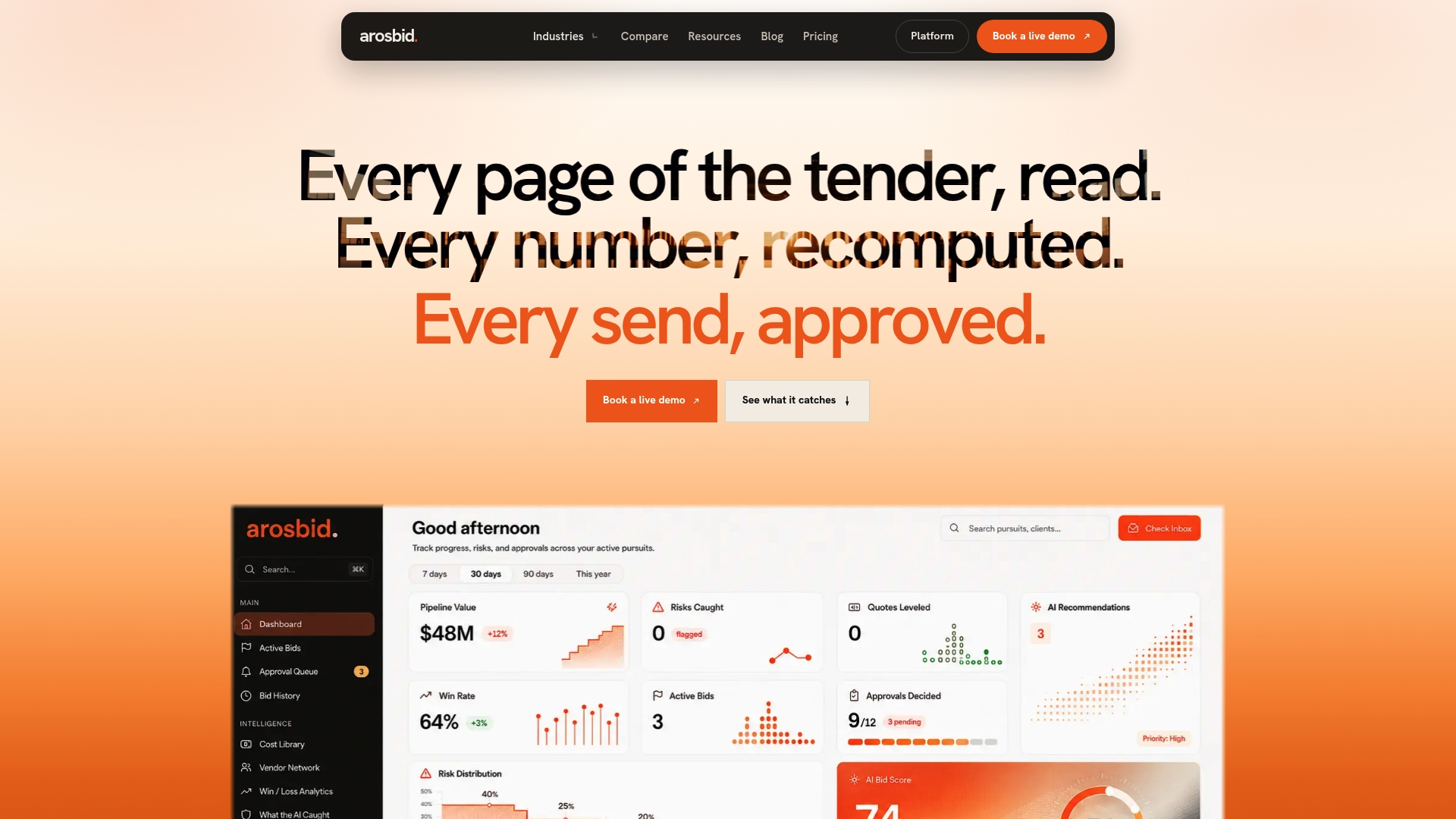
That means the audit trail for buyout savings you’re tracking for a GMP owner is already built, not assembled the night before a review. The platform’s document compliance checks catch the missing insurance certificate or the substitution nobody documented before it becomes a change order fight. And because it plugs into Excel and Outlook rather than replacing them, your team doesn’t have to abandon workflows that already work.
Arosbid offers three plans, One Desk, The Department, and The Whole Year, scaled to how many projects and how many people need visibility into buyout status at once. If you’re ready to see how a centralized buyout log actually behaves on a live project, book a demo and bring your current buyout template. Pricing details for each plan are available on the pricing page.
Sources
- The Quiet Return of Cost-Plus — Construction Daily News
- Project Revenue, WIP Schedules, and Percent-Completion Accounting | Glacier Lake Partners
- Tracking Buy-Out Savings on GMP Construction Projects — RES
- The Construction Buyout: How to Protect Your Profit Margin — RedTeam Blog
FAQ
What Is the Buyout Process in Construction?
Buyout is the process of turning estimated costs into signed, committed costs after winning a project and before construction starts. It covers subcontractor and material negotiation, scope leveling, and executing contracts and purchase orders tied to the original estimate, and a disciplined buyout process is what keeps that conversion from eroding margin.
How Long Does a Construction Buyout Usually Take?
Buyout timelines vary widely by project size and trade complexity, but long-lead items like switchgear or curtain wall need to start within the first weeks of preconstruction given their extended lead times. Most projects target critical-path trades awarded within 60 to 90 days of starting buyout, with less time-sensitive packages following afterward.
What Is the Best Way to Track Buyout on Construction Projects?
The most reliable method pairs a prioritized buyout schedule with a single buyout log that links every committed cost to its Schedule of Values line item. For GMP projects specifically, routing savings through a dedicated holding account adds the auditability owners and finance teams need. Centralized platforms like arosbid’s bid command center extend that same log-and-link approach across multiple projects at once.
What Are the Disadvantages of a Buyout?
Rushed buyout can lock in scope gaps or missing clauses that surface later as change orders, since pressure to award quickly sometimes skips proper scope leveling or insurance verification. It also concentrates financial risk if a single estimator drafts scope without a second review, a pattern tied to the errors that later generate costly RFIs.
How Do Buyout Savings Affect a GMP Project’s Financials?
Buyout savings are the gap between the estimated cost and the actual committed cost for a scope of work, and on GMP contracts that gap often determines how much gets shared with the owner. Tracking those savings by SOV line through a memorialized holding account, rather than blending them into one number, keeps the split transparent and auditable.