Contractors: Compliance First Construction RFP Response That Wins
Contractors: Compliance First Construction RFP Response That Wins ! Construction RFP compliance title card A winning construction RFP response proves you can deliver, not just that you can talk about delivering.
A winning construction RFP response proves you can deliver, not just that you can talk about delivering. Owners score how well you reduce their risk: a tailored executive summary, a scope that mirrors their structure, a realistic schedule, line-item pricing, named team members, and safety numbers that hold up. The action to take the moment an RFP lands is to build a compliance matrix, run a kickoff within 48 hours, and route the draft through layered review before it goes anywhere near submission.
TL;DR:
- Respond with a detailed compliance matrix, layered reviews, and early submission to avoid disqualification and errors.
- Tailor every proposal section to the owner’s priorities, reflecting their structure, scope, and providing clear, current cost data.
- Build a reusable, regularly updated template library for quick responses, ensuring each template is localized and current before use.
- Assign explicit roles within the team for proposal development, including a proposal manager, estimators, schedulers, safety, and legal owners.
- Prepare thoroughly for interviews and debriefs by practicing role-specific questions and swiftly providing clarifications afterward.
Table of Contents
- What Is the Construction RFP Response Process, Step by Step?
- What Should Every Construction Bid Proposal Include?
- How Do You Build a Defensible Construction Bid Pricing Package?
- Who Should Sit on Your Proposal Team?
- How Do You Build a Compliance Matrix That Prevents Disqualification?
- Which Templates Should You Build to Cut Response Time?
- How Do You Prepare for a Construction RFP Interview and Debrief?
- ArosBid Team Perspective: What We Prioritize in Real Bids
- How ArosBid Puts This Playbook Into Practice
- Sources
What Is the Construction RFP Response Process, Step by Step?
Every RFP that lands on your desk starts a clock, and most losses happen before anyone writes a word. They happen in the first 48 hours, when a team skips the read-through, misses a mandatory pre-bid meeting, or assumes last year’s boilerplate covers this year’s scope. A repeatable process fixes that.
1. Read the RFP twice, then extract the skeleton. The first read is for context: what the owner wants, who they are, what kind of project this is. The second read is forensic. Pull every deadline, every mandatory form, every page limit, and every evaluation criterion into a single working document. Note whether pricing is scored separately from qualifications, since that changes how much narrative effort you spend versus how much you spend tightening the number.
2. Make the go/no-go call fast. Decide within a day whether this pursuit fits your capacity, your bonding limits, and your relationship (or lack of one) with this owner. A “maybe” that drags for a week eats into the time you need to actually write a strong response.
3. Kick off within 24 to 48 hours of the go decision. Get the estimator, project manager, superintendent, and proposal lead in a room (or on a call) and assign owners to every section. Nothing kills a proposal faster than three people assuming someone else is writing the safety summary.
4. Work the parallel tracks. From here, three things happen at once:
- Estimating pulls vendor quotes, confirms current material pricing, and builds the cost structure.
- Writers draft the narrative sections: executive summary, project understanding, schedule narrative, team bios.
- Someone owns the attachment hunt: certificates, licenses, insurance certs, references, bonding letters.
5. Layer your reviews. A technical reviewer checks scope and schedule logic. A commercial reviewer checks the pricing sheet for math errors and missing line items. A legal or compliance reviewer checks contract exceptions and mandatory forms. These are three different mindsets, and one person doing all three misses things a second set of eyes would catch immediately.
6. Submit early, not on time. Best practice calls for submitting at least 24 hours before the deadline, which gives you a buffer against portal outages, file upload errors, or a corrupted PDF nobody noticed until 4:58 p.m.
7. Prepare for the interview and plan the debrief before you even know the outcome. If you make the shortlist, the clock resets. If you don’t, request feedback anyway.
The teams that consistently win aren’t the ones with the flashiest graphics. They’re the ones who never miss a step in this sequence, because they’ve run it enough times that it’s muscle memory instead of a fire drill.
What Should Every Construction Bid Proposal Include?
Evaluators score against a rubric, and every section of your proposal exists to earn points against a specific line on that rubric. Skip a section, or write it generically, and you leave points on the table that a competitor picked up.
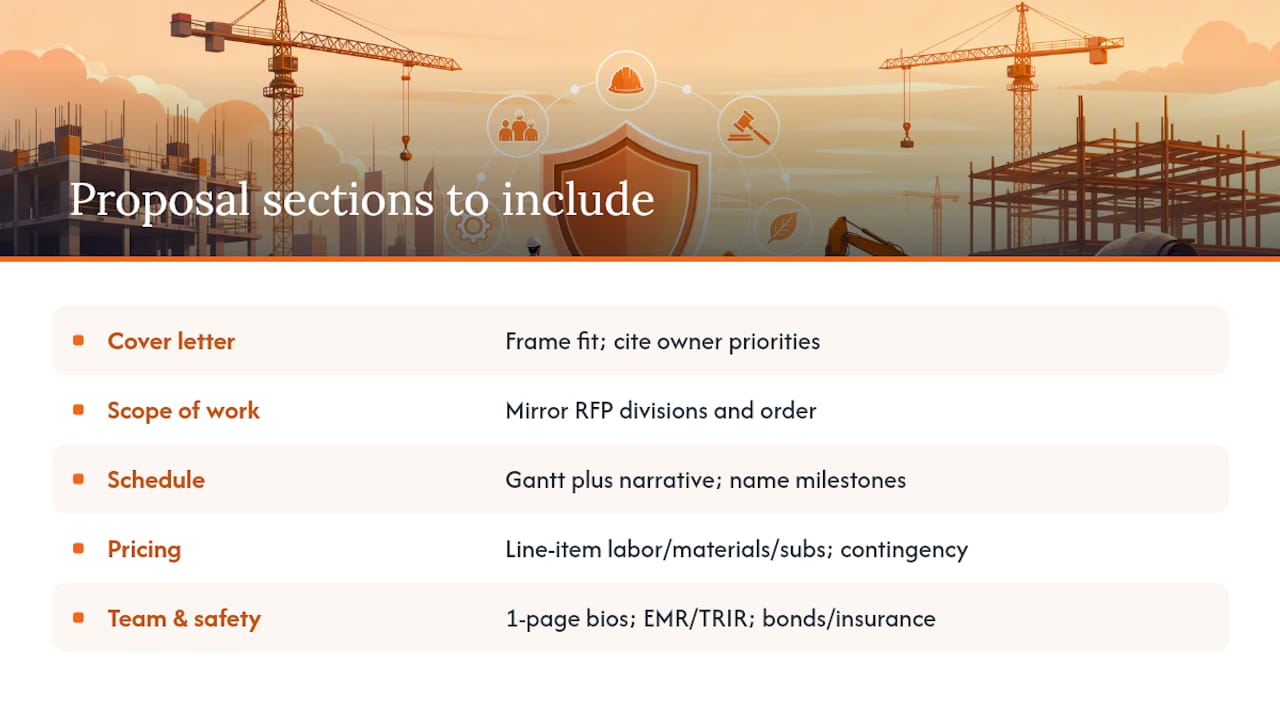
Cover letter and executive summary. This isn’t a formality. It’s your first and best shot at framing why you’re the right fit for this specific owner, on this specific project. Reference their stated priorities directly: if the RFP mentions minimizing disruption to an occupied hospital wing, say exactly how your phasing plan protects that. Generic company history reads as filler because narrative sections should focus on reducing the owner’s perceived risk, not reciting your history.
Project understanding and scope of work. Mirror the RFP’s own structure here. If the owner organized their scope into five divisions, organize your response into the same five divisions, in the same order. Evaluators are often scoring against a checklist, and a scope section that forces them to hunt for information is a scope section that loses points by default.
Schedule and schedule narrative. A Gantt chart alone doesn’t tell the story. Pair it with a short narrative that explains your logic: why the foundation phase runs 6 weeks instead of 4, how you sequence around a winter shutdown, what happens if permits run long. Name the milestones and the constraints driving them.
Pricing sheet. Break out labor, materials, equipment, and subcontractor costs separately, with contingency and fee clearly labeled. Lump-sum numbers without a line-item breakdown are one of the most common reasons evaluators lose confidence in a bid.
Team bios and qualifications. Keep bios to one page, and lead with outcomes, not job titles: “Managed structural buyout for a $40M hospital addition, delivered 3 weeks ahead of schedule” beats “15 years of construction experience” every time.
Safety summary and compliance documents. State your EMR and TRIR numbers directly, then add site-specific mitigations for this project: fall protection near an active roadway, dust control near a school, lockout procedures around live utilities. Attach current bonding capacity letters and insurance certificates.
Pro Tip: Build a one-page “win themes” cheat sheet before anyone starts writing. List the three things this owner cares about most, based on the RFP language itself, and require every section author to reference at least one of them explicitly.
How Do You Build a Defensible Construction Bid Pricing Package?
Price from a cost build-up, never from memory or last quarter’s job. Pull actual current labor rates, fresh material quotes, and confirmed subcontractor pricing, not the numbers you used on a similar job eight months ago when steel and lumber prices looked different. Maintaining a historical cost library keyed by project type and location lets you cross-check current quotes against real precedent instead of guessing whether a number feels right.
Structure the pricing sheet so evaluators can trace every dollar:
- Direct costs, broken into labor, materials, equipment, and subcontractor line items.
- General conditions, itemized separately from direct costs, not buried inside them.
- Contingency, stated as a percentage with a one-line rationale for why you chose that number over a lower or higher figure.
- Fee, shown transparently rather than folded silently into another line.
Alternates and value-engineering options belong in a clearly labeled separate section, never mixed into the base bid. If you’re offering a substitution that saves money or time, show the base price first, then the alternate with its delta, so the evaluator can compare apples to apples without doing math themselves.
A pricing sheet raises red flags fast when it’s rounded to suspiciously clean numbers, when contingency is missing entirely, or when a subcontractor quote is dated three weeks before submission with no confirmation it’s still valid. Evaluators consistently name missing line-item detail as one of the fastest ways a bid loses credibility, even when the total number is competitive. Confirmed subcontractor pricing matters most in trades where materials swing fast; a structural steel estimate built on a two-month-old mill quote is a different animal than one built on this week’s number.
Who Should Sit on Your Proposal Team?
A proposal is only as strong as its weakest section owner, and weak sections almost always trace back to unclear ownership. Assign roles explicitly, in writing, before the kickoff meeting ends.
- Proposal manager runs the calendar, tracks section status, and owns the final assembly. This person doesn’t need to be a construction expert. They need to be relentless about deadlines.
- RFP lead, usually a project executive, owns the win strategy and has final say on pricing and go/no-go calls.
- Estimator builds the cost structure and coordinates subcontractor and vendor quotes.
- Project manager and superintendent write the schedule narrative and confirm field-level feasibility of the plan on paper.
- Safety lead supplies EMR, TRIR, and site-specific mitigation language.
- Procurement owner chases down bonding letters, insurance certs, and licenses, which always take longer to collect than anyone expects.
Standardize your bio format so every team member’s one-pager reads the same way: role, years with the company, two or three measurable project outcomes, and a callout for the most relevant recent project. An organizational chart with named individuals, not just titles, tells the owner exactly who shows up on their site. If your electrical team has certified journeymen on staff, document that alongside the org chart rather than mentioning it only in passing in the qualifications section.
How Do You Build a Compliance Matrix That Prevents Disqualification?
Public and private owners both disqualify submissions for the same reason: a missing form nobody caught until it was too late. A response matrix that maps every RFP requirement to specific evidence prevents that outcome, and it takes a fraction of the time a full rewrite takes after a rejection.
Build the matrix with these columns:
Run the matrix as a living document throughout the pursuit, then use it as your final export checklist the day before submission.
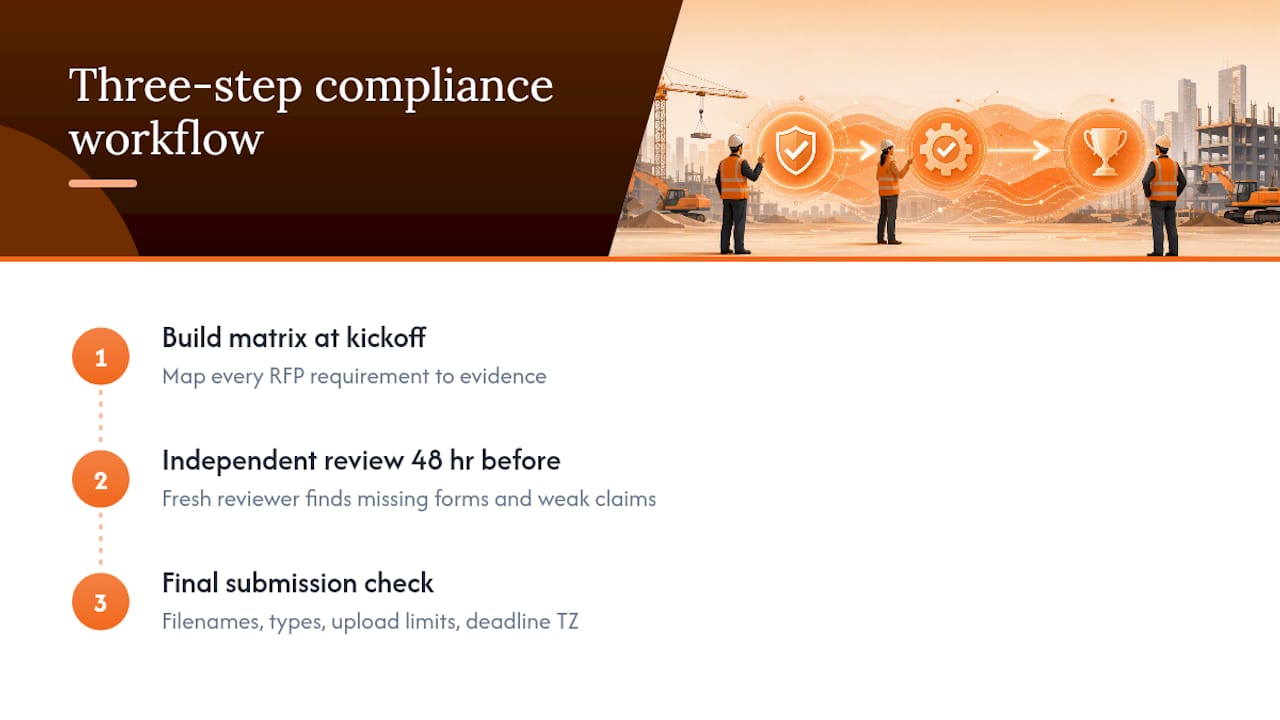
1. Build the matrix during kickoff, not the night before, so nothing gets forgotten in the rush. 2. Run an independent compliance pass 48 hours before the deadline. A reviewer who didn’t write the proposal catches missing forms and weak claims faster than the authors ever will, because fresh eyes aren’t defending their own work. 3. Check submission mechanics last: file naming conventions, accepted file types, portal upload limits, and the owner’s stated time zone for the deadline.
Government RFPs often carry stricter format rules than private ones. Public agency sample RFPs show how granular required attachments and formatting instructions can get, right down to font size and page numbering on certain forms.
Pro Tip: Confirm receipt after every electronic submission. An upload without confirmation isn’t proof of delivery. If the portal doesn’t send an automatic confirmation, email the contact listed in the RFP and ask them to acknowledge it landed.
Which Templates Should You Build to Cut Response Time?
Structured templates, kept current, can roughly halve the time it takes to turn around a response without cutting quality, but only if you treat them as living documents instead of a folder you dig through once a year.
Build a core set: cover letter shell, executive summary framework, scope-of-work shells organized by trade or division, a schedule Gantt template, a pricing sheet with formulas already built in, standardized team bios, a safety summary shell, a reference sheet, and the compliance checklist itself.
- Review and update templates on a quarterly cadence, not annually. Certificates expire, resumes go stale, and insurance limits change more often than most teams remember.
- Version control matters here: an outdated resume date or an expired license number in a “final” template is worse than starting from scratch, because it looks like carelessness rather than a simple oversight.
- Never submit a template unchanged. Localize the assumptions and site-specific mitigations every single time, since a generic traffic control plan copied from a suburban job site reads as lazy on an urban infill project with active pedestrian corridors.
- Keep templates, certificates, and signed forms in one command center with a named owner, rather than scattered across individual laptops and email threads where the “current” version is a guess.
How Do You Prepare for a Construction RFP Interview and Debrief?
Making the shortlist means the proposal did its job. Now the interview decides the award. The written proposal is the foundation, but the interview is where the owner judges team chemistry, problem solving, and how you communicate under pressure, which means a great document with a weak room presence can still lose.
1. Decide who attends and who speaks to what. The project executive opens and closes. The PM and superintendent field schedule and field-logistics questions. The estimator handles anything pricing-related. Nobody should be answering a question outside their lane on the fly.
2. Practice the likely clarifications, not a generic rehearsal. Reread your own proposal for anything vague or aggressive, like an optimistic schedule float or a pricing assumption you didn’t fully explain, and prepare a tight answer for each.
3. Follow up within 48 hours. Send any clarifications, missing documents, or promised follow-ups fast. Speed here signals the same responsiveness you’re promising to bring to the job.
4. Request a debrief if you lose. Ask specifically what separated the winning submission from yours, then turn that feedback into concrete changes to your templates and your pricing approach, not just a note in a drawer nobody reopens.
ArosBid Team Perspective: What We Prioritize in Real Bids
The proposals that win aren’t the polished ones. They’re the accurate ones. Three things are non-negotiable in every pursuit we watch succeed: a compliance pass that isn’t done by the person who wrote the section, named on-site staff instead of placeholder titles, and pricing built from confirmed numbers instead of last quarter’s memory.
Automation earns its place in compliance mapping and vendor quote leveling, where the work is mechanical and errors are silent until it’s too late. It has no place gating the final answer. Human judgment still decides whether a schedule is realistic and whether a client relationship justifies the pursuit at all. Decline when capacity is thin, margins are already compressed, or the owner’s payment history gives you real reason to hesitate.
— arosbid team
How ArosBid Puts This Playbook Into Practice
Everything in this guide, the compliance matrix, the review-first workflow, the template discipline, gets harder to sustain manually as your pursuit volume grows. ArosBid is built around exactly that gap: a command center where your compliance checklist, template library, and vendor quotes live in one place instead of scattered across shared drives and inbox threads.

The platform flags a missed addendum before it becomes a disqualification, levels vendor quotes automatically so estimators spend time analyzing instead of retyping numbers into a spreadsheet, and routes approvals through a structured chain so nothing gets submitted without the right eyes on it. It connects directly to Excel and Outlook, so your team doesn’t have to abandon tools they already know to get the benefit. Whether you’re pricing mechanical scope or roofing work, the same compliance and leveling logic applies across trades. For subcontractor qualifications on specialty scope, pulling in a vetted partner like Vic Sawing for concrete cutting quotes shows evaluators you’ve already lined up your supply chain.
If your team is still assembling compliance matrices by hand at 11 p.m. before a deadline, book a live demo and see how much of this workflow ArosBid can carry for you.
Sources
For public-sector formatting expectations, EPA’s sample RFP shows real attachment and structure requirements. For compliance-first review habits, Pipedrive’s RFP response guide breaks down the checklist approach in more depth.
- 7 tips all contractors need for a successful RFP
- Construction management RFP — Inventive AI
- The Construction RFP Process: A Deep Dive — Autodesk Digital Builder