3 Stage Estimate Review Checklist for Construction Teams
3 Stage Estimate Review Checklist for Construction Teams ! Construction estimate review checklist title card A defensible estimate review checklist proves the estimate is traceable, aligned to scope, and decision-ready.

A defensible estimate review checklist proves the estimate is traceable, aligned to scope, and decision-ready. On the first pass, confirm the document package is sufficient, check that summary lines map to the work breakdown structure, and sanity-check the largest cost drivers before anything else.
TL;DR:
- Most review failures stem from overlooked scope items, incorrect takeoffs, or coordination gaps, making scope verification prior to price analysis essential.
- Cost schedule alignment requires checking that the estimate includes schedule-driven factors like overtime, lead times, escalation, and realistic durations.
- Contingency must be separated from the base estimate and backed by risk analysis, with risk registers linking each major risk to contingency funds.
- Documenting all findings clearly, including evidence and ownership, ensures traceability and enables a proper sign-off process before approval.
- Automated tools that flag missing addenda and conflicting specs, along with vendor quote leveling, significantly reduce review time and improve accuracy.
Table of Contents
- Pre-review checks: confirm the package, define the review scope
- Scope verification: align the WBS and sample-check major takeoffs
- Schedule-cost interface: does the timeline match the price?
- Risk, contingency, and uncertainty: what the range actually means
- Documenting findings and approval gates: closing the loop
- Staged review workflow: sufficiency, validation, then interviews
- Automation and human judgment: what actually cuts review time
- How ArosBid supports the estimate review checklist
- Sources
- FAQ
Pre-review checks: confirm the package, define the review scope
Before a reviewer opens a single line item, the estimate package has to be complete enough to review at all. According to the GAO Cost Estimating and Assessment Guide, a reliable estimate is comprehensive, well documented, accurate, and credible, and none of those qualities can be checked without the underlying files.
A reviewer should confirm the package includes:
- The basis of estimate (BOE) explaining assumptions and methods
- Current drawings and addenda, dated and version-tracked
- A work breakdown structure (WBS) tying scope to cost lines
- The cost model or estimate workbook itself
- A project schedule showing sequencing and durations
- A risk register, if one exists
- Vendor and subcontractor quotes referenced in the pricing
Once the package is confirmed, define the review’s objective and independence level. A quick peer review suits a budget check, while a formal Independent Cost Review or Independent Cost Estimate, as described in the DOE Independent Cost Estimate/Review Guide, fits high-stakes bid or negotiation decisions. Version control matters here too: confirm every source document carries a date and revision number so findings can be traced back to what the estimator actually used.
Scope verification: align the WBS and sample-check major takeoffs
Scope gaps are one of the most common ways an estimate goes wrong. The GAO’s review of construction estimating failure modes points to missing scope items, incorrect takeoffs, and coordination gaps between trades as recurring problems, which is why scope verification has to happen before anyone argues about unit prices.
A practical sequence looks like this:
- Map every summary line in the estimate back to its WBS element and the BOE that justifies it.
- Confirm trade coverage: check that interface items (openings, penetrations, tie-ins between systems) appear somewhere and are not silently assumed by two trades or neither.
- Apply an 80/20 approach: identify the line items that drive most of the cost and reperform or independently sample-check those takeoffs rather than auditing every line equally.
- Verify that the estimate reflects the latest drawing revision and that addenda have been incorporated, not just filed.
- Check unit consistency (square feet versus square meters, tons versus pounds) and confirm productivity assumptions match the crew size and conditions assumed elsewhere in the estimate.
Pro Tip: Pull the highest-dollar line items first. If those hold up, the rest of the estimate is far more likely to be sound.
For trade-specific takeoff mechanics, CMU block layout takeoff best practices offers a useful reference point for reviewers checking masonry quantities, and auditable BIM-based takeoffs can speed up sample re-performance when a model is available.

Schedule-cost interface: does the timeline match the price?
An estimate that ignores its own schedule is not a credible estimate. The GAO’s schedule best practices guidance makes the point directly: a cost estimate has to reflect schedule-related cost effects such as overtime, escalation timing, and sequencing, or it understates real exposure.
A reviewer working this interface should:
- Confirm costs are time-phased and check whether sequencing forces overtime, shift work, or productivity losses that the base estimate does not capture
- Verify procurement lead times for long-lead equipment and materials, and check that escalation is applied at the point of purchase rather than at bid date
- Trace cash-flow timing against the schedule to catch financing or bonding costs the estimate may have missed
- Push back on optimistic durations that quietly remove cost exposure the project is likely to face
A schedule that assumes perfect weather, unlimited crews, and zero rework is not a neutral assumption. It is a cost decision disguised as a scheduling one.
Risk, contingency, and uncertainty: what the range actually means
Contingency is not a rounding buffer, and a reviewer should treat it as its own line of inquiry separate from the base estimate. The base estimate reflects known scope at known prices; contingency and management reserve cover what is not yet known, and blending the two hides the real confidence level from decision-makers.
To review contingency properly:
- Separate the base estimate from contingency and management reserve, and confirm neither one absorbs scope that should have been priced directly.
- Check the contingency basis, whether it comes from a quantitative risk analysis (QRA), empirical historical data, or expert judgment, and confirm the method matches the estimate’s stated purpose.
- Confirm the risk register actually links to the contingency figure, with each major risk assigned an owner and a mitigation plan rather than sitting as an unowned list.
- Require sensitivity or probabilistic output for the top cost drivers so the estimate presents a probable range rather than a single deterministic number.
AACE’s validation guidance is explicit that a defensible contingency ties back to named risk drivers, not a flat percentage applied across the total.
Documenting findings and approval gates: closing the loop
A review that lives only in someone’s head is not a review. Every finding needs a written record: what was found, what evidence supports it, who owns the correction, what it costs in dollars or schedule days, what residual risk remains, and who signed off.
- Log each finding with its evidence, owner, required correction, and cost or schedule impact
- Preserve prior versions and reconciliations so a second reviewer could reproduce the same conclusions from the same files
- Note any unresolved limitations rather than letting them disappear from the record
- Define who signs off at each gate, since a peer review and a full independent cost estimate call for different levels of authority
Pro Tip: Treat the closeout report as a standalone document. If someone outside the review team can’t follow it without asking questions, it needs more detail, not less.
DOE and GAO templates for independent cost reviews both require this kind of formal reporting before an estimate moves forward.

Staged review workflow: sufficiency, validation, then interviews
Running every check at once wastes time on estimates that fail sufficiency before validation even matters. The DOE’s Independent Cost Estimate/Review Guide recommends staging the work in phases so effort goes where it counts.
- Sufficiency review. Confirm the document package is complete and map scope to the WBS before touching pricing detail.
- Focused validation. Rebuild rates and reperform takeoffs for the highest-dollar drivers, then check schedule linkage against the cost model.
- Interviews and closeout. Where documentation leaves gaps, talk to the estimator or run a short on-site check, then finalize findings, resolve open items, and route the report for sign-off.
This sequence keeps the reviewer’s time on the items that actually change the bottom line, rather than treating every line with equal suspicion.
Automation and human judgment: what actually cuts review time
We built our review process around a simple observation: most checklist failures come from low-value work crowding out the checks that matter, like re-tracing which addendum changed a spec three weeks before bid day. Automated addenda detection and vendor quote leveling handle that tracing automatically, which frees a reviewer to spend time on judgment calls instead of document archaeology. Structured workflows also leave an audit trail by default, so sign-offs happen faster because nobody has to reconstruct who approved what.
— arosbid team
How ArosBid supports the estimate review checklist
Running this checklist by hand across spreadsheets and e-mail threads is where most of the time actually goes, not in the judgment calls themselves. ArosBid reads the full bid package, including front-end clauses that generic tools skip, and flags missing addenda and conflicting specifications before they reach the estimator’s desk. Its vendor quote leveling feature keeps pricing sources traceable side by side, and approval tracking preserves the same audit trail a formal review report requires.
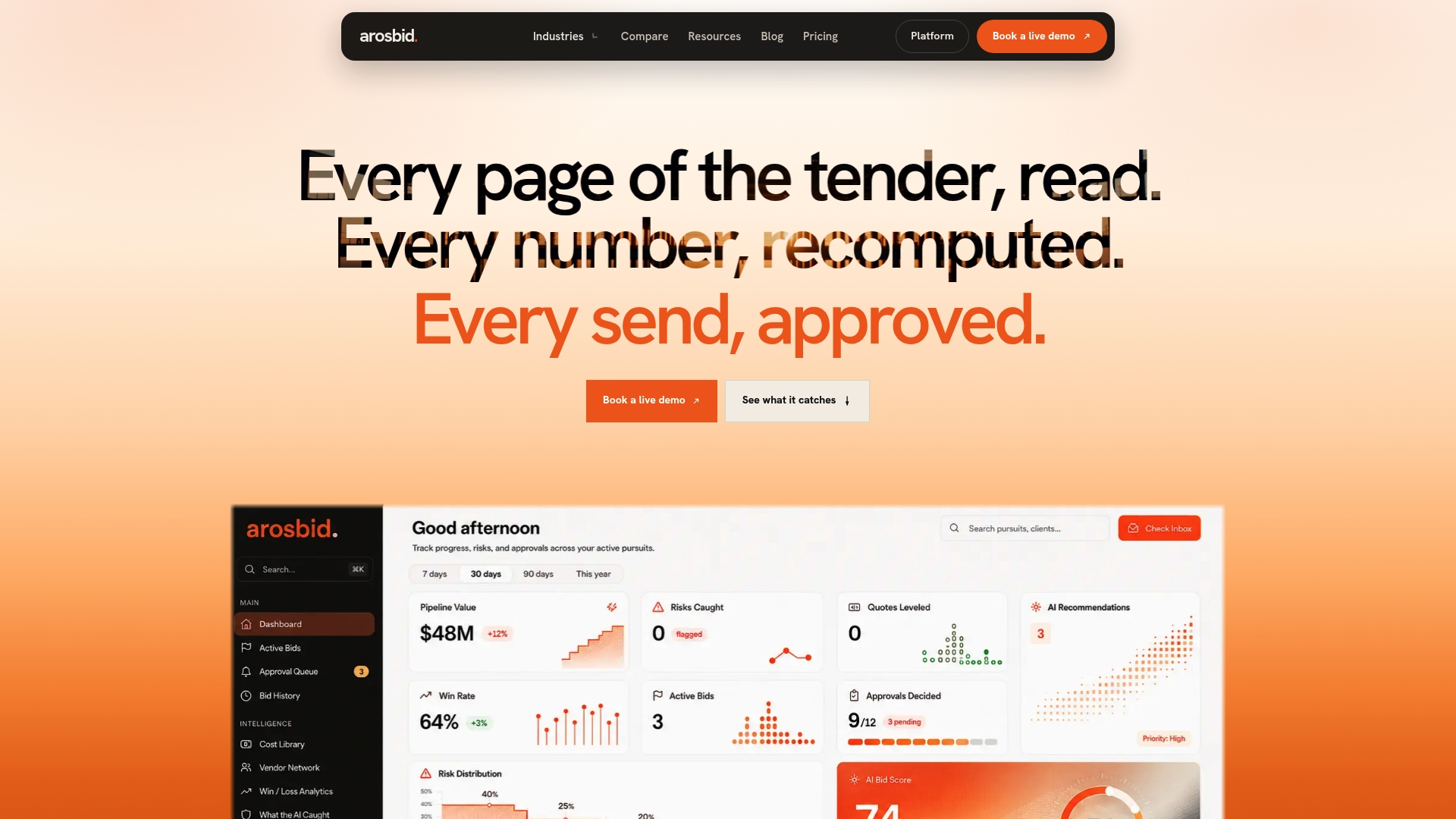
The platform integrates with Excel and Outlook, so a review team does not have to abandon the tools they already use to get the documentation trail an independent review calls for. If your team wants to see how the checklist maps to a working command center, you can book a live demo or check plan details on the pricing page.
Sources
Every major price input needs a paper trail. A reviewer should be able to point to the source and date behind each material, labor, equipment, subcontract, and vendor figure, because a quote from six months ago carries different risk than one from last week.
Key checks include:
AACE’s recommended practice on estimate validation distinguishes qualitative review from quantitative validation and recommends documenting an estimate cost strategy before running either one, so the reviewer knows which benchmarks and tests actually apply to this estimate’s purpose. Vendor quote leveling tools can help here by keeping every bid’s assumptions and inclusions traceable side by side, which is exactly what a vendor quote leveling workflow is built to preserve.
FAQ
What are the 5 levels of cost estimation?
Cost estimating frameworks vary by organization, and not every source defines the same five levels the same way. AACE’s classification system generally runs from a rough order-of-magnitude estimate at the earliest stage to a definitive estimate near construction, with accuracy tightening at each level as design information improves.
Can ChatGPT do construction estimates?
A general-purpose AI tool can help draft assumptions or summarize a scope of work, but it cannot verify quantities against drawings, trace pricing to dated sources, or confirm schedule-cost logic the way a structured review does. Estimate accuracy still depends on traceable data and validation steps like those in the GAO Cost Estimating and Assessment Guide, not on a generative text response.
Can I get estimate templates for free?
Government guidance documents, including the DOE’s Independent Cost Estimate/Review Guide, include sample checklists and report templates that are publicly available at no cost. Trade-specific checklists, like this construction door checklist can also serve as a starting structure for a single trade’s review.
What does a good estimate look like?
A good estimate is comprehensive, well documented, accurate, and credible — the four characteristics the GAO’s cost estimating guide uses to define reliability. In practice, that means another reviewer could reproduce the total from the basis of estimate, the WBS, and the source pricing without asking the original estimator to explain it.