Estimators: One Review Gate to Make Construction Estimating Auditable
Estimators: One Review Gate to Make Construction Estimating Auditable ! Construction estimating audit title card illustration An estimating workflow is a repeatable series of documented steps that turns drawings and specs into an auditable cost baseline.
An estimating workflow is a repeatable series of documented steps that turns drawings and specs into an auditable cost baseline. The single most important move you can make right now is standardizing your Basis of Estimate (BOE) and enforcing at least one review gate before any bid leaves the building. Everything else, digital takeoff, cost libraries, subcontractor leveling, exists to feed that documented, defensible number.
TL;DR:
- Standardizing your basis of estimate and enforcing at least one review gate before bid submission significantly reduces errors and increases bid defensibility.
- Building an estimating workflow with clear ownership, detailed steps, and documentation criteria ensures consistency, traceability, and alignment with project and client needs.
- A comprehensive BOE must explicitly document scope, assumptions, exclusions, risk contingencies, and data sources to support transparency and dispute resolution.
- Using integrated software platforms that include automated clause checks, vendor quote leveling, and audit-ready exports strengthens adherence and minimizes manual errors.
- Focusing on thorough documentation of assumptions and a structured review process offers a better return on bid accuracy than solely relying on advanced estimation software features.
Table of Contents
- What Does an Estimating Workflow Include?
- How Do You Build a Step-By-Step Estimating Process?
- What Belongs in a Basis of Estimate and Shared Templates?
- Which Tools and Integrations Actually Matter?
- What Quality Gates Catch Errors Before Submission?
- How Do You Roll Out a New Estimating Workflow?
- Why Documented Assumptions Matter More Than Software Choice
- Put the Workflow Into a System That Enforces It
- Sources
- FAQ
What Does an Estimating Workflow Include?
Most estimating breakdowns fail not because the math is wrong, but because nobody wrote down why the math was done that way. A working estimating workflow has distinct components, each producing an output the next stage depends on.
- Document intake: drawings, specs, addenda, and front-end conditions get logged and version-controlled before anyone picks up a takeoff tool.
- Scope definition and WBS: the work breakdown structure divides the project into estimable chunks tied to your coding system.
- Digital takeoff: quantities get extracted from plans or models, feeding directly into pricing.
- Assemblies and pricing: labor, material, and equipment costs attach to each quantity, usually pulled from an internal cost library.
- Subcontractor bid leveling: incoming quotes get normalized so you’re comparing scope to scope, not just bottom-line numbers.
- Indirects and contingency: general conditions, overhead, and risk reserves are calculated against the direct cost base.
- Basis of Estimate (BOE): the canonical record of scope, assumptions, exclusions, and contingency logic.
- Proposal assembly: the final, client-facing document built from everything above.
The BOE deserves special attention because it’s the only document that lets someone outside the estimating team understand what was priced and why. These outputs don’t just sit in a folder. They feed procurement (subcontractor scopes and buyout targets), scheduling (duration assumptions baked into productivity rates), and finance (margin projections tied to actual contingency drawn).
How Do You Build a Step-By-Step Estimating Process?
A workflow only becomes reliable when every stage has a named owner and a rough time expectation attached to it. For a typical mid-size commercial project, here’s a sequence that works:
- Project document review (0.5 to 1 day, lead estimator): read the full document set, including front-end clauses, not just the drawings. This is where most disqualifying errors get caught or missed.
- Work breakdown structure (0.5 day, lead estimator): divide the project into CSI divisions or trade packages matching your coding structure.
- Digital takeoff (1 to 3 days depending on project size, estimator or takeoff specialist): extract quantities using takeoff software, cross-checking against the WBS.
- Build assemblies (concurrent with takeoff, estimator): attach labor and material components to each quantity line.
- Apply costs (0.5 to 1 day, estimator): pull unit prices from the internal database or a published reference like RSMeans, adjusted for location and market conditions.
- Subcontractor leveling (1 to 2 days, running in parallel with earlier stages since quotes trickle in late, project manager or estimator): normalize scope across competing quotes before selecting a number to carry.
- Indirects and contingency (0.5 day, senior estimator or preconstruction manager): calculate general conditions and apply contingency based on the project’s risk profile.
- QA and review (0.5 to 1 day, someone who did not build the estimate): the peer review gate covered in detail below.
- Proposal assembly (0.5 day, estimating coordinator): compile the final package, referencing the BOE.
Two decision points show up repeatedly in this sequence and derail teams that don’t plan for them. The first is bid/no-bid, which should happen before document review eats up billable hours on a project you were never going to win. The second is addenda handling: a late addendum can invalidate a completed takeoff, and teams without a clear re-check protocol miss the change entirely. Procore’s guide to the standard estimating process outlines this same document-review-to-peer-review arc, and the timing above tracks closely with what mid-size commercial teams report in practice.
What Belongs in a Basis of Estimate and Shared Templates?
Standardization isn’t about making every estimate look identical. It’s about making every estimate legible to someone who wasn’t in the room when it was built. AACE International’s cost engineering framework treats the BOE as a required deliverable, one detailed enough that an independent reviewer could assess the entire estimate without needing any other document, according to AACE’s Basis of Estimate guidance.
A complete BOE covers:
- Purpose and scope: what’s included, in plain language tied to the WBS.
- Assumptions: productivity rates, site conditions, schedule duration, anything the price depends on that isn’t explicitly stated in the contract documents.
- Exclusions: what the client might expect but isn’t priced. This single section prevents more disputes than any other line in the document.
- Methodology and sources: where the cost data came from, whether internal history or a published reference.
- Risks and contingencies: identified risk items and how much reserve covers each one.
AACE’s guidance goes further, recommending the BOE name the estimating team and qualify any productivity rates or factors used, expressed clearly as units per time or time per unit. That level of specificity is what makes the document useful during a change order dispute six months into construction.
Template mechanics matter just as much as content. A consistent coding structure (tied to CSI MasterFormat or a similar system), standard assemblies, default markup percentages, and clear naming conventions turn a one-off estimate into a repeatable process. Someone needs to own the shared cost library: version control, update cadence, and training on how to use it correctly.

Pro Tip: Store the BOE alongside the signed proposal, not buried in a project folder. When a change order dispute surfaces eight months later, that document is your entire defense.
Which Tools and Integrations Actually Matter?
Software doesn’t replace estimating judgment. It removes the busywork that used to eat the hours judgment requires.
Digital takeoff and BIM tools handle quantity extraction, and modern platforms increasingly use AI-assisted symbol detection to speed that process up. The catch: estimators still have to validate what the software finds. Bluebeam’s guide to construction estimation is direct about this, noting that AI accelerates quantity capture but doesn’t eliminate the need for a human check on the output.
Cost databases split into two categories, and most mature estimating teams run both:
- Internal historical databases: your own completed-project data, the most accurate reflection of your actual productivity and local market conditions.
- Published references: RSMeans provides unit-price data, location factors, and equipment rental costs useful for filling gaps or sanity-checking your own numbers.
Integration priorities follow a simple chain: transferring quantities into a priced bill of quantities, then pushing that into your ERP or accounting system, without breaking the audit trail at any handoff. Teams working on structural or mechanical scopes benefit from industry-specific templates and assemblies built around how those trades actually price work, whether that’s structural steel or mechanical systems. Readers building out BIM-driven takeoff workflows may also find INTEGRA’s guide to the structural engineering project lifecycle useful for understanding how model data flows into cost estimating.
What Quality Gates Catch Errors Before Submission?
Four checks stand between a rushed estimate and a disqualified bid: completeness, consistency, coverage, and compliance.
- Completeness: every scope item on the drawings has a corresponding line item. No gaps.
- Consistency: unit costs and productivity rates match across similar line items, no unexplained outliers.
- Coverage: subcontractor quotes cover 100% of their assigned scope, with no silent gaps between packages.
- Compliance: every addendum, clarification, and front-end requirement has been addressed and documented.
Peer review adds a second set of eyes that didn’t build the estimate: sampling a handful of line items against the cost database, checking major cost drivers against historical benchmarks, and running a margin health check to confirm the number still makes financial sense against the project’s risk profile.
Contingency should scale with uncertainty, not sit at a flat percentage regardless of project type. A well-documented estimate names its residual risks explicitly in the BOE rather than burying them inside a single lump contingency line, an approach AACE’s Basis of Estimate guidance treats as central to defensible change management.
How Do You Roll Out a New Estimating Workflow?
Adopting this whole system at once usually fails. Piloting it doesn’t.
- Define BOE and scope rules: agree on what every estimate must document before you build a single template.
- Build templates and coding structure: set your WBS coding, assembly formats, and naming conventions.
- Populate the cost library: load historical data and reference sources like RSMeans for gaps.
- Pilot on one or two projects: a small pilot surfaces friction points and training gaps faster than a full rollout, a pattern QuickEstimate’s workflow guide also points to.
- Enforce the review gate: no exceptions, even under deadline pressure.
- Train the team: walk through the templates and BOE requirements with everyone who touches an estimate.
- Measure KPIs: track estimate-to-completion variance, bid turnaround time, and margin floor compliance.
- Iterate: adjust templates and gates based on what the pilot and early KPIs reveal.
Why Documented Assumptions Matter More Than Software Choice
Most estimating failures we see traced back to a missed clause or an unstated assumption, not a bad unit price. Teams obsess over which takeoff tool has the flashiest AI, then submit a bid with an exclusion nobody wrote down and a subcontractor quote that quietly excluded fireproofing.
The conventional fix is “get better software.” The real fix is enforcing documentation discipline regardless of which software you use. A BOE that names its assumptions and a review gate that someone can’t skip under deadline pressure will save more bids than any takeoff upgrade. The right principle is this: automation and industry-specific templates matter, but only when paired with a structured checkpoint a human actually has to clear before submission.
— arosbid team
Put the Workflow Into a System That Enforces It
A documented BOE and a review gate only protect your margin if someone actually follows them under deadline pressure, and that’s where most manual processes break down. arosbid’s platform builds the workflow into the software itself: automated clause checks flag missed requirements before they become disqualifications, vendor quotes get tracked and leveled in one place, and BOE-friendly exports keep your documentation audit-ready without extra data entry.
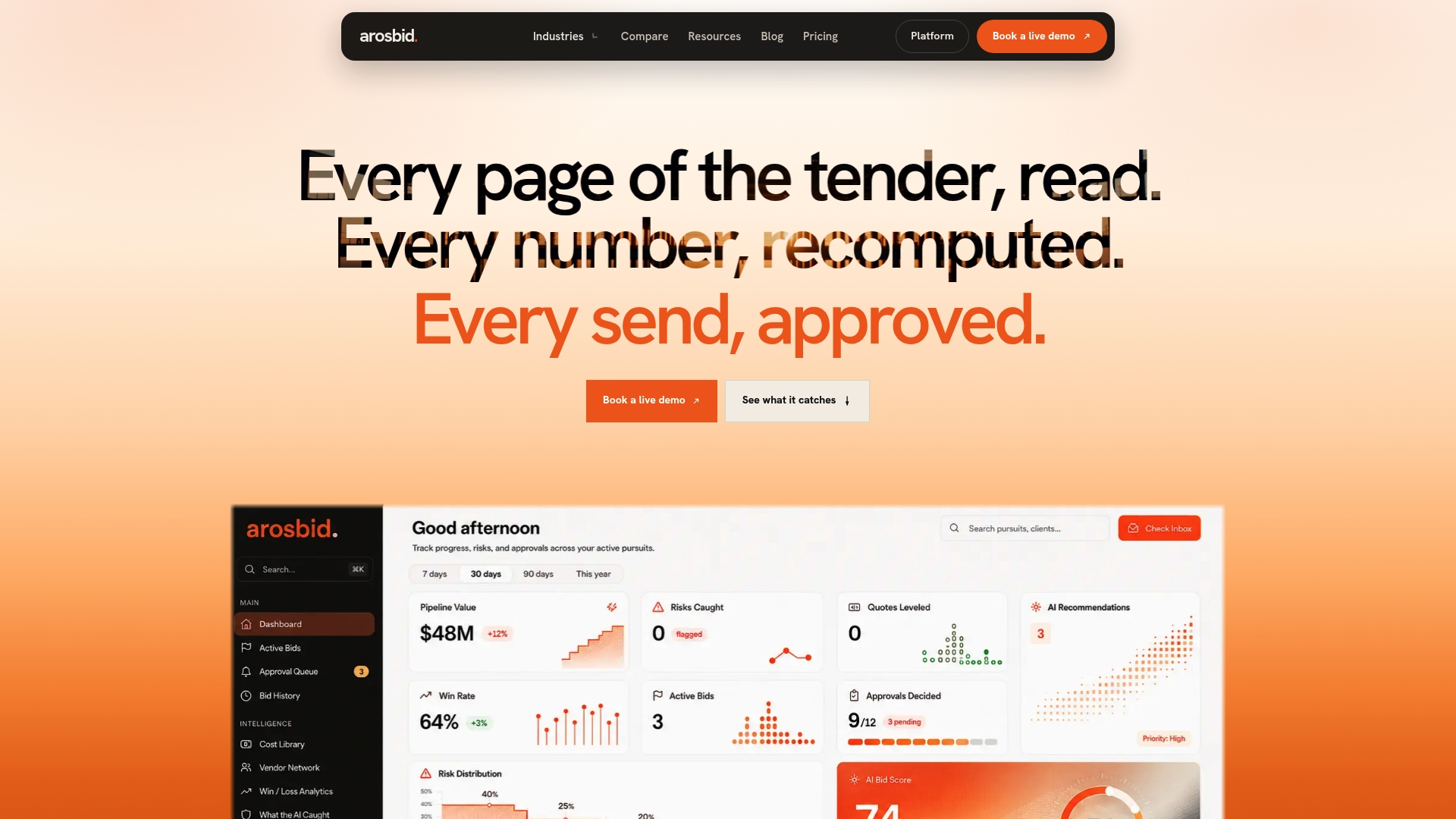
The platform integrates with Excel and Outlook, so your team isn’t ripping out tools that already work. If you’re evaluating options against Trimble AutoBid or comparing trade-specific platforms for MEP, roofing, or steel, start by looking at pricing across the One Desk, The Department, and The Whole Year plans, or book a live demo to see the review gate enforced in your own bid documents.
Sources
- AACE International: Basis of Estimate guidance (TOC_34R-05)
- RSMeans: 2025 Building Construction Cost Data table of contents
- Bluebeam: The complete guide to construction estimation in 2026
- QuickEstimate: Estimation workflow guide for contractors
- Procore: Construction estimation - step-by-step guide
FAQ
Can ChatGPT Estimate Construction Projects?
General-purpose AI tools can help draft language, organize scope notes, or summarize documents, but they can’t reliably extract quantities from drawings or price local labor conditions without training data specific to your market. Digital takeoff platforms with AI-assisted symbol detection, paired with estimator validation, remain the more accurate approach, as Bluebeam’s estimating guide notes.
What Are the Four Types of Estimating?
Construction estimates typically move through four levels of detail as a project matures: order-of-magnitude (rough early-stage figures), preliminary or budget estimates (used for feasibility), detailed or definitive estimates (built from full takeoffs and assemblies), and engineer’s estimates (used for bid comparison). Each level trades speed for precision as more design information becomes available.
What Are the Seven Stages of Construction?
Construction projects generally move through planning, design, pre-construction, procurement, construction, commissioning, and closeout. Estimating work is heaviest during pre-construction, but a well-documented BOE created early keeps carrying weight through procurement and closeout when change orders get evaluated.
What Is the Best Software for Construction Estimating?
The right choice depends on whether you need standalone takeoff, a full bid management command center, or both integrated together. Platforms like arosbid combine automated document review, vendor quote tracking, and BOE-friendly exports with existing tools like Excel and Outlook, which matters more for most trade contractors than switching to an entirely new system.