Pilot 6 to 10 Bids: Proposal Assembly Workflow for Construction Teams
Pilot 6 to 10 Bids: Proposal Assembly Workflow for Construction Teams ! Construction proposal workflow title card illustration Use a compliance-first assembly workflow: intake, then shred the solicitation into a compliance matrix, then assemble from an approved content library, then AI-assisted drafting, then human review gates, then package and submit.

Use a compliance-first assembly workflow: intake, then shred the solicitation into a compliance matrix, then assemble from an approved content library, then AI-assisted drafting, then human review gates, then package and submit. This sequence produces proposals that are faster to build, repeatable across teams, and far less likely to be disqualified for a missed clause or a conflicting spec.
TL;DR:
- Building and maintaining a detailed compliance matrix before drafting ensures all requirements are captured and managed throughout the proposal process.
- Organizing a tagged content library with templates and metadata reduces assembly time and prevents outdated or non-compliant responses from being used.
- AI can assist in drafting and gap-flagging but must be controlled with source citations, exclusion of pricing inputs, and human review gates to prevent errors.
- Final proposal approval requires rigorous review by technical, legal, commercial, and executive reviewers, confirmed through a comprehensive checklist before submission.
- Running a pilot with a limited number of bids helps establish baseline timing, review efficiency, and exception rates, facilitating a successful full rollout.
Table of Contents
- Mapping the end-to-end proposal assembly workflow
- Intake and shredding the RFP into a compliance matrix
- Build and tag a content library and templates for assembly
- Using AI safely: assembly, exceptions, and human gates
- Review, compliance checks, and final packaging checklist
- Pilot plan and KPIs to measure success before full rollout
- ArosBid perspective: why we build around assembly and human gates
- How ArosBid puts this workflow into practice
- Sources
- FAQ
Mapping the end-to-end proposal assembly workflow
Every winning submission moves through the same five stages, regardless of trade or contract size. Skipping a stage, or letting one person own all of them, is where errors creep in.
- Intake and triage: a coordinator logs the solicitation, confirms deadlines, and assigns a lead.
- Requirement shredding: an estimator or proposal manager builds the compliance matrix from the full document set.
- Content assembly: a writer or coordinator pulls approved sections from the library and maps them to matrix rows.
- AI-assisted drafting: a tool drafts and flags gaps against the matrix, under a named reviewer’s supervision.
- Review gates: legal, commercial, technical, and executive reviewers approve commitments before submission.
- Packaging and submission: a second reader confirms every form, signature, and portal upload against the matrix.
Each stage has a clear owner and a clear output, which is what makes the whole chain auditable later.
Intake and shredding the RFP into a compliance matrix
The compliance matrix is the organizing artifact for the entire proposal, and it has to exist before anyone starts drafting. APMP guidance on compliance matrices recommends shredding the full solicitation, including every addendum and attachment, to capture each instance of “shall,” “must,” “will,” “is required to,” and “submit.” A single sentence with three obligations becomes three separate rows, not one, because a merged row is how a requirement gets missed during review.
Build the matrix with these columns:
- Requirement ID
- Source (section and page)
- Requirement text
- Type (technical, commercial, legal, format)
- Mandatory or discretionary
- Owner
- Due date
- Response location in the proposal
- Status
- Notes or exceptions
Three operational rules keep the matrix trustworthy. Create it immediately on receipt of the RFP, before any drafting starts. Update it after every addendum, since a late change to scope or a submission deadline has to flow into the matrix the same day it is issued. Good Stuart’s guide to compliance matrices also recommends a final two-person walk of the completed matrix against the assembled package on the morning of submission, confirming every mandatory row is closed and every form is signed.
Pro Tip: Map the evaluator’s scoring sheet to your matrix rows so reviewers can find your answer to each criterion without hunting through the document.
Build and tag a content library and templates for assembly
Assembly only becomes fast once the source material is organized ahead of the deal. The contractor-bid project’s approach to bid packages treats this as data reconciliation: proposal writing succeeds when approved sections are pre-built and tagged, leaving human judgment for pricing, risk, and scope exceptions rather than for formatting.
Three practices make a library usable under deadline pressure.
- Templates mirror the solicitation’s own structure, so that mapping a matrix row to a response section is a lookup, not a rewrite.
- Every asset carries metadata, including use case, industry, approved claim status, expiration date, and content owner, so a stale case study or an outdated certification never ships by accident.
- Each deal gets a frozen snapshot of the content, pricing workbook, and matrix used, which prevents the version drift that happens when a proposal quietly diverges from the estimate behind it.
A library organized this way turns most of the assembly work into matching matrix rows to existing, pre-approved language rather than writing from scratch on every bid.
Using AI safely: assembly, exceptions, and human gates
AI tools belong in this workflow as assemblers and reviewers, not as decision-makers on anything customer-facing. The AI Deployment Authority’s workflow library on proposal compliance frames this distinction clearly: AI should match matrix rows to candidate library passages, generate a flagged draft brief, and surface missing evidence, but it should never finalize pricing or contract language.
Three controls keep that boundary in place.
- Require a source citation for every AI-generated claim before it enters a draft.
- Exclude pricing inputs from generative prompts entirely, so cost assumptions can’t be altered by a drafting tool.
- Log every AI suggestion in an exception queue assigned to a named human reviewer, with a record of what was accepted or rejected.
On top of those controls, three approval gates cover anything a customer will actually read: legal sign-off on contract language, commercial sign-off on pricing and terms, and executive sign-off before the package leaves the building. Forrester’s research on agentic AI in enterprise execution notes that as these tools get more capable, the emphasis in practice is shifting toward stronger approval logging, not looser oversight. ArosBid’s AI tender review tooling applies this same logic to bid documents, using AI to prepare review briefs rather than to submit anything on its own.
Pro Tip: Treat every AI-flagged gap as a matrix exception, not a draft you edit around: closing it in the matrix keeps the audit trail intact.

Review, compliance checks, and final packaging checklist
The review chain exists to catch what assembly missed, and each reviewer has a specific job rather than a general read-through. Technical reviewers verify scope matches the requirement, commercial reviewers verify pricing and terms, legal reviewers verify contract language and signatures, and an executive confirms the whole package before release.
Submission outputs should include a completed compliance matrix with page references back to the proposal, every signed form, certified attachments, and a confirmation record from the submission portal or courier.
Run this checklist with a second reader on submission morning:
- Every mandatory matrix row shows a status of complete.
- Every addendum has a signed acknowledgment attached.
- Page references in the matrix match the final document.
- Pricing in the proposal matches the estimate workbook exactly.
- All required forms carry an original or authorized signature.
- The submission portal or delivery method has been tested before the deadline.
A second set of eyes on this list is what catches the kind of small mismatch that a solo reviewer under deadline pressure tends to miss.
Pilot plan and KPIs to measure success before full rollout
Test the workflow on 6 to 10 representative bids before rolling it out across every proposal team, using one template, one pricing source, and one approval queue to keep variables controlled. This scope matches the pilot design recommended in the AI Deployment Authority’s compliance review guidance, which stresses testing AI-assisted drafting as a gap-finder before trusting it with customer-facing language.
Track these items through the pilot:
- Time to complete the compliance matrix per bid.
- AI draft pass rate, measured as flags raised per draft.
- Reviewer turnaround time at each gate.
- Final exceptions logged before submission.
A working compliance matrix typically takes two to four hours to build for a typical state or local bid, which gives you a baseline to compare against your pilot’s matrix completion times. Beyond that baseline, track hours per proposal, revision count before send, scope exception rate, clarification requests received after submission, and any shift in win rate across the pilot bids.
ArosBid perspective: why we build around assembly and human gates
We treat a proposal as an assembled artifact, not a document one person writes from a blank page. That assumption shapes every feature we build: matching, flagging, and evidence-checking belong to the system, and final authority over pricing, scope, and commitments stays with the people accountable for the bid. Readers weighing this approach against a fully manual process, or against tools that draft first and check later, are welcome to look at how our platform structures those handoffs.
— arosbid team
How ArosBid puts this workflow into practice
ArosBid maps to each stage described here: intake and triage land in a structured queue, our AI tender review reads the full document set including front-end clauses and flags exceptions for a named reviewer, and approvals, vendor quotes, and document compliance run through one command center rather than scattered email threads. 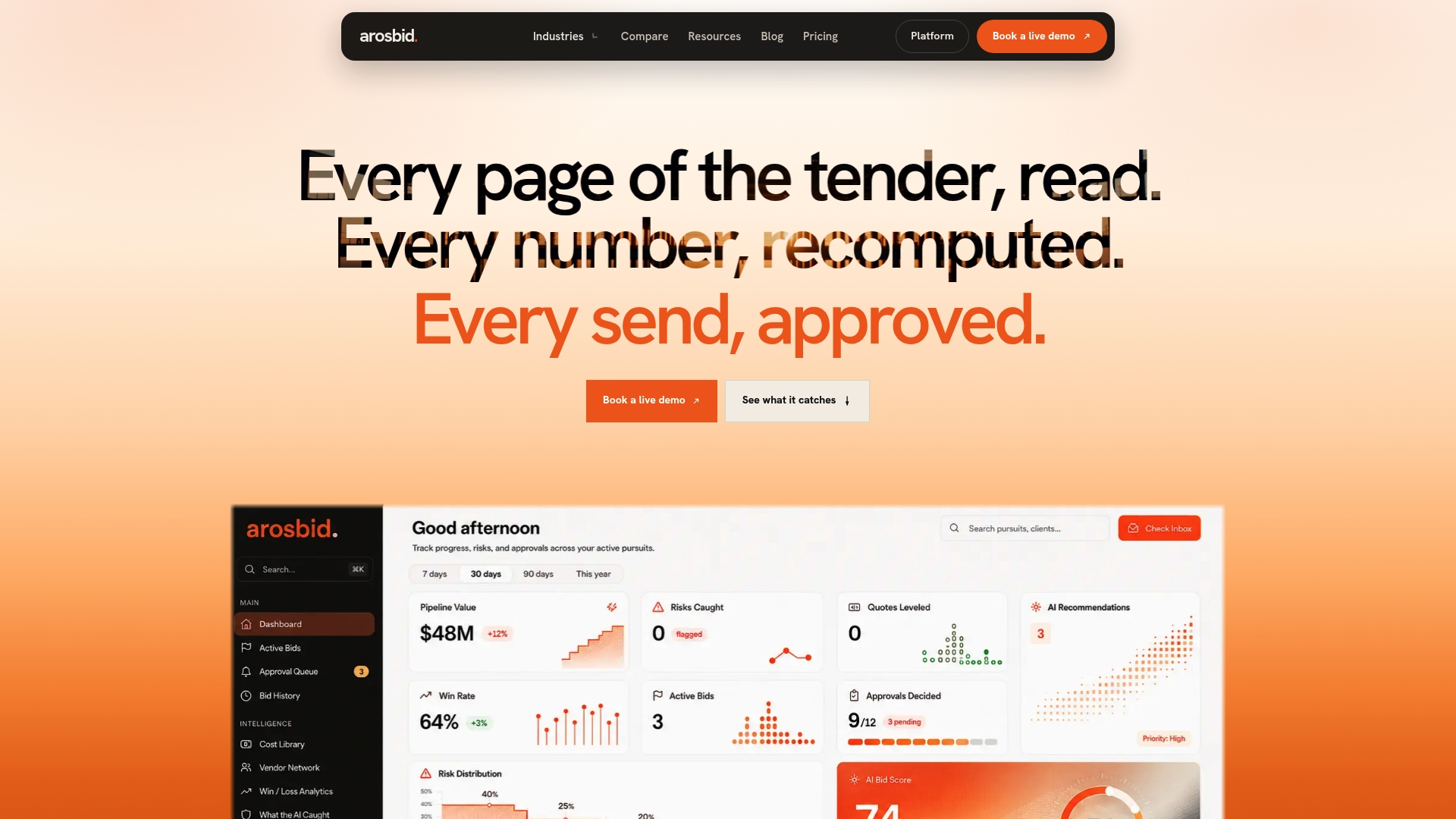 Nothing in the system auto-sends: every commitment still needs a human sign-off, which is the same gate structure this guide walks through. The platform also integrates with Excel and Outlook, so estimating teams don’t have to abandon existing spreadsheets to adopt it. If missed addenda or conflicting specs have cost you a bid before, our work on addenda tracking is worth a look. See plan options on our pricing page or book a demo to walk through your own bid documents.
Sources
This workflow draws on APMP’s shredding guidance, the AI Deployment Authority’s compliance review workflow, Good Stuart’s matrix guide, and the contractor-bid project. For evaluator-side context on how reviewers score bids, Multigroup Contracting’s bid review guide is a useful companion.
- Shred for Success — The Value of a Compliance Matrix
- Proposal Compliance Review | Workflow Library | AI Deployment Authority
- How to Build an RFP Compliance Matrix That Actually Works | Good Stuart
- contractor-bid (project) — structured bid package and deterministic assembly
FAQ
What are the 5 main parts of a proposal?
Most construction proposals include an executive summary, a scope of work, pricing and commercial terms, qualifications or past performance, and required forms or certifications. The exact structure should mirror the solicitation’s own outline so each section maps directly to a compliance matrix row.
What are the 7 steps in an RFP response process?
A typical sequence runs from intake and triage, through requirement shredding into a compliance matrix, content assembly from an approved library, AI-assisted drafting, and then legal, commercial, and executive review gates before final packaging and submission. Skipping the matrix step is the most common source of disqualification.
What are the three C’s of proposal writing?
Definitions vary, but a common version centers on clarity, compliance, and customer focus: writing that is easy for an evaluator to score, fully responsive to every stated requirement, and framed around the buyer’s stated needs rather than generic capability claims. Mapping the matrix to the evaluator’s scoring sheet supports all three.
What are 5 things all proposals should include?
A complete submission generally needs a completed compliance matrix or table of contents keyed to the RFP’s structure, signed required forms, addenda acknowledgments, accurate pricing matched to the estimate workbook, and any certified attachments the solicitation names. Missing any one of these is a common cause of disqualification, which is why a final two-person walk-through on submission morning matters.