Stop Disqualification: RFP Compliance Matrix Proposal Teams L/M/SOW/H
Stop Disqualification: RFP Compliance Matrix Proposal Teams L/M/SOW/H ! Illustrated RFP compliance matrix title card An RFP compliance matrix is a row-for-row map of every requirement in a solicitation to the exact place in your proposal that answers it.
An RFP compliance matrix is a row-for-row map of every requirement in a solicitation to the exact place in your proposal that answers it. Build one on day one, not after your first draft, because it’s the single tool that keeps your bid from getting bounced for missing a mandatory clause. Treat it as your proposal’s source of truth, not a post-submission checklist.
TL;DR:
- A compliance matrix must be built from the start to capture every requirement verbatim, assign a single owner, and track progress separately from drafting.
- It should include seven to ten essential columns, such as requirement, source, owner, response location, status, and evidence, with each row representing an individual atomic requirement.
- During reviews, the matrix guides pink, red, and gold team checks, emphasizing ownership, accurate page references, and verification of current responses and evidence.
- Common disqualification errors involve neglecting Statement of Work requirements, paraphrasing instead of copying verbatim, leaving rows without owners, and conflating compliance with drafting status.
- Automating extraction makes sense for high-volume or complex bids but requires human oversight to review ambiguities and amendments, especially in construction procurement with scattered requirements.
Table of Contents
- What a Compliance Matrix Is and Why Proposal Teams Rely on It
- The Core Columns Every Compliance Matrix Needs
- How Do You Build an RFP Compliance Matrix Step by Step?
- Using the Compliance Matrix Through Pink, Red, and Gold Reviews
- The Mistakes That Actually Get Proposals Disqualified
- A Compact Compliance Matrix Template You Can Copy Today
- When Should You Automate Your Compliance Matrix?
- What Construction Bid Teams Get Wrong About Compliance
- Automate Your Compliance Matrix Without Losing the Human Check
- Where to Verify RFP Rules and Find Compliance Matrix Templates
- Sources
What a Compliance Matrix Is and Why Proposal Teams Rely on It
A compliance matrix does two jobs that people often lump together as one. The first is compliance: did you address every mandatory requirement the solicitation demands? The second is responsiveness: did you address it in a way that actually satisfies what the evaluator is scoring? A proposal can be fully compliant, hitting every checkbox, and still lose points on responsiveness because the answer was thin, generic, or buried on the wrong page.
That distinction matters because evaluators score against Section M criteria while a compliance check just confirms the requirement was addressed somewhere. Federal Acquisition Regulation 15.203 spells out that RFPs must describe the government’s requirement, anticipated terms, the information required in offers, and the factors used to score proposals. Every one of those elements needs a home in your matrix, or you’re guessing at what the evaluator actually wants.
Three groups use the matrix differently, and knowing who reads it changes how you build it.
- Proposal writers use it as an assignment sheet: what to write, where, and by when.
- Reviewers use it as an audit trail during color-team gates, checking that cited pages actually contain the promised response.
- Evaluators, on the rare occasions a condensed version gets appendixed to the submission, use it to confirm quickly that nothing mandatory was skipped.
Most matrices stay internal working documents. Some solicitations, though, especially state and institutional RFPs, explicitly request a compliance or responsiveness matrix as part of the submission package. Procurement guides from state agencies often include sample matrices that evaluation committees use to score responsiveness before technical review even starts. Check Section L for that instruction before you decide whether your internal matrix needs a public-facing cousin.
The Core Columns Every Compliance Matrix Needs
Skip the twenty-column spreadsheet that nobody updates. A working matrix needs a minimal, disciplined column set, and the discipline matters more than the count. Industry guidance converges on roughly seven to ten columns as the practical floor for a matrix that actually gets maintained through a live bid.
| Column | Purpose |
|---|---|
| Requirement (verbatim) | The exact “shall/must/will” language, copied word for word from the solicitation |
| Source reference | Section and paragraph number |
| Type | Mandatory, evaluated, or informational |
| Owner | The single person accountable for the response |
| Response location | Volume, section, and subsection in your proposal |
| Page | The exact page number, filled in last |
| Compliance status | Will Comply, Will Comply With Exception, or Will Not Comply |
| Evidence | Link or reference to the certification, cert, or resume that backs the claim |
That seven to ten column range comes from templates built specifically around this discipline, and one widely used starting structure leans on exactly this set: requirement, source, owner, response location, status, and evidence. Adding more columns rarely improves accuracy. It usually just adds friction that causes people to stop updating the sheet by week two.
The habit that separates a usable matrix from a mess is atomic rows. A requirement that reads “the offeror shall provide staffing plans, resumes for key personnel, and a transition timeline” is really three requirements stitched into one sentence. Split it into three rows. If you leave it as one row, whoever owns it either writes a bloated response trying to cover all three or forgets one entirely, and you won’t catch the gap until a reviewer does.
Standardize your status language too. One practical convention uses exactly three compliance values: Will Comply, Will Comply With Exception, and Will Not Comply. Track project progress in a separate column, using Not Started, Drafted, Reviewed, and Locked, so nobody confuses “I wrote something” with “this is submission-ready.” Conflating those two concepts is one of the fastest ways a mandatory requirement slips through with a half-finished answer attached.
How Do You Build an RFP Compliance Matrix Step by Step?
Building the matrix isn’t a one-afternoon task you knock out and forget. It’s a workflow that runs from the day the RFP drops to the hour before submission. Here’s the sequence that keeps it accurate the whole way through.
- Extract on day zero. The moment the solicitation lands, block out a focused session, often a half day for a mid-size RFP, and read Section L (Instructions), Section M (Evaluation Criteria), the Statement of Work or Performance Work Statement, Section H (Special Contract Requirements), and every attachment. Copy every “shall,” “must,” and “will” statement verbatim into the matrix. Do not paraphrase at this stage. Paraphrasing during extraction is where meaning gets lost.
- Assign a single owner per row. Every mandatory requirement gets exactly one accountable person, plus a target volume and section number where the response will live. Two owners on one row means neither one treats it as theirs.
- Set a review cadence. Schedule a kickoff review of the full matrix, a mid-bid checkpoint to catch drift, a red-team sampling pass, and a final gold sign-off before the proposal locks. Each of these gates has a specific job, covered in more detail below.
- Handle amendments inside 24 hours. When the government or client issues an amendment, and on longer procurements they usually issue several, update every affected row within a day and note the amendment number and date directly on the row. Rows that don’t get flagged with an amendment reference are the ones that quietly go stale.
- Verify page numbers last, then cross-check. Fill in exact page numbers only after your proposal is paginated and stable, then run a final pass matching every matrix row against the actual submitted PDF. This catches the common failure where a section got renumbered late and the matrix still points at the old page.
Pro Tip: Build your proposal outline directly from the matrix instead of the other way around. When the outline mirrors the matrix’s response-location column exactly, a requirement can’t fall through a gap between the two documents because there’s only one document driving structure.
This sequence works because it treats the matrix as living infrastructure rather than a compliance afterthought. Teams that build the matrix after the first draft is written spend most of their time reverse-engineering what they already wrote to match requirements, instead of writing to the requirements directly. That’s backward, and it shows up in the final product as thin, generic language in the sections nobody double-checked.
One more detail worth building into the process from the start: track who has edit rights on the matrix. On a bid with more than four or five contributors, an uncontrolled spreadsheet where anyone can overwrite a status field turns into a liability fast. Designate one person, usually the proposal manager, as the only one who can change a compliance status from Drafted to Reviewed or Reviewed to Locked. Everyone else can update their own response location and notes, but status changes need a single gatekeeper or the matrix stops meaning anything.
Using the Compliance Matrix Through Pink, Red, and Gold Reviews
The matrix earns its keep during color-team reviews, where it shifts from a tracking tool into the actual audit instrument reviewers use to check the proposal. A well-run review gate treats the matrix as the primary artifact reviewers follow, not a supplement to reading the draft cover to cover.
Each gate has a distinct job, and conflating them wastes review time.
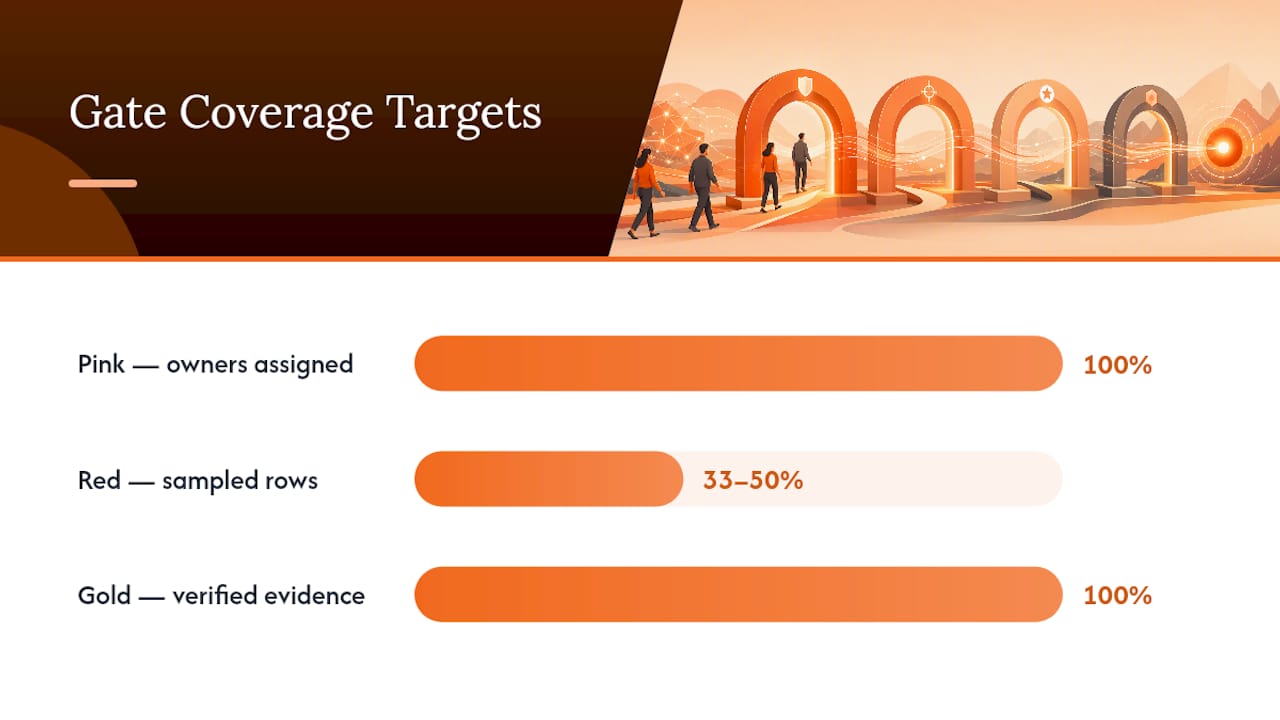
- Pink team checks structure, not prose quality. Every mandatory row needs an assigned owner and a target response location before this review happens. If a row shows no owner at pink, that’s the review’s first finding, not something to note and move past.
- Red team is where sampling matters more than exhaustiveness. Reviewers pick a representative sample of mandatory rows, follow the cited page number into the actual draft, and confirm the response genuinely answers the requirement rather than gesturing near it. A response that discusses the general topic without hitting the specific “shall” language is a deviation, and it gets logged and routed back to the owner.
- Gold team is the final gate. Every mandatory row must show a locked status and every evidence link, certifications, resumes, past-performance references, must be verified as attached and current, not just referenced.
A practical sampling rate for red team review on a mid-size RFP is somewhere between a third and half of all mandatory rows, weighted toward the highest-point-value evaluation criteria from Section M. Full-row sampling on every review gate isn’t realistic on tight timelines, but skipping sampling entirely on red team is how deviations survive to submission.
Orphaned rows, meaning requirements with no assigned owner or no response location by the time red team starts, need immediate escalation rather than a note to fix later. The proposal manager should treat an orphaned mandatory row at red team as a stop-the-line issue, because there usually isn’t time left after red team to draft a response from scratch and still get it reviewed properly.
The Mistakes That Actually Get Proposals Disqualified
Most disqualifications trace back to a small handful of repeatable errors, and industry guidance on compliance failures points to the same few patterns again and again across different procurement types.
- Skipping the SOW and Section H. Teams that build their matrix from Section L and M alone miss requirements buried in the Statement of Work or in Section H’s special contract clauses, wage determinations, insurance minimums, and security requirements often live there, not in the instructions section.
- Paraphrasing instead of copying verbatim. A summarized requirement drifts from what the solicitation actually asked, and reviewers checking against a paraphrase can miss that the real language required something more specific.
- Leaving rows without a single accountable owner. Shared ownership on a mandatory row means nobody treats it as theirs until it’s too late to fix.
- Conflating compliance status with drafting progress. Marking a row “complete” because a paragraph exists, without checking whether that paragraph actually satisfies the requirement, is how thin responses survive to submission.
The mitigations are the direct inverse of each failure list, and they cost almost nothing beyond process discipline: extract verbatim, assign one owner per row, keep status and progress in separate columns, and treat the matrix, not the draft document, as the authority everyone works from when there’s a discrepancy.
Operationally, decide early where the matrix lives (a shared spreadsheet with locked status-editing rights works fine for teams under ten contributors) and who has authority to change a compliance status. Page-number discipline deserves its own rule: never fill in page numbers until the document is in its final pagination pass, because renumbering after an early “final” draft is one of the most common ways a matrix and a submitted PDF drift out of sync.
A Compact Compliance Matrix Template You Can Copy Today
You don’t need proprietary software to start. A spreadsheet with the right columns, populated correctly, does the job for most mid-size bids. Here’s a compact version with sample rows showing how requirements from different solicitation sections map into a real proposal.
A published example built around a full NAVSEA-style solicitation, for reference, shows populated matrices running into the dozens or hundreds of rows once staffing plans, period-of-performance clauses, wage determinations, and every attachment get properly broken into atomic entries. That scale is normal for a complex federal procurement. Don’t be alarmed if your matrix for a large RFP tops 150 rows; a short commercial RFP might land closer to 30.
One decision point worth flagging early: check Section L before you decide whether to include a condensed version of your matrix as an appendix in the actual proposal submission. Some solicitations explicitly ask for a “compliance matrix” or “responsibility matrix” as a deliverable, in which case a cleaned-up, evaluator-facing version, stripped of internal notes and owner names, belongs in your final package. If Section L is silent, keep it internal.
When Should You Automate Your Compliance Matrix?
Automation earns its place once you’re running roughly four or more RFPs a month, handling solicitations that run past 100 pages, or coming off a recent disqualification that traces back to a missed clause. Below that volume, a disciplined manual process with a locked-status gatekeeper usually outperforms the setup cost of a new tool.
What automated extraction reliably catches: explicit modal language, every “shall,” “must,” and “will” clause, pulled out of a scanned or digital PDF far faster than a human doing a manual read-through. What it reliably misses or flags incorrectly: compound requirements bundled into one sentence, cross-references buried in an attachment that points back to a clause three sections earlier, and ambiguous language where intent matters more than the literal wording. Guidance on automated extraction tools is consistent on this point: automation reduces first-pass labor substantially, but it introduces false negatives on exactly the clauses that cause the most damage when missed.
That’s why teams adopting automation still need a dedicated steward, someone whose job includes reviewing every auto-extracted row for accuracy, resolving flagged ambiguities, and updating the matrix within a day of any amendment. Automation without a steward just moves the risk from “we missed a clause” to “the tool missed a clause and nobody checked.”
- Automation candidates: high RFP volume, long solicitations, teams with a history of missed-clause disqualification.
- Still requires human review: compound sentences, cross-referenced attachments, anything where the requirement’s intent isn’t stated in plain modal language.
- Operational change needed: a named steward, integration with existing tools rather than a parallel system, and a defined amendment-response process.
This is exactly where arosbid’s AI Tender Review fits into a construction bid team’s workflow. It flags clauses and conflicting specifications across a solicitation package automatically, but it’s built around the human-plus-technology model rather than a fully hands-off extraction. That distinction matters for construction bids specifically, where a missed wage determination or an overlooked bonding requirement causes real disqualification risk, not just a lower evaluation score.
Pro Tip: If you’re testing whether automation is worth adopting, run it in parallel with your manual process on one live bid before switching over. Compare the auto-extracted row count against your manual extraction, and treat any gap as a list of exactly what still needs human eyes.
What Construction Bid Teams Get Wrong About Compliance
Construction bidding has a compliance problem that federal contracting guides rarely address directly: the requirements aren’t just in Section L and M, they’re scattered across wage determinations, DD Form 254 security clauses on federal facility work, and incumbent transition provisions that get buried three pages into an attachment nobody re-reads after the first pass.
arosbid built its approach around exactly that gap. Missed clauses and conflicting specifications are the most common reason a technically strong construction bid gets disqualified before an evaluator ever scores the technical approach, and that’s precisely where a structured command center for tracking approvals, vendor quotes, and document compliance earns its place over a static spreadsheet that nobody updates past week two.
A few construction-specific items deserve their own line item in any matrix, not a footnote: Davis-Bacon or state prevailing-wage determinations, security clearance requirements tied to a DD Form 254 on government facility work, and incumbent transition clauses that specify staffing continuity or asset handoff timelines. Miss any of these and you’re not looking at a scoring deduction, you’re looking at a non-responsive bid.
The trades that feel this most acutely are the ones juggling vendor quotes and subcontractor bids alongside their own compliance obligations, structural steel and mechanical estimating teams in particular, where a single overlooked spec conflict between the SOW and an attachment can invalidate an otherwise winning number. A compliance matrix that only lives in one estimator’s head doesn’t survive that complexity.
— arosbid team
Automate Your Compliance Matrix Without Losing the Human Check
A spreadsheet gets you compliant. A command center gets you compliant faster, with fewer people re-checking each other’s work at midnight before a deadline. arosbid combines AI-driven document review with human oversight so your team catches missed clauses and conflicting specifications before they ever reach a reviewer, not after a red-team pass flags them too late to fix properly.
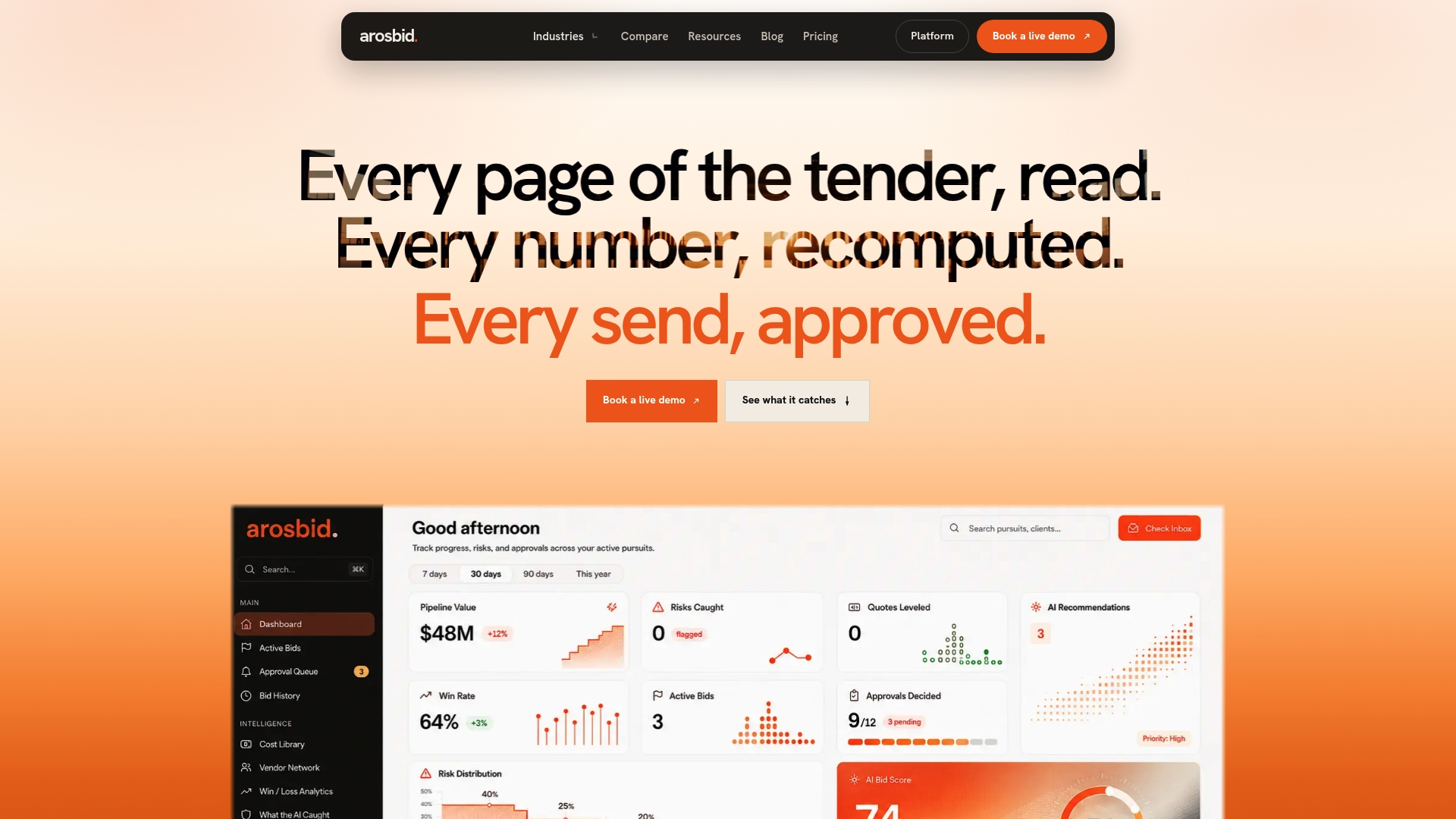
The platform’s AI Tender Review extracts requirements from Section L, M, the SOW, and attachments automatically, then routes them into a structured matrix your team can still edit, annotate, and lock the way you already do in Excel. AI Bid Leveling applies the same discipline to vendor quotes, so subcontractor compliance gets tracked with the same rigor as your own proposal responses. Everything syncs with the Excel and Outlook workflows your team already runs on, so adopting it doesn’t mean tearing out what works.
If you’re running four or more bids a month, or you’ve been burned by a missed clause before, book a live demo and see how the command center handles a real solicitation from your pipeline.
Where to Verify RFP Rules and Find Compliance Matrix Templates
Government procurement rules and matrix templates change by jurisdiction, so verify anything specific to your bid against a primary source rather than a secondhand summary.
- FAR 15.203 on acquisition.gov defines exactly what a federal RFP must include and how evaluation factors get structured, the baseline for any federal compliance matrix.
- State and institutional procurement guides, including Pennsylvania’s RFP process guidelines, publish sample responsiveness matrices and scoring rubrics specific to that jurisdiction’s evaluation committees.
- Free downloadable templates from RFP Snapshot and qlows give you a ready starting column structure if you’d rather adapt an existing sheet than build one from scratch.
- If your team needs help translating raw procurement language into concrete proposal deliverables before it ever hits the matrix, guidance on identifying business requirements walks through that translation step in more detail.
Sources
- Compliance Matrix Template for Government Proposals Free | RFP Snapshot
- How to create an RFP compliance matrix (with a template) — qlows
- Acquisition
- Rfp