Full Spec Test: When to Issue an RFQ or RFP for Construction
Full Spec Test: When to Issue an RFQ or RFP for Construction ! RFQ and RFP construction procurement title card Use an RFQ when your scope and specs are locked and price is the deciding factor; use an RFP when you need vendors to propose how they'd solve the problem.
Use an RFQ when your scope and specs are locked and price is the deciding factor; use an RFP when you need vendors to propose how they’d solve the problem. The GSA frames this as the core federal procurement distinction, and FAR Part 15 governs how proposals get evaluated on more than price. Run an RFI first if you’re not sure what’s even available. Pick the wrong document and you’ll either overpay for judgment you didn’t need or underpay for a scope nobody actually priced correctly.
TL;DR:
- Use an RFQ when scope and specifications are finalized, and the goal is to lock in a firm price based on detailed quantities.
- Conduct an RFI early in the process to explore available solutions before defining scope or requesting detailed proposals.
- Evaluate RFQ responses quickly within one to two weeks, while RFPs generally require three to six weeks due to their complexity and evaluation process.
- Avoid mixing judgment with firm pricing in a single request and always set evaluation criteria before bids arrive to prevent disqualification.
- Connecting bid workflows with automated tools reduces spec conflicts and ensures pricing remains aligned with scope changes, minimizing errors and disputes.
Table of Contents
- RFQ vs RFP vs RFI: What Sets Them Apart in Construction
- Can You Write a Full Spec Sheet? That’s the Real Test
- Scoring and Timelines: Price-Only vs Weighted Value
- What Goes Into a Solid RFQ or RFP Document
- Where Procurement Teams Get RFQ and RFP Wrong
- Why Connected Bid Workflows Cut RFx Errors
- What This Guide Boils Down To
- A Different Way to Handle RFx Risk: What arosbid Offers
- Sources
- FAQ
RFQ vs RFP vs RFI: What Sets Them Apart in Construction
Each document answers a different question. An RFQ asks “how much will this cost?” for work you’ve already fully specified. An RFP asks “how would you solve this?” when the approach itself matters. An RFI asks “what’s out there?” when you’re still mapping the market. The GSA’s own definition of RFQs centers on known requirements, which is the whole point: no known requirements, no RFQ.
The sequence in most construction procurement runs RFI, then RFP, then RFQ. You research the market, define the solution through a proposal process, then lock pricing once scope is final. Vendor output shifts accordingly, from general capability information, to a detailed technical and cost proposal, to a firm quote against fixed quantities.
Common construction applications:
- RFQ: rebar, concrete supply, prefabricated components, single-trade packages with a finished spec
- RFP: design-build contracts, complex mechanical/electrical/plumbing systems, general contractor selection
- RFI: new market entry, unfamiliar building systems, vetting subcontractor capacity before a bid package goes out
Can You Write a Full Spec Sheet? That’s the Real Test
Ask yourself one question before drafting anything: can you write a complete, itemized specification with quantities right now? If yes, issue an RFQ. If you’re missing pieces, if the “right” answer depends on how a contractor would approach it, issue an RFP instead. Business Amazon’s procurement guidance puts it almost identically: the clearest test is whether you can hand a vendor a detailed spec sheet or whether you need their judgment to fill in the gaps.
Here’s how that plays out on real jobs:
- Ordering structural steel to an approved shop drawing. Quantities, grades, and delivery dates are fixed. RFQ.
- Selecting a design-build partner for a hospital wing. The contractor’s approach to phasing, infection control, and MEP coordination changes the outcome. RFP.
- Choosing a curtain wall subcontractor for a repeat building type. If the spec is proven and you’re just chasing price, RFQ. If it’s a new facade system nobody on your team has installed, RFP.
- Sourcing an unfamiliar prefab modular vendor. You don’t know who’s even in that market yet. RFI first, then decide between RFQ and RFP once you understand the field.
The RFI matters most when you suspect your specification itself might be wrong. Skipping it on unfamiliar systems is how procurement teams end up writing an RFQ for a product nobody actually manufactures at the volume they need.
Scoring and Timelines: Price-Only vs Weighted Value
RFQ evaluation is mostly mechanical. Check compliance against the spec, confirm lead times and payment terms, then rank by price. Most teams close this out in one to two weeks because there’s little to interpret.
RFP evaluation takes longer and costs more to run. LegalClarity’s comparison of the two processes notes that RFP responses demand more time and resources to prepare and evaluate on both sides, and that expense only pays off when partner capability matters more than the lowest number on the page. Expect three to six weeks for a construction RFP, longer for design-build.
A typical weighted scoring split often balances cost, technical fit, proposed approach, and past performance across various ranges depending on the project.
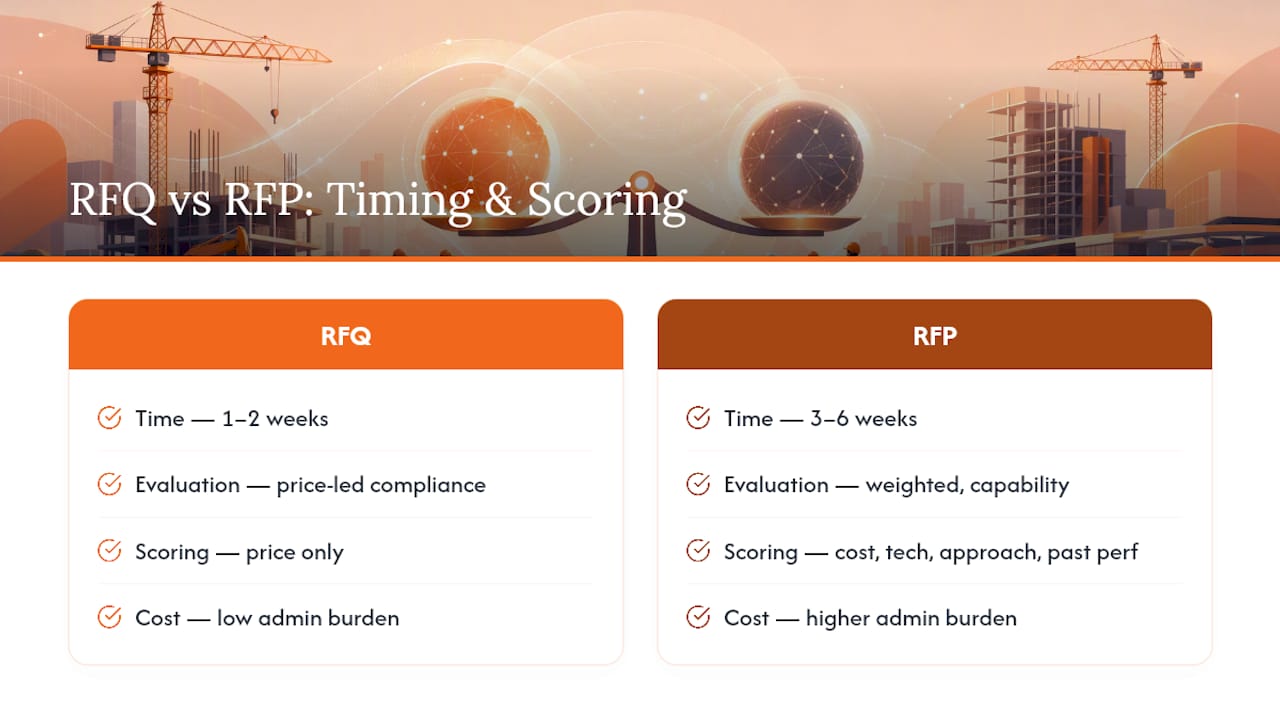
FAR Part 15 allows exactly this kind of tradeoff under “best value” contracting, where price and non-price factors are weighed together rather than price winning by default. Build a committee, publish your weights before bids arrive, log every question and answer, and record every addendum. That paper trail is what protects the decision later if a losing bidder challenges it.
What Goes Into a Solid RFQ or RFP Document
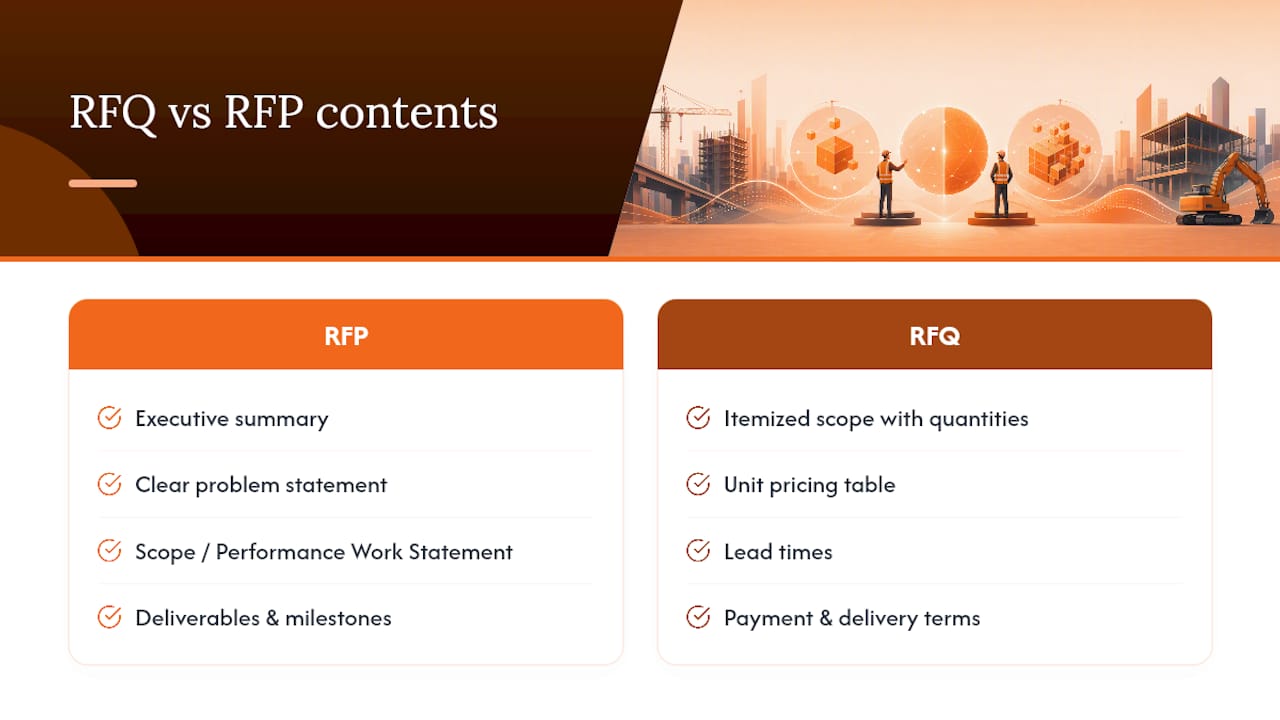
An RFP needs an executive summary, a clear problem statement, a scope of work or performance work statement, defined deliverables and milestones, acceptance criteria, published evaluation criteria and weights, submission instructions, mandatory qualification requirements, and guidance on contract type.
An RFQ needs less narrative and more precision: an itemized scope with exact quantities, a unit pricing table, lead times, payment and delivery terms, and warranty or acceptance language.
Both documents need a formal Q&A process. Set a firm window for questions, publish every answer to all bidders at once (never privately to one), issue addenda for anything that changes scope, and extend the deadline when addenda land late. Buildxact’s construction procurement guide recommends keeping RFQ line items tied directly to your live estimate, so pricing stays current even after the scope shifts mid-process.
Pro Tip: Build your RFQ pricing table directly from your estimate’s line items rather than retyping them. When scope changes, you update one source instead of chasing down which version of the quote request is now out of date.
Where Procurement Teams Get RFQ and RFP Wrong
Most RFx failures come down to five habits worth killing before your next bid package goes out.
- Mixing judgment and firm pricing in one request. If you’re asking vendors to propose an approach and give you a locked number in the same document, split it into a proposal stage followed by a quoting stage.
- Publishing criteria after bids come in. Evaluation weights need to be set and shared before anyone submits, not reverse engineered to justify a winner.
- Inviting too many or too few bidders. Three to five prequalified vendors is the common range for a meaningful comparison, per Business Amazon’s guidance, unless the market is thin and you genuinely need more coverage.
- Skipping the pre-issue checklist. Confirm scope is locked, pricing is linked to your live estimate, the scoring matrix is built, the Q&A window is scheduled, and contract type is specified, before anything goes out the door.
- Letting an RFP drift into an RFQ midstream. Once vendors have proposed a technical approach, don’t quietly ask for a “final number” without a formal pricing stage. That’s how disputes start.
Why Connected Bid Workflows Cut RFx Errors
Spec conflicts and missed clauses are the most common reason a bid gets thrown out before it’s even scored. Automated tender review catches contradictions between a drawing and a written spec before a vendor ever prices against the wrong version, and vendor quote leveling puts RFQ responses side by side so a buried unit price difference doesn’t slip through.
Tying RFQ pricing to live estimate line items, as Buildxact’s construction procurement research recommends, keeps a quote honest even after scope changes twice before award.
Teams using connected bid management platforms catch these mismatches earlier, which is exactly the problem AI tender review and bid leveling tools are built to solve.
What This Guide Boils Down To
The test hasn’t changed in years: if you can write a full spec, quote it. If you can’t, propose it first, then quote it. Run the sequence, RFI, RFP, RFQ, and document every criterion, every Q&A, every addendum, because that record is what protects your decision later. Adopt that discipline now, and half your disqualification headaches disappear before a bid ever lands.
— arosbid team
A Different Way to Handle RFx Risk: What arosbid Offers
arosbid is built for the moment a spec and a drawing disagree, which is where most bid disqualifications actually start. The platform runs automated document review across your entire bid package, tracks vendor quotes side by side so pricing comparisons stay honest, and connects to Excel and Outlook so your team isn’t abandoning tools it already trusts.
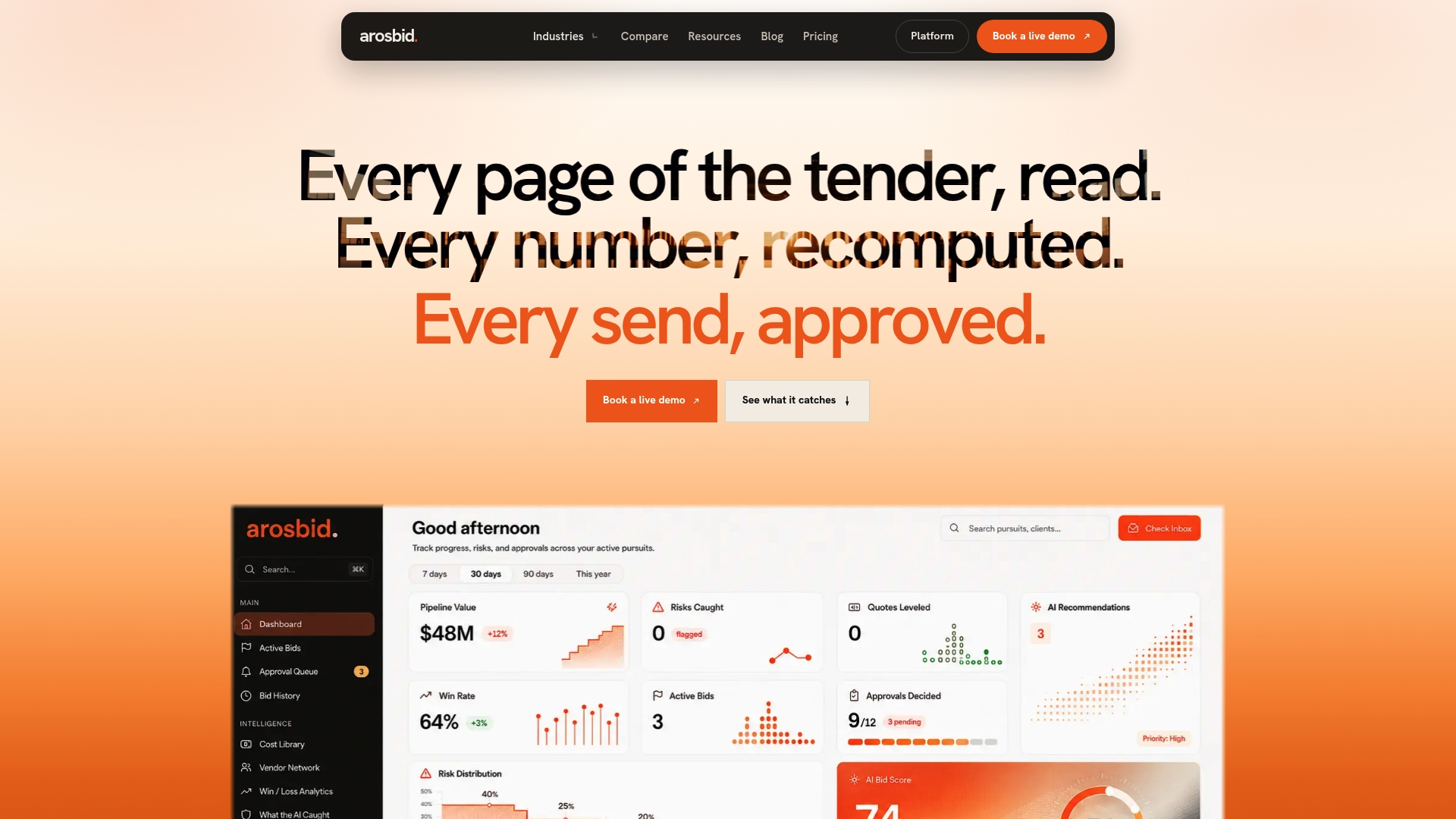
If your procurement team is still catching spec conflicts by hand after the RFQ or RFP has gone out, that’s the point a platform starts paying for itself faster than a process rewrite would. Trade contractors handling repeated RFQ cycles, and general contractors managing complex RFP evaluations, both benefit from a single command center tracking approvals, compliance, and vendor responses in one place. arosbid offers three plans, One Desk, The Department, and The Whole Year, with pricing available on the ArosBid pricing page. See it against your own bid package by booking a live demo.
Sources
- GSA — RFIs, RFQs, and RFPs
- Acquisition
- Request for Quote vs Request for Proposal — LegalClarity
- RFP vs RFQ Guide: When to Use Each | Buildxact US
FAQ
When Should You Use an RFQ Instead of an RFP?
Use an RFQ when your scope, quantities, and specifications are already finalized and price is your main decision factor. Use an RFP when you need vendors to propose their own technical approach, which the GSA’s procurement guidance treats as the core dividing line between the two.
What Comes First: RFI, RFP, or RFQ?
The RFI comes first when you’re still researching what’s available in the market. It’s followed by the RFP to evaluate vendor approaches, then the RFQ to lock in firm pricing against a finished scope.
What Are the Disadvantages of an RFP?
RFPs take longer to prepare, submit, and score than RFQs, often three to six weeks versus one to two. That extra time and cost, as LegalClarity notes, only makes sense when vendor approach genuinely affects the outcome, not for straightforward, well-defined purchases.
What Is the Difference Between RFP, RFQ, and RFT?
An RFP solicits a full proposed solution, an RFQ solicits a price against fixed specifications, and an RFT (request for tender) is largely the RFP’s equivalent term in construction and government procurement outside the United States. All three sit downstream of an RFI in a typical procurement sequence.
Does Software Like arosbid Replace the RFQ or RFP Process?
No. arosbid doesn’t replace either document; it reviews your bid package for spec conflicts, missing clauses, and pricing inconsistencies before submission, and keeps vendor quotes organized for comparison, regardless of whether you’re running an RFQ or an RFP.