Require Validity Dates for Supplier Quote Tracking in Construction
Require Validity Dates for Supplier Quote Tracking in Construction ! Decorative supplier quote tracking title card Supplier quote tracking means recording line-item price, quantity, validity date, lead time, and commercial terms for every vendor quote in one shared system instead of scattered emails and PDFs.

Supplier quote tracking means recording line-item price, quantity, validity date, lead time, and commercial terms for every vendor quote in one shared system instead of scattered emails and PDFs. The immediate next step: require a validity date on every incoming quote and map each vendor line to its matching bill-of-materials line in a shared tracker. Keep technical compliance review separate from financial scoring so every selection decision leaves a traceable record.
TL;DR:
- Mapping each vendor line to a bill of materials and capturing validity dates and lead times ensures accurate comparisons and reduces costly omissions.
- Separating technical compliance review from financial scoring preserves audit trail and prevents low prices from overshadowing scope gaps or non-conformance.
- Using AI-assisted data extraction and structured workflows speeds up bid leveling, minimizes manual retyping, and improves traceability of revisions.
- Requiring a quote validity date at intake and maintaining revision history helps defend decisions if prices change before the award.
- Evaluating quotes beyond price by considering lead time, exclusions, commercial terms, and past performance produces a more reliable vendor selection.
Table of Contents
- What supplier quote tracking is and why it matters for bids
- Core data fields and features to capture for every quote
- Workflows to solicit, collect, version, and approve quotes
- Traceability and SOPs: keeping quote data current
- How to evaluate quotes beyond lowest price
- ArosBid’s view: mapping these checks to a real workflow
- Immediate next steps and a short pilot checklist
- How ArosBid fits into this workflow
- FAQ
- Sources
What supplier quote tracking is and why it matters for bids
Supplier quote tracking covers every RFQ, e-quote, PDF attachment, and subcontractor bid that feeds an estimate. Those documents arrive in different formats from different vendors, often using their own part numbers and line descriptions, and they typically land in individual inboxes rather than a shared folder.
When quotes stay scattered, estimators lose line items between email threads, miss expiration dates on pricing, and rebuild comparisons from scratch when a vendor resubmits. Buyout teams then discover gaps after award, when fixing an omission costs far more than catching it during leveling.
Structured tracking closes that gap. Mapping every vendor line to a bill-of-materials line, timestamping submissions, and logging revisions turns a pile of quotes into a comparable, auditable record. Teams that do this consistently catch missing scope earlier, move through buyout faster, and can explain exactly why they picked one vendor over another, which matters as much to an internal audit as it does to an owner’s procurement review.
Core data fields and features to capture for every quote
A quote is only useful for comparison when it carries the same structured information every time, regardless of which vendor submitted it or what format they used. Build a tracker around these fields rather than accepting free-text pricing emails.
- Line-item ID, unit, quantity, unit price, total, and currency for every priced item, matched against the project bill of materials.
- Inclusions and exclusions stated explicitly, since silence on an exclusion often becomes a dispute later.
- Alternates or substitutions, flagged separately from the base bid so they never get averaged into a straight price comparison.
- Lead time and quote validity date, both required fields rather than optional notes.
- Delivery terms, warranty terms, and payment terms, since these shift the real cost of a quote beyond its face price.
- Contact metadata, so a question about a line item routes to the person who quoted it.
On the system side, look for searchable line mapping that lets you pull every vendor’s price for a specific BOM item at once, alias matching that recognizes when two vendors describe the same material differently, and OCR or e-quote import that pulls structured data out of PDFs instead of requiring manual retyping. Timestamps and revision history on every submission turn the tracker into a record you can defend, not just a spreadsheet you can edit.
Workflows to solicit, collect, version, and approve quotes
A reliable quote process runs on a few fixed steps with clear ownership at each one, rather than ad hoc follow-up emails.
- Standardize the RFQ directly from the takeoff or bill of materials and send it to prequalified vendors so every bidder prices the same scope.
- Ingest quotes through structured import or AI-assisted extraction from PDFs, then map every line to its BOM counterpart before anyone starts comparing numbers.
- Record timestamps on receipt, require a validity date on each submission, capture contact metadata, and preserve every revision rather than overwriting the prior version.
- Separate technical compliance review from financial scoring, and log who made each decision and why, which keeps the bid comparison matrix defensible instead of just documenting the lowest number.
- Convert the selected lines into a buyout or purchase order, and log any deviation that happens after award so the final record matches what was actually bought.
Pro Tip: Set the validity date as a required field at intake, not a note added later; a quote with no expiration is a quote you cannot defend if material prices move before award.
Skipping the versioning step is the most common failure. A vendor resubmits a lower number by email, someone updates the spreadsheet cell, and the original submission with its timestamp disappears, along with any trace of why the price changed.
Traceability and SOPs: keeping quote data current
Traceability depends on procedure as much as software. A 2025 study in Buildings outlines a standard operating procedure framework combining QR tags, mobile scanning, GPS or location data, and offline caching with synchronization once a connection is available, citing a 15-minute sync interval in its example architecture. Role-based access and timestamped edits prevent two people from working off diverging local copies of the same quote record.
The same study found that procurement and implementation phases account for the majority of tracking failures, and that standardized material cards paired with verification steps at receipt reduced mismatches between what was quoted and what was delivered. Automated discrepancy alerts, flagging a delivered quantity or spec that does not match the recorded quote, close that loop without requiring someone to catch it manually.
None of this is really about the technology itself. Scanning, timestamps, permissions, and exception alerts are a process design choice that makes a quote record accountable across a project team instead of living in one estimator’s inbox.

How to evaluate quotes beyond lowest price
The lowest number on a quote rarely tells the whole story once lead time, exclusions, and commercial terms are factored in. A defensible evaluation records the same fields for every vendor and shows the reasoning behind the final pick.
- Price by line, compared against the same BOM mapping used during intake.
- Inclusions and exclusions, so a cheaper quote missing a scope item does not look artificially competitive.
- Lead time and quote validity, which can outweigh a small price difference on schedule-critical trades.
- Commercial terms, including warranty length and payment schedule.
- Technical compliance and past performance, scored independently of price.
Procurement guidance from multilateral development banks recommends separating technical review from financial review entirely, with each scored by different reviewers before the two are combined. That guidance also calls for checking arithmetic corrections and flagging any abnormally low bid before it moves forward. Document every correction and every reason a higher-priced but fully conforming quote was chosen over a cheaper one. That written rationale, not the spreadsheet of numbers alone, is what holds up when someone asks why a particular vendor won months after award.
ArosBid’s view: mapping these checks to a real workflow
We built our bid process platform around exactly this sequence: an RFQ goes out from the takeoff, vendor submissions come back into a command center, AI-assisted leveling maps each line to the BOM, and an approval step converts selected lines into a buyout or purchase order with the full revision history attached. We kept the workflow inside Excel and Outlook rather than asking teams to abandon either one.
— arosbid team
Immediate next steps and a short pilot checklist
Start this bid cycle: require a validity date on every quote, standardize your RFQ template, map vendor lines to BOM line IDs, and timestamp every submission on receipt.

For a pilot, pick one trade and run a tracked workflow alongside your current manual process on a single job, then compare time-to-buyout and price variance between the two, using accurate roofing quotes from a reliable Toronto contractor as an example. Assign one owner for the tracker, set a minimal review gate separating technical and financial sign-off, and define success as fewer missed line items and a faster buyout, not just a lower headline price.
How ArosBid fits into this workflow
We built our platform to match the checklist above rather than add a separate system on top of it. Quote capture, AI-assisted bid leveling, approval gates, and buyout conversion all live in one record, and the Excel and Outlook integration means your estimators keep working in the tools they already use.
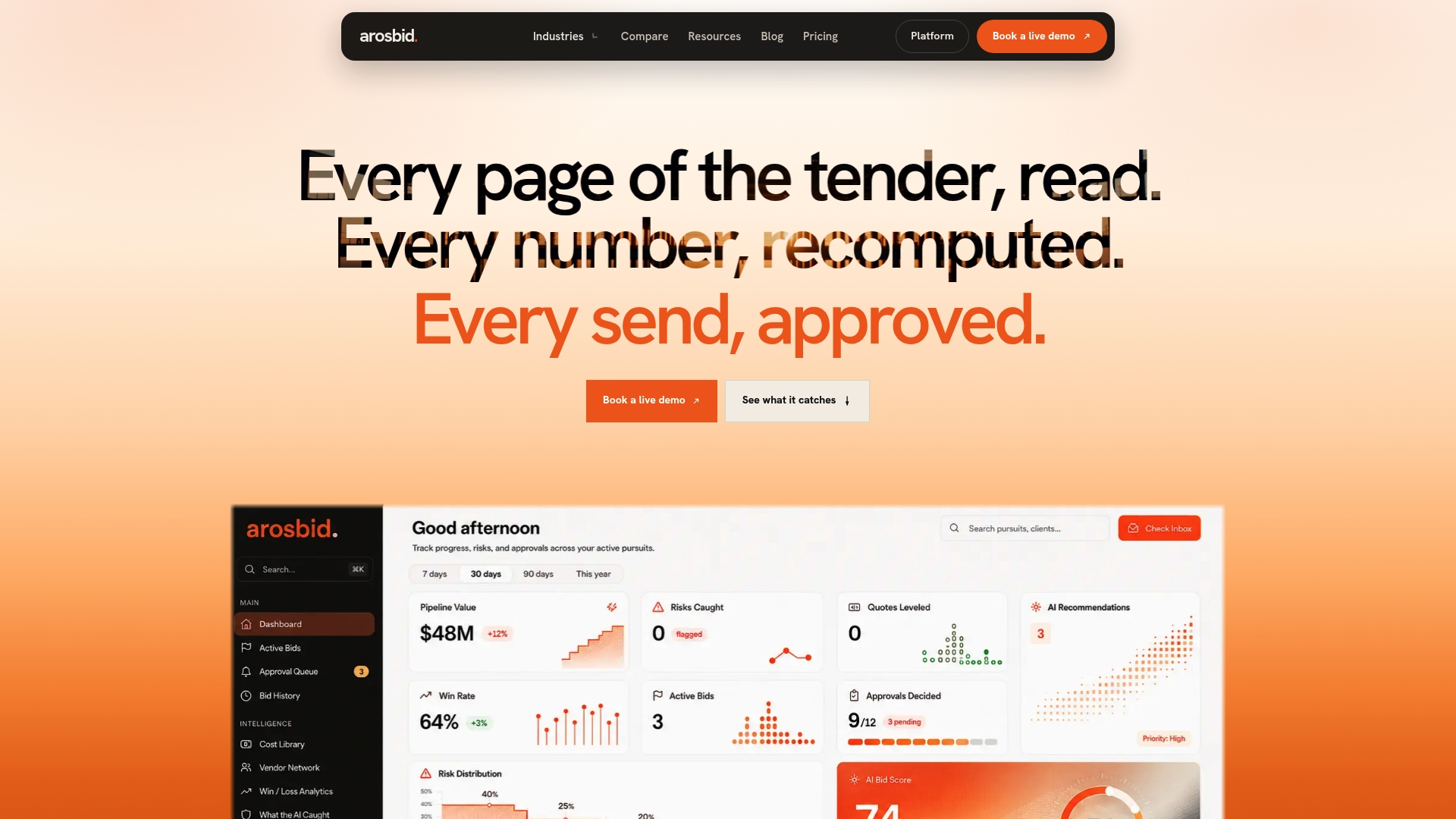
- Quote capture and BOM mapping, so vendor lines land against the right takeoff item automatically.
- AI-assisted leveling, which handles vendors who describe the same material with different names.
- Approval and buyout conversion, with the full revision history carried through to the purchase order.
If you want to see this running against your own vendor list, book a live demo or check plan details on our pricing page, where One Desk, The Department, and The Whole Year cover different team sizes.
FAQ
What is supplier quote tracking in construction?
Supplier quote tracking is the practice of recording every vendor quote’s line items, prices, lead times, and terms in one shared system instead of separate emails and PDFs. It gives estimators a single, comparable record for every bid and a traceable history for audits.
What fields should every tracked quote include?
At minimum, track line-item ID, unit, quantity, unit price, inclusions and exclusions, lead time, and a quote validity date. Commercial terms like warranty and payment schedule round out a record that can be defensibly compared against competing vendors.
Why separate technical review from financial scoring?
Separating the two prevents a low price from overshadowing a quote that fails to meet spec, and it mirrors the procurement evaluation guidance used on development bank projects. Each reviewer scores independently before the results are combined.
How does automation help compare multiple vendor quotes?
AI-assisted extraction reads line items out of vendor PDFs and matches differing nomenclature to a single bill-of-materials line, cutting the manual retyping that usually slows down leveling. Our AI bid leveling tool applies this approach directly to incoming trade RFQs.
How much does ArosBid cost?
Pricing details for the One Desk, The Department, and The Whole Year plans are available on our pricing page, where current plan options are listed directly.
Sources
- Bid evaluation: procurement guidance note
- Improving material tracking for sustainable construction: a SOP framework for resource efficiency
- Defensible bid comparison matrix (conference paper)